Death toll in Iran mounts as UK calls for Ayatollah’s regime to show restraint
The flagpole outside the Iranian embassy in London was toppled by a protester.
The death toll in Iran mounted as protests continued to be brutally suppressed while the UK Government called for the Tehran regime to show restraint.
Hundreds of people have been killed and thousands detained in the uprising against Supreme Leader Ayatollah Ali Khamenei’s rule.
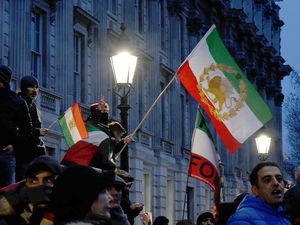
In London, protesters returned to Iran’s embassy, toppling the flagpole outside the building.
It is the second day running the Iranian flag has been targeted at the embassy – on Saturday a protester scaled the front of the building to replace the flag with the pre-Islamic revolution lion and sun standard.
The Foreign Office rejected reports from Iran that the UK’s ambassador in Tehran Hugo Shorter was summoned over the flag incident, with sources insisting he merely “had a meeting” at the Foreign Ministry.
US President Donald Trump said on Sunday night that “Iran wants to negotiate” after he threatened action following the crackdown, but did not rule out a response.
“I think they’re tired of being beat up by the United States,” he told reporters after saying Iran had proposed negotiations and his administration was in talks about a meeting.
Earlier, demonstrators gathered outside Downing Street to call for the Islamic Revolutionary Guard Corps (IRGC) to be banned as a terrorist organisation – a call which has support from senior figures in Parliament including Labour peer Lord Spellar and former Tory leader Sir Iain Duncan Smith.

Transport Secretary Heidi Alexander said there was a “very thorough process” that was necessary before decisions about proscription could be made by Home Secretary Shabana Mahmood.
She said: “As a government, we keep those decisions about the proscription of organisations under constant review and I have no doubt that Shabana Mahmood is doing that at the moment.”
Ms Alexander said the UK’s priority was to “stem the violence”.
She told Sky News’s Sunday Morning With Trevor Phillips: “The British Government has always viewed Iran as a hostile state.
“We know that they pose a security threat in the Middle East and beyond and we know that they have been a repressive regime in terms of their own population.
“And so I think the priority, as of today, is to try and stem the violence that is happening in Iran at the moment.”
Ms Alexander added: “It’s a concerning situation there and we would like to see anything that happens in future involving a peaceful transition where people can enjoy fundamental freedoms and we see proper democratic values back in the heart of Iran.”
Foreign Secretary Yvette Cooper praised the bravery of those taking to the streets in Iran.
She said: “It takes real courage to speak up in an authoritarian system, especially for young women, but it should not require courage just to make your voice heard.
“These are fundamental rights: free speech; peaceful assembly; and the exercise of those rights should never come with the threat of violence or reprisals.”
Iran has warned it will target US troops and Israel if President Donald Trump carries out his threat of military action against the Tehran regime.
Tory leader Kemi Badenoch said it would be right for the US to help oust the Islamic Republic’s leadership and indicated she would support RAF involvement if necessary.
She told BBC One’s Sunday With Laura Kuenssberg: “You’ve seen the recent RAF strikes, for instance, in Syria.

“Without over-speculating – we are talking about hypothetical situations – we have worked in alliance with other countries.
“I think this has to be something that we do with a broad coalition of countries.
“That is the right way to do it, and to make sure that we create a stable Iran.
“The worst possible thing would be for this to escalate to a point where the situation gets worse, not better.”
Protests in Iran began on December 28 over the ailing economy and have transformed into the most significant challenge to the regime for several years.
The internet and telephone lines have been cut off, but footage of events in Tehran and other cities has made it to social media.
The US-based Human Rights Activists News Agency said the number of confirmed fatalities had risen to at least 544 – 496 protesters and 48 members of security forces.
More than 10,000 people have been detained during the two weeks of protest.