Bill for peers to debate assisted dying could reach nearly £2m, analysis shows
Analysis of money claimed by peers for debating assisted dying in September shows that nearly £2m could be spent on allowances by May.
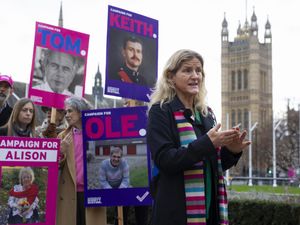
Taxpayers could fork out nearly £2 million for peers to debate the assisted dying Bill in Parliament, according to new analysis.
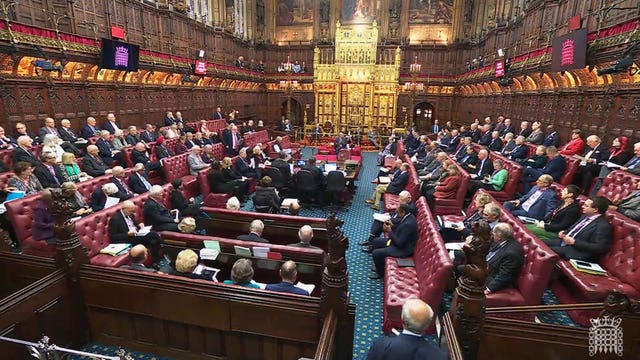
It comes as House of Lords members will meet again on Friday for the seventh day of debate on the draft law in the upper chamber.
Analysis from the Press Association shows that if average attendances remain the same, and the proportion of peers claim the maximum income tax-free allowance of £371 continues, then the overall bill for peers alone will be £1.95 million for the 16 days allocated so far to the consideration of the Bill.
This does not take into account other costs required for the House of Lords to sit, including security.
Figures published by the House of Lords confirmed £270,807 has already been paid out to peers for their attendance on two days in September for the second reading of the Bill.
Supporters of the Bill have accused some peers of time-wasting and attempts to talk it out – so it runs out of time and fails, while opponents have argued it must be closely scrutinised and made stronger through amendments.
Campaign group My Death, My Decision – which supports assisted dying – said terminally ill people would think the projected overall sum would be worth “every penny”.
However, it hit out at a “disproportionate” number of amendments, which stand at more than 1,000.
Not Dead Yet, a disability rights group opposed to the Bill, said the extra sittings were important to ensure proper scrutiny took place.
In December, the Terminally Ill Adults (End of Life) Bill was awarded an extra 10 days of committee stage amid concerns peers would not have time to discuss the more than 1,000 amendments proposed to the Bill.
There were claims from supporters of the Bill that those opposed to it were trying to slow its progress and block the legislation.
A source close to peers opposed to the Bill argued that it was in “such a poor state that it needs an extraordinary amount of time for the Lords to do their job of scrutinising these new laws properly”.
The Bill’s proposals would allow people with terminal illnesses in England and Wales who have less than six months to live to apply for an assisted death.
It would have to be approved by two doctors and a panel including a social worker, senior legal figure and a psychiatrist.
For the Bill to become law, further days in the Lords are expected to be allocated.
Data analysed by the Press Association for the six days peers have sat so far to debate the Bill, found around £733,967 could be claimed by members of the upper chamber, an average of £122,327 per sitting.
Peers can claim a daily rate of allowance of £371 for attending the House of Lords. They can opt to claim a reduced rate of £185. This is tax-free.
This presumes the same proportion of peers continue to claim the reduced rate. For the two second reading sittings in September, a maximum of 6.6% of peers claimed the lower rate.
According to attendance figures from the House of Lords, if this average is to be repeated across the next 10 days of committee stage it would mean an overall cost of £1,957,245.
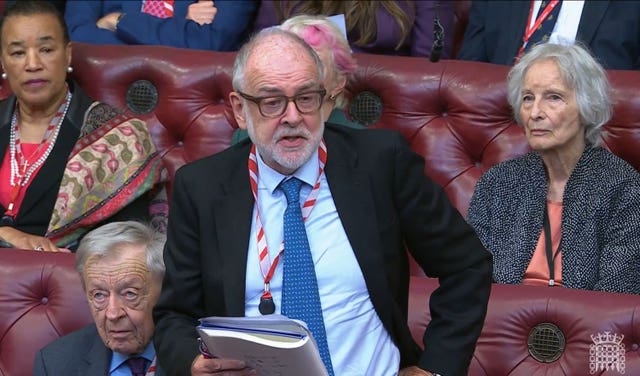
This led to the bill for peers on September 12 running to £141,709. A week later it was lower, due to fewer attending, at £129,098.
The figures came to light after a written question from Conservative peer Lord Farmer to the House of Lords senior deputy speaker.
A spokesman for Not Dead Yet UK said the amount showed the importance of proper scrutiny.
He said: “This Bill proposes one of the most profound changes to law, medicine and society in generations. It would permanently alter how the state responds to death, disability and vulnerability. Careful, line-by-line scrutiny is not an optional extra – it is Parliament doing its job.
“If the overall cost of lords’ scrutiny approaches £2m, that reflects the scale and seriousness of what is being proposed, not obstruction.”
Nathan Stilwell, campaign manager for My Death, My Decision, said: “For terminally ill people, if that cost results in a safe, compassionate choice at the end of life, many will say it’s worth every penny.
“However, we should be honest about what is driving up costs: a small number of peers have tabled a disproportionate volume of amendments, and debate has proceeded at a glacial pace.”
Darren Hughes, chief executive of the Electoral Reform Society, said it added to reasons for the House of Lords to be made into a “democratic chamber”.
Mr Hughes said: “The controversy over this and other recent bills has thrown a spotlight on the stark democratic deficit in the House of Lords.
“People will rightly be uncomfortable at the spectacle of completely unelected and unaccountable politicians making decisions that potentially impact every person in this country.
“Keir Starmer himself described the unelected lords as ‘indefensible’, and this episode further underscores the need for the Government to make good on its pledge to reform the upper house into a democratic chamber.”