Starmer: Decision to send troops to Ukraine to be voted on by MPs
British and French forces will help to train Ukrainian troops and protect stocks of weaponry, aimed at deterring future Russian aggression.
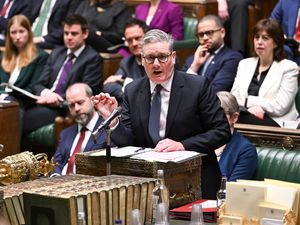
Sir Keir Starmer said MPs will have the opportunity to vote on whether troops will be deployed to Ukraine in the event of a peace deal.
Downing Street was however unable to say whether the Commons vote, which would take place before deployment, would tie the Government’s hands should MPs reject the prospect of British boots on the ground.
British and French forces will help to train Ukrainian troops and protect stocks of weaponry, aimed at deterring future Russian aggression, following a joint agreement signed in Paris.
The Prime Minister told the Commons the number of personnel placed in “military hubs” in Ukraine will be determined in accordance with the UK’s military plans.
The agreement was revealed following a meeting of the coalition of the willing on Tuesday.
The US has signalled it will provide a security guarantee to the European-led peacekeeping efforts, something which Donald Trump has previously appeared reluctant to do.
US special envoy Steve Witkoff said the president “strongly stands behind” a security guarantee, though details of how this would work were not revealed.
Sir Keir told the Commons on Wednesday there is no difference between the UK and US over security guarantees for Ukraine.
Conservative leader Kemi Badenoch criticised Sir Keir for not making a statement to Parliament on the agreement, claiming this showed a “fundamental lack of respect” for MPs.

Opening the first PMQs of the year, Sir Keir said: “Yesterday, I stood side by side with our European and American allies and President Zelensky at the coalition of the willing meeting in Paris.
“We made real progress on security guarantees, which are vital for securing a just and lasting peace.
“Along with President Macron and President Zelensky, we agreed a declaration of intent for the deployment of forces in the event of a peace deal. We will set out the details in a statement at the earliest opportunity.
“I will keep the House updated as the situation develops and, were troops to be deployed under the declaration signed, I would put that matter to the House for a vote.”
He added that a statement would be made to the House “at the earliest opportunity”.
Mrs Badenoch suggested Sir Keir wanted to dodge questions from MPs, adding: “Why is today not the earliest opportunity?”
She then pressed the Prime Minister to “confirm how many troops would be sent to Ukraine and whether they would be in a combat role”.
He replied: “I will be clear with the House that there would only be deployment after a ceasefire, it would be to support Ukraine’s capabilities, it would be to conduct a deterrence operations and to construct and protect military hubs.
“The number will be determined in accordance with our military plans, which we are drawing up and looking to other members to support. So the number I will put before the House before we were to deploy.”

He reiterated if there was a “legal instrument” required, he would have a debate and vote in the Commons.
The Prime Minister later added: “On the question of security guarantees, there is nothing between the UK and US and we’ve been constantly discussing this over many many weeks and months.”
Neither the Prime Minister’s press secretary nor the official spokesman could say whether a Commons vote rejecting British deployment in Ukraine would bind the Government, as it did when David Cameron lost a vote on military action in Syria in 2013.
The spokesman told reporters: “I think the point is, until we’ve secured the cessation of hostilities, our planning teams are focused on ensuring the coalition of the willing is able to flex to the requirements of any peace deal and ensure Ukraine’s armed forces are able to regenerate, to defend Ukraine, and support European security for generations to come.
“So it is a staged process.”
The spokesman would not say how many British troops would be deployed in Ukraine under the plans initially, nor whether there was a commitment by France and the UK to match each other’s military contribution.
Elsewhere, European leaders and the Trump administration remain at odds over the US president’s desire to take over Greenland, the vast Arctic island which is an autonomous territory of Nato ally Denmark.
Using the US military is “always an option” for the president, the White House said of the proposed annexation on Tuesday, after it revealed Mr Trump has been discussing a “range of options” to acquire Greenland.
In the Commons, Mrs Badenoch called for an urgent meeting of Nato leaders.
Sir Keir did not commit to this, but said: “Nato is the single most important and effective military alliance the world has ever seen.”
He had joined European leaders in rallying alongside Denmark earlier on Tuesday, insisting they will “not stop defending” Greenland’s territorial integrity.
Danish PM Mette Frederiksen warned America seizing her country’s territory could spell the end of Nato.
Deputy Prime Minister David Lammy will meanwhile continue discussions over Ukraine with US vice president JD Vance in Washington DC.
Mr Lammy is travelling to Washington to take part in celebrations to mark the 250th anniversary of the United States.
Elsewhere, Reform UK leader Nigel Farage said the UK is in “no position” to put boots on the ground in Ukraine if a peace deal is reached, as it would not be sustainable for the military.
He also suggested Reform would not support a long-term deployment by British forces in the eastern European country, but instead favours a time-limited commitment where UK troops rotate with others.
Mr Farage told a press conference in London on Wednesday morning: “Would I be prepared to be part of an international peacekeeping force? Yes, but our own engagement with it would be time-restricted and on rotation, and then you might think seriously about saying yes, but in these circumstances, no, I don’t believe this has been probably thought through.”
Commons Defence Committee chairman Tan Dhesi, a Labour MP, issued a similar warning as he called for “robust scrutiny” of the details of any deployment.
In a statement on behalf of the committee, Mr Dhesi said the announcement of a deployment was “welcome” but “intensifies the very real challenges our armed forces are already facing”.
He added: “It also runs the risk of overstretching our armed forces and so calls into question the UK’s ability to sustain pre-existing commitments to our allies.”