Ice warnings in place across UK before storm set to bring heavy snow
It comes amid an Arctic air mass which has brought wintry showers across the country.
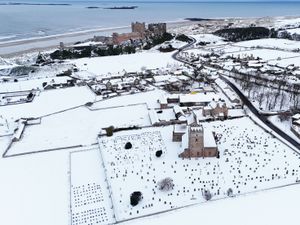
Ice warnings are in place across the UK ahead of a storm which is set to bring heavy snow later in the week.
The Met Office has issued yellow ice warnings for most of the UK, including Northern Ireland, for Wednesday morning amid an Arctic air mass which has brought wintry showers across the country.
A yellow warning for snow and ice is in place all day on Wednesday in northern Scotland, with residents there told to expect a further 5-10cm of snow.
Temperatures are expected to drop as low as minus 6C in parts of rural Scotland and just below freezing more widely overnight, the Met Office said.

On Tuesday, the temperature at Marham in Norfolk dropped to minus 12.5C, according to the Met Office.
Forecaster Marco Petagna said: “In the ice warnings, be careful of slippery surfaces and potential for injuries, so take care on footpaths.
“Icy patches could affect untreated roads, not all roads and pavements and cycle paths are treated so just be aware that away from major highways there could be icy and slippery conditions for a while tomorrow morning.”
The Met Office has advised those travelling on Wednesday morning to check road conditions, bus and train timetables and amend travel plans if necessary.
A yellow warning means some disruption is possible, such as travel delays, but many people can continue with their daily routine, according to the forecaster.
It comes before a yellow weather warning for snow, expected in a large part of England covering Sheffield, Peterborough, Bath and Worcester, and in much of Wales, will be in place from 6pm on Thursday until midday Friday.
The severe wintry weather will be brought by the strong winds over northern France, named Storm Goretti by the country’s forecaster, Meteo France.
Snow is likely to develop over higher ground in south Wales late on Thursday, before rain turns to snow more widely across England and Wales overnight, the Met Office said.
Some areas could see 5-10cm of snow settle, while others could see as much as 20cm.
Storm Goretti is also expected to bring disruption in south-west England, with a yellow warning for strong winds in place for Cornwall, Devon and the Isles of Scilly from 3pm on Thursday until just before midnight.
The recent drop in temperature has triggered cold weather payments for hundreds of thousands of households, designed to help elderly and vulnerable people with heating costs, the Government said.
Eligible households automatically receive £25 when temperatures are recorded or forecast to be zero degrees or below over seven consecutive days.
Payments will support households in 451 postcode areas in England, Wales and Northern Ireland, including Penrith in Cumbria, the Yorkshire Dales, Norwich in Norfolk, Milton Keynes in Buckinghamshire, and Crawley in West Sussex.
Cold weather payments have been triggered on five separate days, December 30, January 1, January 2, January 3 and January 6, and have been triggered twice for households in parts of Cumbria and Northumberland, which stand to receive a £50 payout.
Aberdeenshire Council has declared a major incident as the region deals with ongoing heavy snow.
The local authority says there is a “good chance” some rural communities will be cut off and there may be power cuts. Schools in the area will be also closed for a third day on Wednesday.
The UK Health Security Agency (UKHSA) has extended amber cold health alerts for England as an early warning that adverse temperatures are likely to affect health and wellbeing, running until Sunday.
The train operator LNER, which runs the east coast mainline, has extended its advice to passengers not to travel between Edinburgh and Aberdeen as they “cannot guarantee” trains will operate until this Friday at the earliest.
ScotRail said services between Inverness and Wick, Lairg and Ardgay were cancelled or disrupted on Wednesday with no trains between Inverness and Kyle of Lochalsh until at least 1.35pm.
RAC breakdown spokesperson Alice Simpson said: “In these conditions, the key is allowing more time at every stage of the journey, whether that’s clearing vehicles of snow and ice before setting off or reducing the speed at which you’re travelling.
“Never be tempted to use hot water to clear a frozen windscreen which, rather than being a hack could actually lead to an expensive crack.
“Instead, leave more time before setting off and carry a decent scraper and de-icer so you can clear the windscreen quickly.
“It’s important to have plenty of screen wash that protects down to at least minus 10 degrees, ensuring you always have a clear view due to all the dirt from gritted roads.”