Mushroom pellets use fungi ‘superpowers’ to restore forests around world
Rhizocore Technologies aims to curate Earth’s largest library of fungal specimens.
A Scottish company is helping to regrow forests with specially made mushroom pellets, using the “superpowers” of fungi.
Teams from Rhizocore Technologies are collecting samples of fungi from around the world, with the goal of curating Earth’s largest library of fungal specimens.
Their product, a small rectangular grey pellet, helps tree-planting projects succeed in ground which may lack the appropriate fungus in the soil – boosting chances of forests regrowing.
Scientists who created the company explain that trees need a system of mycorrhizal fungi around their roots in order to thrive, forming a symbiotic relationship.
Deforestation and human activity can lead to this vital fungi degrading in the soil.
The company’s “rhizopellets” are planted alongside saplings and enhance the roots of the tree as it grows.
Each pellet is impregnated with a specific type of fungal culture which will help the tree thrive in its location.

Rhizocore say these pellets can improve tree survival rates by up to half and a recent scheme involving Forestry and Land Scotland saw a relative improvement of 25%.
At their facilities near Edinburgh, thousands of pellets are being produced in a carefully controlled process which involves “brewing” specific fungi.
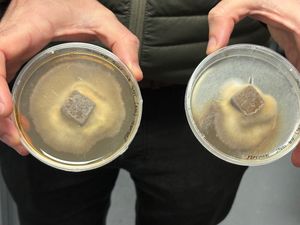
The team receives samples of mycorrhizal fungi which are collected and analysed in small dishes.

Some of these are stored in a cryogenic freezer where they are kept at minus 80C.
When the right fungal culture is identified, it is brewed into a liquid which is then applied to the pellets.
Rhizocore recently received a £4.5 million investment in order to expand its work into North America.
The company’s founder Dr Toby Parkes said: “Our results clearly show that planting success can be increased by tapping into the belowground fertilisation superpowers of fungi.”
He told Press Association the company aims to “protect, restore and harness the fungal kingdom of life for the betterment of nature and for people”.

There are up to three million species of fungi around the world, he said, with only around 10% of them catalogued.
Rhizocore’s pellets have been used in reforestation projects and commercial forestry in the UK and Europe, forming a “mutual, beneficial relationship with our trees”, he said.
Dr Parkes said: “Typically our clients are buying our fungi from us that we’re matching to their conditions, mainly because of economic reasons in improving the survival and growth rate of trees. ”
He said: “I sometimes scare my team, because I say we want to have the largest living repository on the planet – that would mean 60,000 samples.”
Dr Parkes added: “We want to be working globally and we want to be protecting as many fungal species as possible, biodiversity doesn’t care about borders.”

Rhizocore’s plant data scientist Dr Petra Guy said: “A lot of reforestation might take place in ex-agricultural soils, and the trees you’re planting might need the specific type of fungi which won’t occur there, because there have been no trees there for a long time.
“Or if you’re trying to reintroduce trees into upland moor sites, where there haven’t been trees for hundreds of years, these fungi can be non-existent.”
Her job involves finding the right kind of fungi for the right kind of tree – meaning she takes part in some “very enjoyable” foraging in the soil.