UK economic slowdown in third quarter confirmed – ONS
The ONS said growth slowed to 0.1% in the third quarter from a downwardly revised 0.2% in the three months to June.
The UK economy grew by an unrevised 0.1% between July and September while expansion was weaker than first thought in the second quarter, according to official figures.
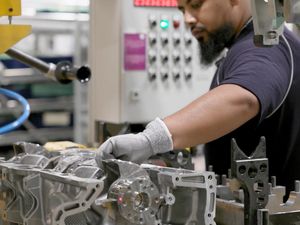
The Office for National Statistics (ONS) confirmed growth slowed in the third quarter after the cyber attack at Jaguar Land Rover knocked activity in the manufacturing sector.
But output was also worse than first thought in the previous three months, with gross domestic product (GDP) expanding by 0.2% in the three months to June, revised down from the previous estimate of 0.3% growth.
The ONS also revised up growth for the final quarter of last year, to 0.3% from 0.2% previously recorded, although the out-turn for 2024 as a whole was left unchanged at 1.1% growth.
Liz McKeown, ONS director of economic statistics, said: “Today’s updated figures paint the same picture as our initial estimate, with growth continuing to slow in the third quarter.
“Growth in services were partially offset by falls in production, with a marked drop in car manufacturing.”
Despite the second quarter revision, the UK economy remained the joint fastest growing economy in the G7 group of countries, alongside Japan, with growth of 0.9%, followed by the US.
The Bank of England said last week it expected growth to flatline in the final three months of 2025, as it cut interest rates from 4% to 3.75%.
Growth has now been on a downward path since the beginning of the year.

Figures from the ONS also showed that GDP per person in the UK showed no growth in the three months to September, ending six quarters of expansion in a row.
A more detailed breakdown of the economy in the latest data revealed that the household savings ratio fell to 9.5% – its lowest level since the second quarter of 2024.
This came as household income fell sharply by 0.8%, driven by a £6 billion increase in taxes, according to the ONS.
Matt Swannell, chief economic adviser to the EY Item Club, said: “The outlook for the private sector remains subdued.
“Real household income growth is now slowing sharply, and although the household saving ratio decreased in the third quarter, it remains high compared to historical standards.”
“Given that fiscal policy is tightening and the effects of borrowers refinancing cheap fixed-rate mortgages will more than offset cuts to bank rate, another year of sluggish growth for the UK economy is expected in 2026,” he added.