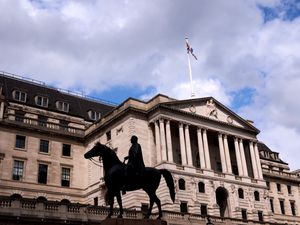
‘Early Christmas present’ for some homeowners as Bank of England cuts base rate
Property professionals are now expecting the new year to start with a ‘bang’ as mortgage lenders look to attract borrowers and home movers.

The Bank of England has delivered an early Christmas present to some homeowners, as the base rate was cut from 4% to 3.75% on Thursday.
The average homeowner on a tracker mortgage will see their monthly payments reduce by nearly £29 as a result of the Bank of England chopping a quarter point off the base rate, analysis has found.
UK Finance said that, based on outstanding balances, the average tracker borrower will see their monthly repayments reduce by £28.77.
The average homeowner on a standard variable rate (SVR) mortgage will see their monthly payments fall by £13.88, based on typical outstanding balances and assuming that the base rate cut is passed on in full.
Lenders set their own SVRs but in practice they often follow the movements of the Bank of England base rate.
Around 533,000 homeowner tracker mortgages were outstanding in June 2025, as were around 509,000 SVR deals, according to UK Finance.
While the cut will not immediately affect homeowners on fixed-rate mortgages, it could be good news for many of those whose deals are set to expire soon.
According to UK Finance’s figures, around 1.8 million fixed-rate deals are due to expire in 2026.
Property professionals are now expecting the new year to start with a “bang” as lenders look to attract borrowers and activity returns to the housing market post-Christmas.
David Hollingworth, associate director at mortgage broker L&C Mortgages, said: “Fixed rates have improved substantially and improved the choices for those still edging toward the end of an ultra low five-year fixed rate.
“Lenders are competing hard and there could be more scope for lenders to improve their rates in the new year when they will want to get off to a good start.
“Although rates are already pricing in further rate cuts next year, there’s still scope for market expectation to see rates drift down further.”
Iain McKenzie, chief executive of The Guild of Property Professionals, said: “For buyers and movers eyeing the new year, it feels like an early Christmas present.”
Andrew Montlake, chief executive of Coreco Mortgage Brokers, said: “Borrowers will be celebrating some early Christmas cheer.”
He added: “Today’s cut will have the knock-on effect that mortgage rates look certain to decrease slightly and kick off a mortgage melee in the new year.”
Nathan Emerson, chief executive of property professionals’ body Propertymark, said: “There is real potential for lenders to support first-time buyers with more focused products to help uplift the market over the coming weeks and months.”
Jason Tebb, president of OnTheMarket, said: “With the Budget now out of the way, the atmosphere of uncertainty has lifted and this rate cut delivers a real pre-Christmas boost for the housing market which bodes well for activity in the new year.”
Ed Monk, pensions and investment specialist at Fidelity International, said: “A rate cut to end the year is an early holiday gift for borrowers – and there’s reason to hope that more cuts will arrive in 2026.”
He added: “Markets are pricing in one further quarter-point cut in the first half of 2026 but the picture beyond that is less certain.
“However, the chances of a second cut next year are increasing.”
Matt Smith, a mortgage expert at Rightmove, said: “The financial markets and mortgage lenders have been expecting today’s (Bank of England base rate) cut for a while, and therefore responded early with mortgage rate cuts in December to round off the year.”
He added: “It does mean we could now see a fresh round of rate cuts in the new year as lenders look to start the new year with a bang.
“Home movers are likely to see the most notable rate drops for two-year fixed products rather than five, and next year we expect the gap between two-year and five-year deals to grow.”
Nicky Stevenson, managing director of Fine & Country, said: “Lower rates, combined with a more benign Budget backdrop, are likely to translate into stronger inquiries and transactions in the new year.”
Mark Manning, managing director of Northern Estate Agencies Group, said: “I expect 2026 to start with a flurry of activity as mortgage rates become even more competitive and people use the festive period to start planning their next move.”
The fall in the base rate could also spell more meagre returns for some savers, who also need to bear in mind the eroding impact of inflation on their cash.
Office for National Statistics (ONS) figures released earlier this week showed Consumer Prices Index (CPI) inflation was at 3.2% in November, slowing from 3.6% in October.
Paul Broadhead, head of mortgage and housing policy at the Building Societies Association, said: “Falling rates, combined with the pending changes to savings taxation, will be felt by those working hard to build financial resilience and save for their future, including those saving for a first-home deposit.”
According to Moneyfactscompare.co.uk, the average easy access savings rate on the market has fallen from 2.96% in December 2024 to 2.54% in December 2025, while the average easy access Isa rate on the market has decreased from 3.16% to 2.73% over the past year.
Over the same period, the average notice account rate on the market has fallen from 4.10% to 3.50% and the average notice Isa rate has decreased from 3.97% to 3.40%.
Rachel Springall, a finance expert at Moneyfactscompare.co.uk, said: “Savers with the most flexible pots are hit the hardest by cuts to the Bank of England base rate as providers use this as a signal to reduce variable rates.”
She added: “It can take a couple of months for the savings market to catch up to rate cuts, so it’s vital savers check the latest rates and switch if they are now getting a paltry rate.”
Mike Ambery, retirement savings director at Standard Life, part of Phoenix Group, said: “It’s sensible to keep some easy-access cash for everyday needs and emergencies, but once that’s covered, relying on cash alone might not be enough.
“Looking at longer-term options – such as pensions, which remain one of the most tax-efficient ways to save, or other investments – can help your money work harder, protect its value, and support your financial security as the interest rate landscape shifts.”
The value of investments can go down as well as up but investments can sometimes outperform cash savings over the longer term.