Streeting apologises to patients as doctors begin five-day walkout
Officials have said the strike come at the ‘worst time’ for the NHS amid rising flu cases and other winter illnesses.
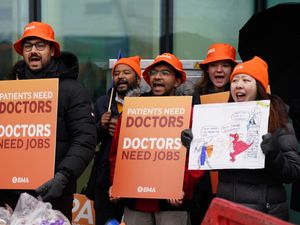
The Health Secretary has apologised to patients as doctors began a five-day walkout in England in an ongoing row over jobs and pay.
It comes as healthcare leaders warned the impact of the strike will be “felt all the way into January and beyond”.
Wes Streeting said the Government did “everything we could” to avoid the strike, including holding 11th-hour talks with British Medical Association (BMA) officials on Tuesday.
He said health officials are doing “everything we can” to minimise the impact of the strike, but warned patients will face disruption as the walkout comes at the “worst time” for the NHS.
Hospitals are dealing with rising flu cases and other winter illnesses.
Dr Layla McCay, from the NHS Confederation, told Sky News: “What healthcare leaders are telling us is that the impact we will see from these particular strikes will affect particularly things like the waiting lists, and the disruption that is being caused this week will be felt all the way into January and beyond.”
Mr Streeting told the Health and Social Care Committee he is “just as, if not more, worried” about the weeks that follow the strike.
He added: “It is dicey. I was at the operational centre this morning… I think we’re off to a decent start, but this is going to be a challenging five days and a really challenging few weeks, and we’re doing everything we can to keep the show on the road.”
He told MPs the current strike will cost around a quarter-of-a-billion pounds and the health service has “managed to absorb” the financial pressures of strikes so far.
Earlier on Wednesday, Mr Streeting told broadcasters: “We did everything we could to avert these strikes and to stop strike action from taking place.
“I think people can see that I’ve tried my absolute best to avoid these strikes on what is the worst time for the NHS.
“I’m really sorry to patients for the disruption that is happening as a result.”

He said the Government met with BMA representatives on Tuesday to see if “even at the 11th hour, we could avert the strikes”, but added: “After constructive discussions, we still weren’t able to persuade the BMA either to come into negotiations or indeed to delay strikes to January.”
After meeting with health leaders on Wednesday morning, Mr Streeting added: “Our entire focus now is on keeping patients safe, particularly over the next five days of strike action, but also through what is the peak period for the NHS.
“We are doing everything we can to minimise the disruption. There is going to be disruption.”
He said patients in need of healthcare should come forward as usual.
Elsewhere hospital leaders have called for resident doctors and the Government to start talks with external mediators, saying the dispute has reached an “impasse”.
Daniel Elkeles, chief executive of NHS Providers, told Times Radio: “What’s so frustrating is that this strike feels no closer to being resolved than it ever has been, and it’s getting more and more acrimonious as well.
“We seem to have reached an impasse – it seems quite incredulous to us that the Government who put such a good offer on the table last week could have been met with such a resounding ballot from the doctors saying ‘we don’t agree’.
“It feels like we need to do something to unlock this, and if external mediation is the thing that will unlock it, then please, can we get on and do it?
“Because there is a small window after this strike where before the residents reballot, and where you could say you don’t need to reballot because we’ve actually managed to reach an agreement, and we need to get to that point.”
Conciliation service Acas said it is “well prepared and ready to help with the dispute”.
The BMA has already granted some medics permission to leave the picket line and return to work in the maternity unit at Nottingham University Hospitals NHS Foundation Trust due to “unique and difficult circumstances”.
Hospitals have been told to aim to deliver 95% of usual activity during the strike, though health leaders have conceded this could be “more challenging due to the onset of winter pressures and rising flu”.

Dr Jack Fletcher, chairman of the resident doctors committee at the BMA, said: “It is well past the time for ministers to come up with a genuinely long-term plan. If they can simply provide a clear route to responsibly raise pay over a number of years, and enough genuinely new jobs instead of recycled ones, then there need not be any more strikes for the remainder of this Government.”
Shadow health secretary Stuart Andrew said he has heard from a patient who is “worried for her life” because of the walkout.
He added: “We’re likely to see about 9,000 appointments a day being cancelled, and that has real-life consequences.
“These are real people who are expecting to have treatment that they’ve been preparing for for some time. We’ve been getting messages from all over the country.
“A woman contacted to say her cancer treatment is not going to happen over these next five days, and in her own words, she says, ‘I’m worried for my life’.
“That’s the thing that really worries me.”