
Big interview with Ben Garner - West Brom's ambitious assistant reaping rewards of years of graft
Ben Garner has come a long way since he started teaching PE at school, but after years of hard work the 36-year-old is now an assistant head coach of a Premier League club.
It's not been a straightforward journey for the Albion man, who was promoted to his new role from first team coach this week.
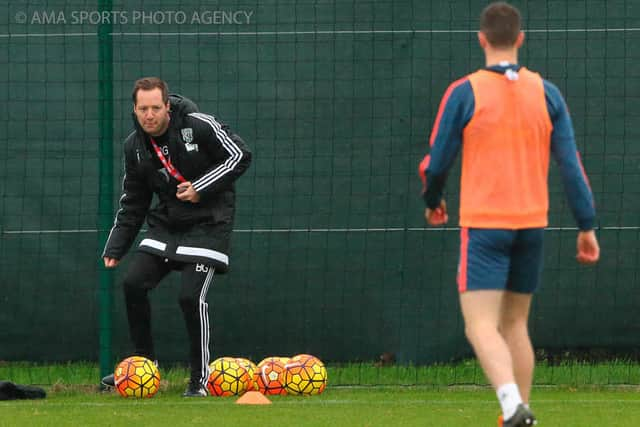

Hours and hours on the training ground in his 20s are now paying off, but even though he's now got a two-year-old daughter to keep him busy, there's still a fierce ambition driving him on and a firm desire that one day, he'll be a manager in his own right.
Don't let his age fool you into thinking he's inexperienced. He's spent the last 12 years in professional academies and first-team football.
Garner suffered a nasty ankle injury at the age of 19 that cut short a promising playing career when he was in the Crystal Palace youth team.
He then completed a sports science degree before spending six months running a soccer school in Chicago.
On his return to England, he got a job as head of boys' PE at St David's College in South London.
When he was 24 he was picked up by his old club and became Palace under-11s coach, a part-time role he combined with his job at St David's. And he immediately got the bug.
"Once I started coaching, I never missed playing," he said. "As soon as I started coaching I felt very comfortable doing it.
"You need to get experience, you need to learn, come up with sessions, get used to dealing with players, but I always found it quite natural and comfortable.
"Don't get me wrong, there are things I'm absolutely hopeless at, but it felt right for me from day one to be honest."
His desire to learn and his willingness to take on more and more teams meant that the majority of his 20s was spent coaching in South London.
"The thing that was great with Palace is there wasn't really the structure there is now with academies," he said. "I could do what I wanted with the team. It was my ideas.
"I started with the u11s, moved on to the u13s and u16s. Then I had two or three really good seasons when I was working with u15s and u18s.
"For two years there I was coaching a ridiculous amount of hours a week because I was taking two or three teams. That was great, because it was getting three years of experience in one.
"That really helped me in terms of what ideas I liked, what ideas I didn't like. Those early years I was learning from my own experiences."
Garner was still playing football for Sutton United until the age of 25, when he officially retired after doctors warned him that arthritis would set in on his right ankle if he kept it up. But he picked up some useful titbits from his short-lived non-league career.
"There was a manager there called Phil Dunn, he was very astute. I was working in academy football, which was heavily possession based. But he was very clever with things.
"One example, he'd always tell the centre-forward to flick the ball straight on so we know where it's going and the players can make runs off that. Don't flick right or flick left, every time it comes up you flick straight so we know where it's going if we've got a midfield player running.
"Simple bits of information like that coming from a completely different angle was good for me at the time."
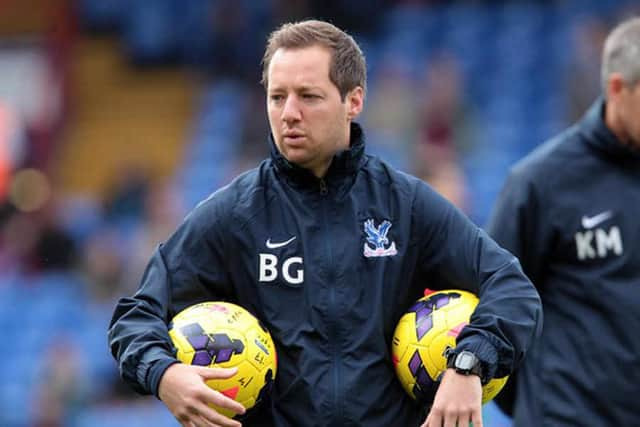
Pulis has now got three assistants as Garner joins Dave Kemp and Mark O'Connor in the role, and he can also count Gerry Francis as first team coach.
So what are the dynamics on the training field and in the dressing room?
"Generally myself and Mark O'Connor will take the first part of training in terms of technical work, passing and some possession," explained Garner. "Any defensive or set piece work, Tony will be hands-on with that.
"If he wants anything done in terms of attacking shape and some patterns then he'll delegate that to me or one of the others.
"At the meetings, I work closely with the two analysts, James (Ryder) and Carl (Blakemore), who are very good.
"We look at the strengths and weaknesses before we play each team and I'll present to the players about the opposition and what we're going to do tactically."
Garner has his own ideas, his own philosophies on the game, so what happens when he disagrees with Pulis?
"I'll put my view across and sometimes it might be different, but once he's made his decision on whatever way we're going to go you've got to go down that line and back him 100 per cent," he said.
"I don't think it's good to be a yes man and just agree with everything. If I've seen something different I think it's right that I raise that and put it across.
"Sometimes Tony will say 'I see that, great,' sometimes he'll say 'no, we're going to do it this way', and that's the sign of a good manager.
When he became coach of Palace's under-18s, Garner turned full-time, thanks to Eagles assistant manager Lennie Lawrence championing him at the time.
He worked with Ian Holloway, Neil Warnock and Alan Pardew but it was Tony Pulis who had the biggest impact on him.
"I've been really fortunate to work with some experienced managers," he said. "Ian Holloway was the first to step me up to the first team which I'm grateful for. He's a great guy, a heart of gold, there's not many managers who would give someone that opportunity at such a young age.
"But Tony was great because when he came in we were a club that didn't have any Premier League experience, either from a playing point of a view or on the coaching staff.
"Tony came in, knew exactly what he wanted to do. I'm not sure the club would have stayed in the league that season without his know-how. That was a fantastic learning curve for me."
When Pulis left Palace in the summer of 2014, Garner stayed at the club that had treated him so well. But a year later he was persuaded to join back up with the Welshman because of the chance to work with the Albion first team.
"When the opportunity came to come here and work with Tony again, I jumped at it," he said. "He's very experienced, he's worked through the leagues.
"He probably doesn't get the recognition he deserves for his man management, his coaching and his defensive organisation, which is as good as anyone.
"He gives me a lot of responsibility as well. And that's great because I want to be active, I want to learn and I want to improve."
Garner is trying to learn as much as he can from Pulis, because his promotion to assistant head coach is just the latest step on the road to his ultimate goal, managing a team himself.
He took charge of the Baggies for the recent international friendly with Delhi Dynamos, and there's no doubt he's eyeing up a future in the hot seat.
"I'd love to have the opportunity down the line to be a number one in my own right," he said.
"That's been my ambition since I started coaching, but it's whether that opportunity presents itself with the right club at the right time.
"It's not easy in this country to get those opportunities, especially with me not having a playing career."
However, some of the best managers in the game had undistinguished playing careers.
"Arrigo Sacchi never had a playing career and he changed the way people played the game, he was a pioneer, " said Garner.
"Mourinho, Wenger, not distinguished playing careers. On the other hand Guardiola had a great playing career, it depends on the individual.
"I've got confidence in myself that given the right opportunity I would do well, but it's almost convincing someone to give you that opportunity at the right club, at the right time, and be able to manage the way you want to manage as well."
More and more, Garner is finding himself focusing on management rather than coaching.
"I read a lot, and I study a lot," he said. "I used to read a lot of coaching books but I've moved away from that now.
"You get to a certain point in your coaching – even though people say I'm quite young – I've been coaching for 14 years now. In terms of sessions I've got a lot of experience.
"Now I try to read and learn about the management and that side of things.
"I've just read Carlo Ancelotti's book. In this country we've been used to having a manager – and a head coach is a strange phenomenon.
"In his book it's the other way around, he can't understand how people try and deal with everything.
"But if you've got someone who's good on the football side but can't deal with people, they won't succeed.
"It's a human science before it's a sport science, you've got to understand how people work, keep them happy, keep them motivated. Then add that football side on top to be successful.
"It's an old saying, but if you lose the dressing room, they can be absolutely fantastic, but if they don't enjoy being at the club it becomes very difficult.
"Understanding players, what they want, how they want to train, what information and feedback they crave, all that is vital if you're going to be successful."
It's obvious Garner is giving himself the best chance of being exactly that.