
Matt Maher: Unai Emery's power remains despite Aston Villa's shock off-field change
The most important takeaway after 48 frenzied hours at Villa is Unai Emery’s power base appears undiminished.
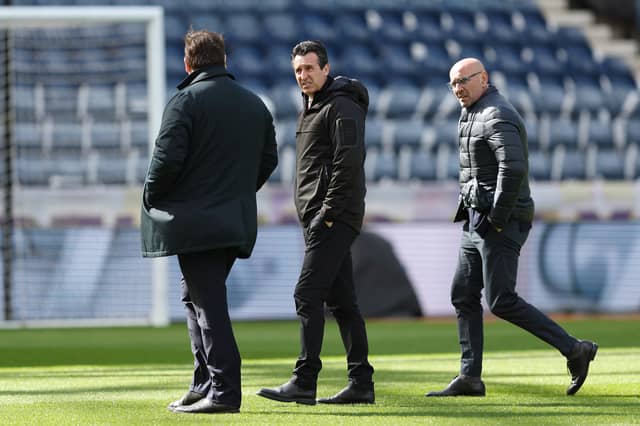


For a little while, at least to the untrained observer, it may have appeared to be eroding.
From Sunday’s impetuous early stomp down the tunnel at the Stadium of Light, through the extraordinary post-match press conference in which he branded his players “lazy”, to the moment it emerged Monchi would be leaving the club, you wondered whether the foundations of the Kingdom of Unai were beginning to wobble.
Instead, with the dust settling and vision once again clear, you suspect they are strong as ever. One close ally might have departed, yet another is arriving in the shape of Roberto Olabe, ready to fit right into a structure in which Emery remains the authority.
That’s not to say Monchi’s exit, after little more than two years as president of football operations, isn’t big news.
It would feel markedly more significant, however, if his replacement had been someone with no previous connections to Emery, an appointment driven by club ownership to try and claim back some of the control ceded to the manager since his arrival in November 2022.
Olabe, on the contrary, has known Emery since they were team-mates at Real Sociedad 30 years ago. Just over a decade later, he was responsible for giving his fellow Basque one of his first jobs in management at Almeria.
He was also on Villa’s original shortlist to become president of football operations before Monchi was appointed in June, 2023.
That particular list was drawn up by Emery and Villa’s then chief of staff, Damian Vidagany, with some input from co-owner, Nassef Sawiris.
Their top-choice at the time, Barcelona sporting director Mateu Alemany, had previously worked with Vidagany at Valencia but having initially indicated he would accept Villa’s offer, he changed his mind, prompting the switch to Monchi.
The latter, who worked alongside Emery at Sevilla when the Spanish club won three Europa League titles, became part of Villa’s new triangle of power which also included Vidagany, who was promoted to director of football operations as part of the restructure.
Crucially, however, it was and is Emery who has final say on all major decisions, something which must be taken into account in any assessment of Monchi’s performance.
No-one could say he had it particularly easy.
The ambition of Villa’s owners and their manager put the emphasis on buying players for the here and now, with the rising wage bill creating issues for a club which has long been prepared to push the boundaries of financial fair play.
Monchi and Vidagany spent June last year urgently trying to offload players to avoid breaching the Premier League’s profit and sustainability rules, the sale of Douglas Luiz to Juventus bringing the numbers under the limit. Throughout, it has been a juggling act, one which in the early days at least, Monchi appeared to accept.
“The most important thing is not selling players,” he told a group of journalists a year ago. “The most important thing is to buy good players.”
The second sentence, critics would argue, hits on the crux of the problem. Tight financial margins conversely means there can be little room for error in the market and too many of Villa's big money buys have failed to fully deliver.
Amadou Onana and Ian Maatsen, to give just two examples, have combined for just 33 Premier League starts after being signed for combined fees of nearly £90m. The decision to spend more than £20m last January on Donyell Malen, meanwhile, looks more questionable with every passing, unmemorable substitute cameo.
Morgan Rogers, clearly, has been a huge success but the only “hidden gem” uncovered during Monchi’s tenure.
Villa’s inability to offload some of their biggest names this summer, most notably Emi Martinez, made the most recent market a painful experience for all.
There’s no huge fun in being a sporting director when you don’t have any money to spend. A charismatic man of genial nature, Monchi had more recently appeared a subdued figure.
Though the tendency is always to search for the bust-up, the trigger point at which an exit becomes inevitable, the truth about his exit is rather less dramatic, with a gradual breakdown in relations leading to an acceptance, from all parties, things weren’t quite working out the way they wanted.
Throw in the all-too-often forgotten human element, notably the fact Monchi’s family remain based in Spain, and the decision becomes even more understandable. Surprised but not shocked was the general sentiment around Bodymoor Heath when he said his goodbyes on Monday.
Olabe will soon replace him in the triangle of power. Just like Monchi, he arrives with the reputation of being one of the best talent-spotters in Europe having presided over an era of huge success at Real Sociedad, where Alexander Isak, Mikel Merino, Martin Odegaard, Martin Zubimendi were among those recruited and sold at considerable profit.
Villa will hope he can deliver similar magic and provide a fresh voice amid an environment which, owing to this summer’s stasis in the transfer market, was at risk of going stale.
There is, of course, nothing Olabe can do immediately about the most pressing issue of getting results on the pitch.
This remains a difficult moment for the Spaniard, with Villa at their lowest ebb since he first walked through the door nearly three years ago.
Internal pressure might be at a minimum but external noise - not least in the stands - will only grow the longer his team’s poor form continues.
Yet any notion the club’s ownership might be losing faith, or putting the first steps in place for a possible post-Emery era, can be forgotten for now.
Comment Guidelines
Iconic Media encourages reader discussion on our stories. User feedback, insights and back-and-forth exchanges add a rich layer of context to reporting. Please review our Community Guidelines before commenting.