Human tragedy on inhumane scale
Journalists are taught not to become emotionally involved with the tide of human events, no matter how tragic, writes Martin Swain.
Our job is to tell the story first and save the tears of sympathy for later. In which case, I must confess, that on this day 20 years ago, I failed lamentably to fulfil the demands of my profession.
On this day 20 years ago, an afternoon lit up by beautiful Spring sunshine, I was dispatched to Hillsborough to cover the FA Cup semi-final between a Liverpool team in its final throes of greatness and a Nottingham Forest side managed by Brian Clough, a legend desperate to win the one trophy which had eluded him.
I was late. Held up by traffic congestion, the crawl to Sheffield Wednesday's stadium was fretful.
The match was to be beamed live on TV – a rare occurrence in those days – but that only raised the importance of ensuring I was at the ground in good time to ring the Express & Star sportsdesk and dictate the two teams before beginning a running report of the match.
Steady down, I told myself. Each pub I passed was overflowing with red-shirted Liverpool supporters enjoying a pint under the warming sun little knowing, like me, the role they would play in the events to follow. Half an hour to kick off. If they weren't worried, why should I be?
If I'm honest, the next thing I recall is the game starting. Just like any other game. Sure I was aware that, to our left, where the Liverpool fans were supposed to have gathered, there were vacant spaces either side of a congested, straining central area.
Where were they all? I thought. This is one of the best supported teams in the country. No matter. The game is on. An attack by Liverpool ending with Peter Beardsley striking an effort against the bar.
"Okay," I said to the 'copytaker' waiting to dictate my report in Queen Street. "Let's get going. First par: 'Liverpool began brightly with a move that almost brought them an . . . hang on . . . it's all kicking off in the Liverpool end . . . oh Jeez, what are they doing . . . hang on . . . they might have to stop this . . .'
And that's pretty much the last coherent thought I remember issuing that day. What seemed like an eternity later, I recall our sports editor at the time, Brian Clifford, saying 'Swainey, it's OK, we're seeing it all on TV, we'll take it from here. Get something for Monday.' But not much else.
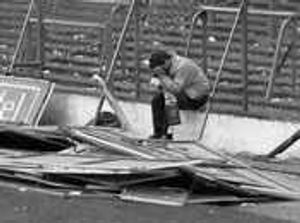
I've never properly thanked Brian for somehow understanding that his reporter at Hillsborough was, by then, in a state of total shock. Of no bloody use to him whatsoever. I was there for a football match but by the time I heard those words they had carried out the first victims and covered their faces with blankets. In the penalty area. That meant they were dead. And that was Hillsborough, April 15, 1989.
I'm not a hack who has spent much time collecting memorabilia but, in a bedside table, I have the programme for Liverpool v Forest, an FA Cup semi-final which lasted but a few minutes before it was abandoned.
I never look at it. I know it's there. A bit like my memories of the whole, ghastly experience. I never look at them, but I know they are there.
Actually, I have one other really vivid recollection. Even as the enormity of the tragedy was becoming clear to those of us who stared at the Leppings Lane End in a stunned disbelief, a Forest fan wandered down the walkway in front of the press box and began venting abusive scorn towards the Liverpool supporters who, he did not know, were being crushed to death.
This was four years after Heysel where Liverpool fans had fought with, and been blamed for the death of, Juventus supporters. English clubs were banned from Europe and the prime minister of the day, Margaret Thatcher, fully endorsed the suspension. There was no such thing as society, she claimed. And if there was, football supporters were a sub-human culture which existed beneath it.
If Liverpool fans were spilling on to the pitch in a desperate scramble to get out of the pens which were killing them, it can only have been to cause trouble. To threaten the Forest fans at the other end of the ground.
Such was the tragedy, the lunacy of Hillsborough, that while innocent young football fans were having the air crushed from their lungs, the police were more concerned about forming a cordon across the halfway line to prevent them getting at rival fans.
You have all heard the stories by now. The inevitable, wholly understandable demand for justice from bereaved families let down by a startled and incompetent police force who, it is claimed with good supporting evidence, falsified reports and even stole video tape to protect their mishandling of this grotesque human calamity. For me, there is just a numbness about the entire experience. Later that day, we were ushered over to Hillsborough's gymnasium, which became an emergency morgue, for a briefing from a police official.
I took one brief look inside, saw the vomit on the chests and blood under the noses of those poor, terrified, desperate people and walked away.
Those who stayed later needed counselling . . . but we don't talk about it. We never do. These are the first words I have written about the whole sorry day since. I hope they are the last. I can do no justice, offer absolutely nothing, to those poor people who died.
I just stood there and watched their children, their sisters, brothers, fathers and mothers, pulled out, one by one. I was speechless and immobile.
They were dead.
I'm ashamed I could do no more and can only hope their cruel, senseless, terrible passing will one day be explained to their loved ones and ensure that no-one ever again suffers such a desperate fate.