Growing good food
All over the country, seed catalogues are falling through letter boxes.
For those of us who are keen gardeners, it's time to thumb through the pages and start to think about our vegetable patch or allotment, and decide which vegetables to grow in the spring, for a summer harvest.
So how do you decide what you grow? It may be what tastes best, or it may just be just what grows with the least effort; it's certainly hard to resist the sheer bounteousness of courgettes, even if they're not your favourite vegetable. We are still eating our way through a freezer full of last summer's homemade courgette fritters, courgette quiches, and courgette soup! It's a running joke with our grandson, that almost everything we've eaten this winter contains courgette in some form.
Another consideration, especially at this health-conscious time of year, is nutrition. So what are the healthiest vegetables to grow? I know that all vegetables are good for you, but according to the Nutrient Rich Foods (NRF) index, some are even healthier than others. Plants differ in their ability to deliver the essential nutrients needed for a healthy diet. A recent paper in the Journal of the Academy of Nutrition and Dietetics looked at this question, using the NRF index.
For each food, the NRF index adds up all the percentage daily values per serving for nine 'good' nutrients, then subtracts the sum of the percentage daily values for three 'bad' nutrients that we eat too much of. The daily values are worked out by the US Food and Drug Administration, but are similar to Britain's guideline daily amounts. The nine good nutrients are protein, fibre, vitamins A, C and E, calcium, magnesium, potassium, and iron. The three bad guys are the usual suspects: saturated fat, sugar, and salt. The more of the former and the less of the latter, the higher a food scores.
But that's enough of the complex nature of nutrients and food scores. If we look at vegetables, near the top of the healthy veg charts are dark green varieties of all kinds, including leafy salads, chard, cabbage, and broccoli. The king of healthy veg, and an excellent source of nearly everything, is spinach. My wife has just made up some butternut, mushroom and spinach pies. They are delicious and full of goodness. So, if maximising healthy nutrients per square yard is your aim, then salads leaves, cabbage, spinach and broccoli are the things that should fill your veg plot with this summer.
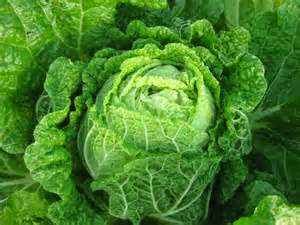
Next come squashes, pumpkins, and carrots, closely followed by a large group of other vegetables including asparagus, beetroot, cauliflower, green beans, iceberg lettuce, courgettes, onions, and turnips; all good for you, but not quite up there with cabbage. All these vegetables are slightly better for you raw than cooked, largely owing to the loss of vitamins and minerals on cooking.
Next come potatoes, although here there's a lot of variation in how you choose to eat them; baked or boiled is much better for you than chips. And don't forget certain potato varieties are better for mashing or roasting than others. I swear by Maris Piper as a good all round cooking potato. However, sweet potatoes have the highest NRF index of all, above even leafy vegetables. Sweet potatoes are a particularly good source of vitamins and also of potassium, which can help to lower your blood pressure. Incidentally, the definitive answer to whether potatoes count as one of your five a day is no, but sweet potatoes do. It's just a pity that, despite new hardier cultivars becoming available, sweet potatoes are still not all that easy to grow in the UK, however hard I try!
But don't get too carried away by differences between individual vegetables. If we take a step back and look at the bigger picture, all fruit and veg have high NRF scores. Dry beans, pulses, nuts, and seeds have similarly high scores.
Fruit and vegetables also outscore meat, which, though it has plenty of nutrients, is let down by lack of fibre and high levels of saturated fat.
A bit below meat comes eggs, then dairy products and grains, and finally, with negative nutrient scores, pure processed things such as sugar and fats.
In short, compared with all the other foods you could be eating, any fruit and veg is a healthy option, and, of course, growing them is good for you too.
This reminds me, I have to get down to the allotment and get the soil turned over before the next frost and snow arrives to help break down the clay-filled sod.