Red Deer (Cervus Elaphus)
This blog is primarily about red deer as they are the cervidae species that I have been most interested in to date, although we do have locally other species of deer, most notably fallow and muntjac.
Up until fairly recently I had never seen a local red deer in its natural habitat, I had heard rumours of their existence but had never seen one. I had seen fallow deer on Cannock Chase but never a red.
I made a decision that I would make an effort to locate, observe and hopefully get a photograph or two of this mythical local beast.
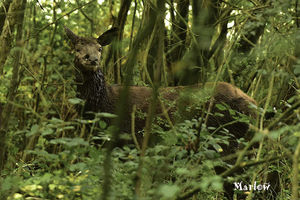
I decided to investigate further and got as close as I could before I realized this animal was on private land and I could venture no further. It was indeed my first glimpse of a red deer.
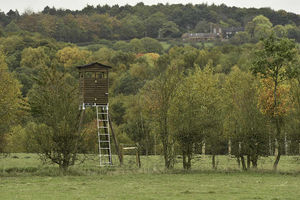
When I got home I wrote a nicely worded letter to the landowner asking for permission to come onto his land to photograph the deer. I was a little surprised when I was refused but I realize now why as this landowner has subsequently erected a shooting tower type platform to cull the deer on his land. This has caused local controversy with much debate on social media ensuing.
Since then I have found other local populations of red deer and when I get the opportunity I pop over and have a look at them and take a few snaps. I do not have the time to spend hours in the field observing them unfortunately but you can learn a lot from even casual observations.
For me the first thing that stands out about red deer is their size, they are unmistakable being our largest wild mammal. A full grown male can stand 135 cm at the shoulder. That means that for even a fairly tall person you are going to be eye to eye with one of these creatures and they do just that they look you in the eye. I have on several occasions been walking through undergrowth turned a corner and there has been a huge specimen just standing there staring me in the eye obviously trying to assess my intentions.
They are so quiet, stealth is obviously a talent that they have had to develop for reasons of survival and is probably one of the reasons that so few people have seen one. Although they can become very familiar with people and in some areas will almost rub shoulders with locals if they do not feel threatened.
They are extremely agile creatures and will clear most fences with ease and are very fleet of foot. When you see a group of them effortlessly gliding across open farmland at pace, it becomes easy to understand that they evolved to out run wolves and other predators.
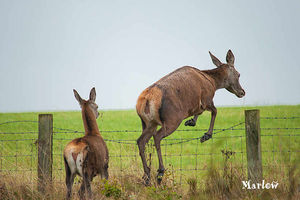
Mature red deer stags usually possess a set of antlers which are made of bone that are shed and regrown every year. The antlers which are extremely fast growing become larger on each successive year in the stags age until about the age of ten years. Unfortunately, multi branched antlers have always been highly prized by hunters. whilst the antlers are growing they are covered in a blood rich skin called velvet that helps supply the essential nutrients for rapid growth. The skin is shed or rubbed off in time for the annual rut.
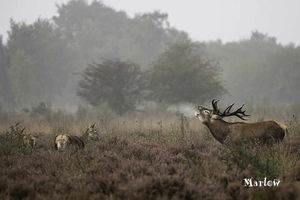
My most inspiring moment with red deer thus far was earlier this year when I managed to arrive pre-dawn to an area where there was a spectacular male rutting. We could hear him roaring from some distance away. When we arrived on the scene he was charging about at pace clearing off any lesser males that arrived on the scene. For a short while I felt like I had been transported through time to a primordial swamp and I guess the scene that was being played out in front of me harkened back to antiquity. As the sun came up he just settled down and rested in the long growth.
If you want to see red deer heading for the centre of Cannock Chase is probably not the best plan as many seem to live on the fringes off urbanization in our region in closer proximity to people than most would imagine. To illustrate this point only last summer I was photographing a mother and yearling calf in a field next to a large built up area. A local teenager who was walking along the path towards me said ''Hiya mate what are you photographing''. I nodded in the direction of the two large herbivores that were about twenty five yards away from him. 'Wow, what are they doing here'' he said ''they live here'' I answered
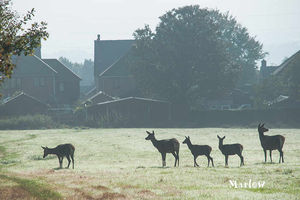
Living so close to urbanization must be their biggest downfall as many are injured or killed on local roads every year. I myself witnessed two seriously injured hinds one Saturday morning in two different locations thirty minutes apart. With ever more roads and potentially railways slicing up our countryside this can only get worse as the deer are forced to cross busy highways to move from one feeding ground to another.
There is no doubt that along with many other species all across the country deer must be feeling the pressure from increased development and with loosening of land regulations to accommodate more housing etc.
Culling is always a hotly contested debate regarding local deer with mixed opinions between different factions. Larger local herds are culled by landowners who site over population which leads to over grazing, poor health and damage to crops and local infrastructure. Arguments are raised that with no natural predator's deer numbers if left unchecked would have a knock on effect on local bio-diversity.
Opponents of culling say that with the high number of road deaths in the area and poaching casualties, culling is not needed or necessary. That culling is used to provide an income to landowners who hire out the rights to shooting deer and that trophy hunting of large males goes on.
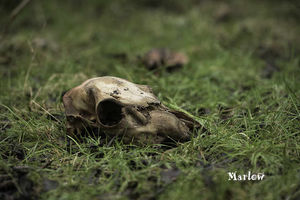
I am not going to add to this debate but my observations would lead me to believe that there is a large disproportion between males and females with very few mature males being seen.
There is little doubt that our local red deer face many challenges in their ever shrinking habitat, human interference and the constant threat of road traffic injury's or death all play a part in their daily existence.
I would finish this blog by saying if you have never seen any of our species of deer especially reds make an effort to get out and see some. I would recommend going to one of the many organized deer parks that abound. If possible, go during the rut and observe from a safe distance.
A few red deer statistics : source British Deer Society
Males 107-137 cm at the shoulder, weight 90-190kg
Females 107-122 cm at the shoulder, weight 63-120kg
The breeding season or rut occurs from the end of September to November, with calves being born after an eight month gestation period in May to mid-July.
Red deer graze on grasses and dwarf shrubs e.g. heather and bilberry but will also eat tree shoots during the winter.
Lifespan can be exceptionally up to eighteen years.
Antlers start growing in the first year from the age of about ten months.
Who to call if you see an injured or dead deer on the road side : source Cannock Chase Council
Staffs County Council Ranger Service : 01543 871773
Forestry Commission : 01889 586593
Staffs Police : 08453 302010
Deer Pager Number : 07699 745400