
Lloyds Bank is moving out of its landmark Wolverhampton home - but did you know its first branch was in the Black Country?
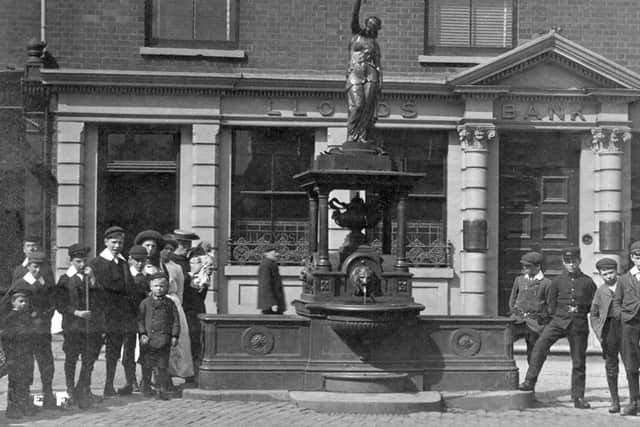
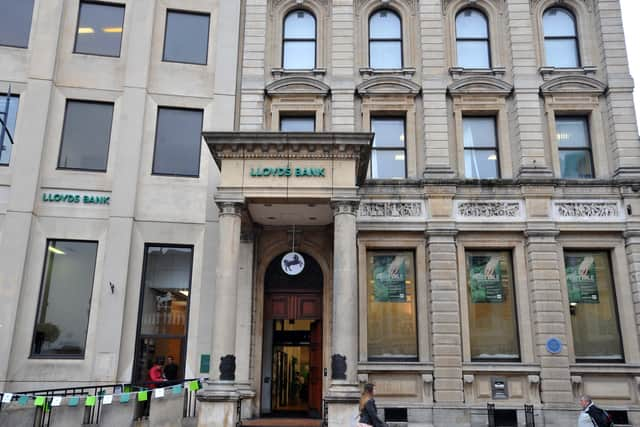
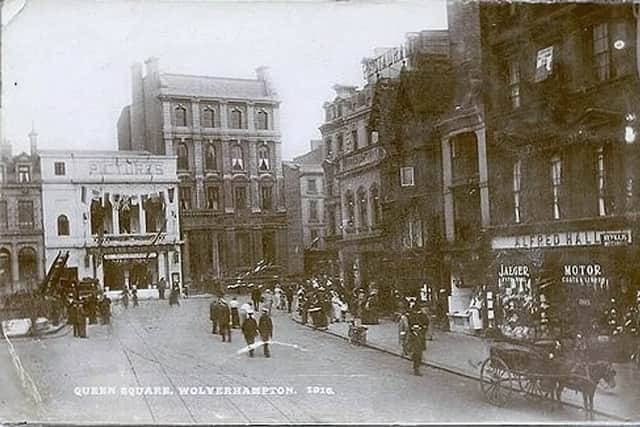
It will be the end of an era this autumn when Lloyds Bank moves out of its imposing Italianate building in Wolverhampton's Queen Square, after 146 years.
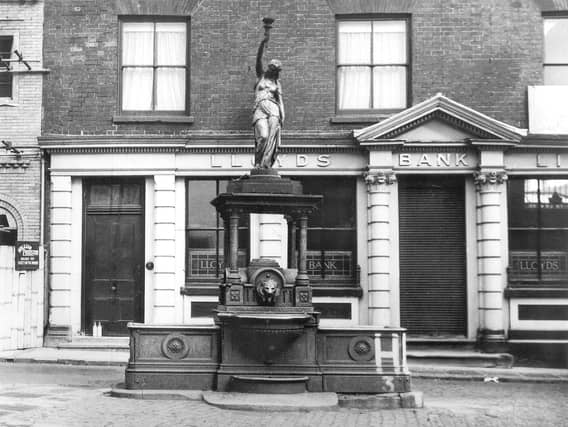


The bank will still be represented in the city, with a smaller branch in the Mander Centre. But did you know that Lloyds' first ever branch was in the Black Country?
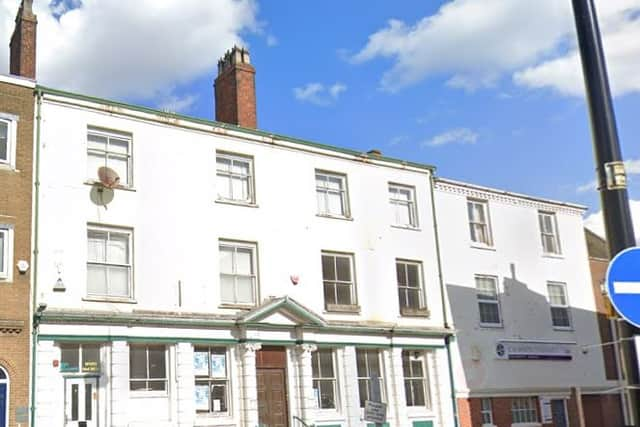
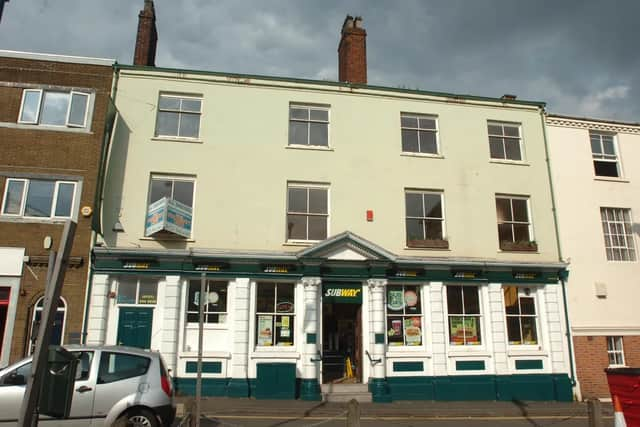
To most locals, the shabby building in Unity Place, Oldbury, is probably best remembered as the old Subway, its peeling green paint a tell-tale sign of its recent use as a sandwich bar. But this scruffy-looking building played a hugely important role in shaping the world of modern financial services – it was the first branch of Lloyds Bank.
While the Black Country and Shropshire's role as the birthplace of the Industrial Revolution is well known, the area's importance in the banking revolution which took place at the same time gets far less attention. Britain's biggest high-street banking group owes its origins not to the Square Mile, but to a Quaker industrialist whose father had fled persecution in his native Wales to make a living in the quieter climes of the West Midlands.
Today, Lloyds Banking Group employs 65,000 people, and has 30 million customers. But it had already been trading for more than 100 years as a modest family business before it opened its first walk-in branch just off Birmingham Road in Oldbury town centre.
The story began in Welshpool, where Sampson Lloyd Snr was born in 1664 in difficult circumstances. His parents, Charles and Elizabeth, had been detained for refusing to swear an allegiance to King Charles II. It is not certain where Sampson was born – the majority of reports say at Welshpool Gaol, where his parents served eight years, but others suggest they might have been under house arrest – but either way, he would have spent much of his childhood in custody.
A little respite came with the 1672 Declaration of Indulgence, which saw Quakers freed from prison, but not a great deal. They might no longer have been incarcerated for their beliefs, but they were still despised and persecuted. Sampson's father, who was a descendant of the Welsh royal family, decided it was time to leave behind the hostility he faced in his homeland, and to make a new life in England.
However, the Five-Mile Act, introduced to restrict the influence of the Quakers, prevented any non-conformist clergymen from living within five miles of a corporate borough. That ruled out the major centres of the Black Country, but Birmingham, still a sleepy backwater yet to be granted borough status, was also beginning to emerge as a manufacturing centre in its own right. Just like the Quaker Cadbury family, the Lloyds decided that the future second city was ideally located to benefit from the Industrial Revolution which was about to explode just up the road, but was still small enough for them to live a peaceful life free from interference.
Indeed, Sampson Snr's brother-in-law John Pemberton had already made a successful career as an ironmaster in Birmingham and it is believed he moved to Birmingham in 1698, settling at 56, Edgbaston Street where he kept an iron warehouse. His son, Sampson Lloyd II, was born in 1699, and they opened a slitting mill at the end of Bradford Street, powered by water from the River Rea.
Following the death of Sampson Snr in 1725, Sampson II and his older brother Charles went into business together, buying another mill in the town and trading in iron. Two years later Sampson II married Sarah Parkes, the daughter of wealthy Wednesbury industrialist Richard Parkes who died in 1728, leaving what would eventually become the Patent Shaft steelworks in Wednesbury to his four daughters. Sampson naturally became involved in the management of that business too, and the following year Sarah died too, at the age of 29, leaving one son, Sampson III.
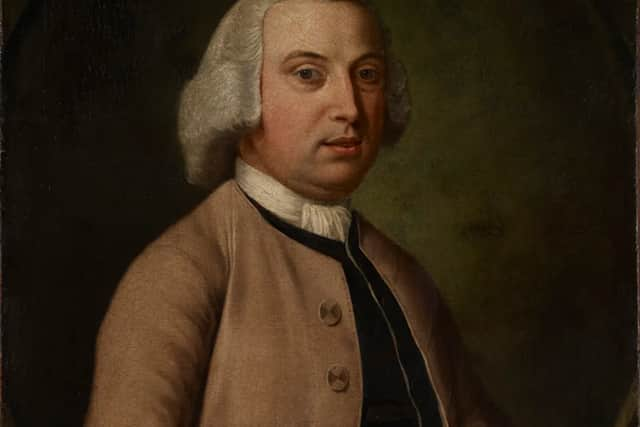
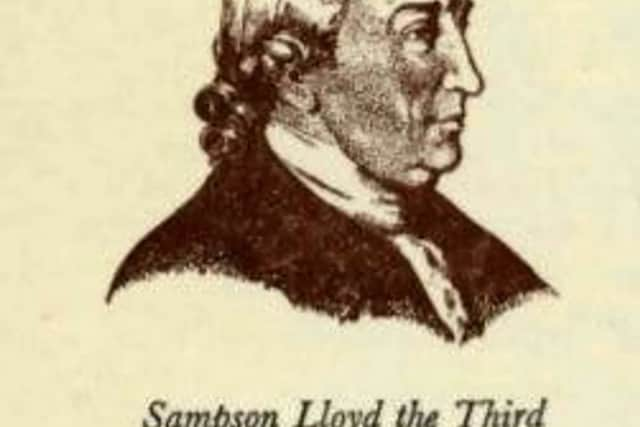
And in 1765, at the age of 66, Sampson II decided to start a bank. His motives for doing this relatively late in life are not known, but it may have been something he wanted to do for his son, Sampson Lloyd III.
He entered into a partnership with leading Birmingham button maker John Taylor, and the bank, initially known as Taylor's and Lloyds, began operating from 7 Dale End in Birmingham. We do know that there was a growing demand for commercial banks during the 18th century, in part due to the new-found wealth from the Industrial Revolution, and a lack of confidence in the established banking system. Up until 1640 the well-off would have left their deposits under Crown Protection with the Royal Mint, but after King Charles I 'borrowed' £150,000 to spend on his army, merchants looked elsewhere to deposit their wealth. By the 18th century the modern banking system was beginning to emerge, and Quakers, who had a reputation for the ethical management of their finances, were well-positioned to benefit.
When Taylor's and Lloyds was formed, four shares were issued, with both men bringing their sons into the business, and between them the four men invested £6,000 – well over £1 million each at today's prices. Two clerks were also employed, at a cost of £80 a year. It seems incredible given the huge sums of money involved, but such was the trust between the four men that no legal deed was ever brought into place during the first 100 years of operation.
The Lloyds were soon established as the dominant figures in the partnership, while the day-to-day running of the bank was left to Sampson Lloyd III. And Sampson Lloyd Snr's hunch that Birmingham could be a good place to do business would pay dividends. By 1765 Birmingham's population had grown to 25,000, and within 15 years this had doubled to 50,000. The sleepy backwater was emerging as an industrial powerhouse, and Taylor's and Lloyd's was the only bank in town.
In 1777, the philosopher and economist Edmund Burke described Birmingham as "the toy-shop of Europe", producing in vast quantities all manner of steel ornaments, toys and trinkets. But it was not just a toyshop, it was also a huge arsenal with a prodigious output of guns and swords. It has been estimated that in the last quarter of the 18th century the city made more than 750,000 consignments of arms – there does seem a certain irony that a major beneficiary of this burgeoning industry would be a family of pacifist Quakers.
At one time in its early years it was said that half of Birmingham was indebted to Taylor's & Lloyd's. But one obstacle to Birmingham's growth as a centre of commerce was the state of the roads leading to it. And how the Lloyd family dealt with his problem gives an interesting insight into what made them such a force in the world of business. A coach service to London had been running since 1731, but passengers making this treacherous journey not only had to resign themselves to two and a half days on the road, but also with the likelihood that they would be relieved of their valuables by highwaymen along the way.
The long procession of wagons carrying coal from the Black Country collieries also floundered along the rutted roads, making the going still harder for other traffic. So Sampson Lloyd II and son next turned their attention to overseeing the construction of the 22-mile Birmingham Canal. Known as the 'Silent Highway', the waterway would transform Birmingham's fortunes, halving the price of coal overnight. It also proved a shrewd investment, paying a dividend of 20 per cent. Sampson Lloyd II died in 1779 at the age of 80, but the bank continued to see rapid growth under Sampson Lloyd III and his half-brother Charles.
Interestingly, Charles had learned his trade at the rival Freame, Barclay, Freame and Co – now Barclays Bank – after his sister married Charles Barclay.
In its early days, the bank's emblem was a beehive, representing industry and hard work. The famous black horse was originally displayed outside Humphrey Stokes's goldsmiths shop in London from 1677, and was adopted by Lloyds in 1884 when it took over the London-based Barnett, Hoares & Co bank, which had absorbed Humphrey Stokes.
The industrial expansion which took place during the Victorian era meant the nature of banking was changing, and in 1864 Taylor's and Lloyd's opened its first retail branch in Oldbury. And while the informal agreement between two Quaker families might have been appropriate for the time, it was now considered expedient to put the bank on a more formal footing. In 1865 the Lloyds Banking Co – the association with the Taylor family had ended in 1852 – was registered, with a capital value of £2 million.
The Oldbury branch would prove to be the first of many. Lloyds acquired the status of a London bank, changing its name again to Lloyds Bank Ltd, and a network of branches sprang up across the West Midlands, including one in Great Bridge which opened in 1876, and another in Darlaston which opened in April, 1886. The first Lloyds branch in Wolverhampton is thought to have opened about 1875, moving to its soon-to-be-vacated site in 1879.
It was not until 1912 that the bank moved its headquarters to Lombard Street in London, and it was at this time, through a number of mergers and acquisitions, that the bank established branches across the country.
The original branch in Oldbury closed about 20 years ago.
The Lloyd family lived in Birmingham until the 1930s, occupying a house in Hagley Road which has since been demolished to make way for an office block.
The family’s last surviving daughter, Mary Eliot Walker, died in 2003.
Comment Guidelines
Iconic Media encourages reader discussion on our stories. User feedback, insights and back-and-forth exchanges add a rich layer of context to reporting. Please review our Community Guidelines before commenting.