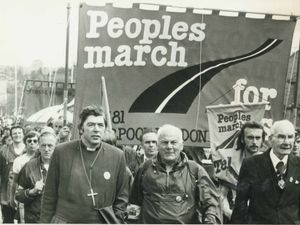
Challenging views on international law - your letters, plus a flashback to the 1981 People’s March through Wolverhampton
In today's letters, readers debate military action, the limits of international law, and who bears responsibility for protecting civilians in conflict zones.

You can enjoy other pictures from the past and more with our weekly FREE Nostalgia Newsletter - with scores of archive pictures and exclusive features on the history of Wolverhampton, Staffordshire and the Black Country - all sent to your inbox every week. Sign up here
War is morally right despite law
In his response regarding the events in Iran, Alan Harrison offers a robust defence of international law. My original correspondence explicitly stated that, under international law, the war on Iran is unequivocally illegal. My support for military action against Iran is not rooted in any adherence to international legal standards or jurisprudence.
Indeed, I question the validity of the entire concept of an international, legally binding, and enforceable framework. Nation-states tend not to regard this concept above their self-interest, and the institutions designed to enforce it are often considered laughable, ineffective, and, sadly, emblematic of a particular worldview.
I justify the regime change in Iran not through legal arguments but through a straightforward moral perspective, as I perceive it. The suppression of freedoms for Iranian citizens, the orchestration and execution of acts of terrorism, and the mass murder of their own populace render the Iranian cleric-led regime uncivilised, incompatible with the moral values I uphold—regardless of what any well-educated lawyer might suggest.
Martin Bristow, Wolverhampton