'Why I believe this West Midlands tram revival is a step in the right direction – a century later'
Trams were most definitely seen as the future for transportation.
In many of the suburbs in Birmingham, including Hall Green where I live, there are what are known as ‘central reservations’ – central grass strips, often with trees along the edges – creating a dual carriageway.
Whilst giving the sense of greater greenery than would otherwise be the case, those living nearby or passing by probably rarely consider why these strips were created.
These boulevards were created when such suburbs were being built as the city expanded following the First World War and to deal with the rapidly increasing population which between 1901 and 1931 nearly doubled from 522,204 to 1,002,603.
Major arterial roads out of the city were laid in order to accommodate trams that would extend outwards in what is now the grassed ‘sandwich’ between the two roads.
A century ago, when trams were in their heyday in Birmingham and in other cities and major towns, this form of transit was seen as an efficient and effective way to move people.
Today, the West Midlands Metro is continuing to grow, with several major projects aimed at improving connections across the region.
Among the most significant is the 11km extension from Wednesbury to Brierley Hill, which will run through Tipton and Dudley, bringing tram services to areas that have not had rail links for decades.
In Birmingham, work is also progressing on the Eastside extension, which will extend the network to Digbeth and Curzon Street, the future site of the Birmingham Curzon Street railway station.
Further ahead, there are plans to extend the network towards Solihull and Birmingham Airport, creating improved links between the city, surrounding towns and key transport hubs.
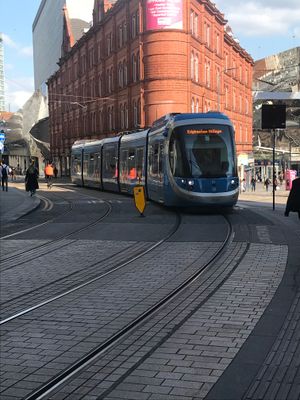
When trams first appeared, they ensured all citizens could travel around the city on the major routes for commuting, shopping and schools and were perceived as the height of luxury, certainly when compared to using horse-drawn carriages or bicycles when introduced.
Trams were most definitely seen as the future for transportation.
The network for Birmingham was extensive and was linked to the Black Country and, in a different version which exists (the property Bearwood Parish Council), is presented in the style of London Underground.
Trams, a form of transportation for fare paying passengers, then normally consisting of a double-deck carriage on rails and derived from the Scandinavian word for a beam or baulk of wood, were first introduced on the Oystermouth Railway to allow trips between Swansea and the Mumbles in South Wales.
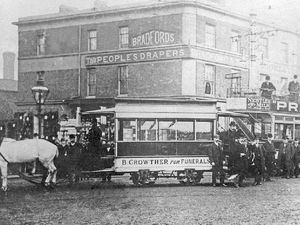
It took until 1872 for trams to be introduced in Birmingham when Birmingham and District Tramways Company built a route between the city boundary at Hockley Brook, via Handsworth, to West Bromwich.
Trams didn’t extend into the city because Birmingham Corporation, as the city council was then known, had not laid tracks within its boundary.
This was remedied in September 1873 when a route was opened between Monmouth Street in the city centre and Hockley Brook.