Major proposal for Birmingham cycle route takes a step forward
Major proposals for a Birmingham cycle route that runs from the city centre to a key road have taken a step forward.
Major proposals for a Birmingham cycle route that runs from the city centre to a key road have taken a step forward.
Back in 2020, the city council installed temporary pop-up cycle lanes across Brum in a bid to help people travel ‘safely and actively/ during the Covid pandemic.
The local authority in November 2021 then consulted on making a particular cycle route – the one which runs from the city centre to the A457 Dudley Road – permanent.
“Since the 2021 consultation, the designs have been modified to address feedback and improve the route and cycling infrastructure,” the council said recently.
“We have also improved the signalised junction, including crossings at the A4540 Icknield Street.”
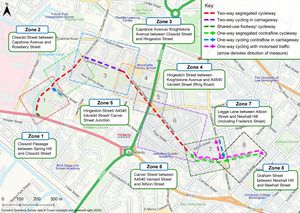
The council has now launched a public consultation on these updated designs, with the project being funded by Department for Transport.
The authority is also pushing ahead with other cycle route plans across the city as it looks to reduce carbon emissions and reconnect communities by “prioritising people over cars”.
In particular, the city council has ambitions of creating a city-wide cycle network and said earlier this year that transforming Brum’s transport is “fundamental to meeting the challenges of the next decade and beyond”.
“Economic, population and housing growth will create additional demand for travel, which cannot be accommodated via ongoing car dependence,” the council wrote.
It added that tackling the climate emergency “cannot be achieved without a wholesale shift towards public transport and active modes”.
All cycle lanes on the route from the city centre to the A457 will be separated from general traffic and from people walking/wheeling using a combination of:
Level differences (the lanes are higher or lower, with a kerb in between)
Lane separator units (the lanes are at the same level with a rubber or concrete kerb between them)
Lines marked on the ground
The public consultation can be found on the Birmingham Be Heard website here.