Developers behind Birmingham indoor market plan to ‘pursue appeal’
The developers behind divisive plans to demolish Birmingham’s Bull Ring Indoor Market building are pursuing an appeal after planners rejected the proposals.
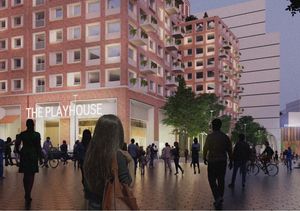
The proposed development for the site in Edgbaston Street would provide up to 745 apartments or up to 1,544 student bedrooms – or any combination of those uses – in the city centre.
It would also provide new public realm works, a private central courtyard and roof-top terraces as well as commercial space.
But fears over what could happen to the market traders was a recurring concern at three council planning meetings throughout this year.
The council said there were plans for a temporary market on the former wholesale market site, which the traders could be moved into ahead of the transition into a new permanent market building on the Smithfield site.
The lease on the current indoor market was extended until 2027, which the council said would provide the “necessary time” to deliver a temporary market.
But members of the council’s planning committee remained uneasy at a meeting earlier this month, with Coun Gareth Moore saying: “I welcome the extension of the lease until March 2027.
“But I remain concerned because that doesn’t guarantee a temporary site will be available by March 2027.
“I don’t think we have the guarantees that a 900-year-old market will be continuing.”
“The market has a place in Birmingham’s history,” Coun Lee Marsham, chair of the committee, added. “There is a strong case to change the market and make it develop and thrive in new ways in the decades and centuries ahead.
“At the moment, I don’t think this scheme in front of us is the scheme which is right for this city. I don’t say that lightly because I understand the weight of the decision we’re making.”
Members of the planning committee unanimously voted to refuse the proposals at the July meeting.
Coun Marsham urged developer Hammerson to “continue to work with the city”.
“We need you but you need us as well and we have to get this right,” he said. “We say this in good faith and as critical friends, not as enemies.”
Following the decision, a spokesperson for Hammerson said “[the] decision is deeply frustrating given its continued focus on a non-planning matter”.
The company confirmed it intended to launch an appeal in a bid to “maintain the timetable for the project”.
A spokesperson for Hammerson said today, July 23, that it remained “highly committed to Birmingham as a city for growth and has a long history of investment”.
“We have worked closely with the planning officers at Birmingham City Council to create a project that aligns with the city’s future plans, including around housing, the environment, public realm and green spaces,” they continued.
“We have had three consecutive highly positive recommendations for the scheme and are working closely with the council’s team to extend the term of the market until 2027.
“This deadline means the planning process is now on its critical path to ensure there is time to prepare the major investment needed for this project.
“In this particular circumstance, therefore, we have chosen to pursue an appeal to maintain the timetable for the project.”
‘Support for traders’
A council update, issued ahead of a planning meeting in February, said there had been “notable progress” on the Smithfield plans, adding it provided a “greater level of certainty over future market provision”.
It said the council would be submitting an application to the Enterprise Zone for funding to secure the delivery of both the temporary and replacement permanent markets.
“Until such funding is secured, there remains a risk to the delivery plans,” the update acknowledged at the time.
A further update, issued before the meeting this month, later confirmed the outline business case was approved by the Enterprise Zone Partnership Board and would be presented to a future cabinet meeting prior to the submission of the funding bid.
“In parallel, the council is progressing joint venture negotiations with Lendlease, which is expected to take on responsibility for delivering the temporary market facility,” it said.
The council said the plan provided a “credible pathway” towards providing the future markets as well as “continuity for traders and the public”.
“This will include relevant support for the traders in the various stages of transition,” it added at the time.
“It is considered there are no reasonable grounds upon which this application could be refused or delayed further.”
Those behind the scheme said its benefits would include new housing, the potential of creating a ‘gateway’ development, public realm enhancements and the use of brownfield land in a ‘highly sustainable’ location.