Stafford residents lose battle against massive solar farm - as big as 77 football pitches
Residents have lost their battle to stop a massive solar farm being installed on farmland in Stafford Borough.
Stafford Borough councillors rejected the application for the 49.9MW facility on land at Lower Farm at Drointon Lane, Grindley in Stafford, last year.
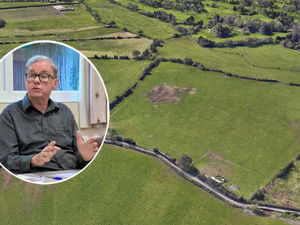
But planning inspector Stephen Normington overturned the decision after an appeal by Novus Renewable Services Limited. Permission has now been granted for the development, which Councillor Brendan McKeown said would take up space equivalent to 77 football pitches.
In his decision notice Mr Normington said: “It is inevitable that being located in a countryside location, a solar farm of this scale would have some adverse landscape character and visual impact. However, through a combination of topography, existing screening and the introduction of landscape mitigation, the adverse effect would be localised.
“Moreover, as the existing and proposed planting matures, some of the adverse effects would be acceptably mitigated. Whilst the 40-year lifetime of the scheme is significant, once the solar farm was decommissioned, there would be no residual adverse landscape effects.
“I recognise that the land could continue to be used as grazing land around and under the solar panels, and that in due course the land would be returned to full agricultural use – albeit that this would likely be 40 years in the future. In this regard, Natural England have advised that the development is unlikely to lead to significant permanent loss of BMV (best and most versatile) agricultural land as a resource for future generations due to its temporary nature and proposed construction method.
“Concern has been expressed in relation to the safety of the BESS (battery energy storage system) installation, which would include a significant number of containers containing racks of batteries, and other equipment. The Staffordshire Fire and Rescue Service (SFRS) raised no in principle objections to the appeal proposals but provided advice regarding the installation of fire preventative and control measures.
“In the absence of any formal objection from the SFRS, I have no other compelling reasons to dismiss this appeal on fire risk grounds; however I recognise that fire risk remains a serious concern for local residents. Given the limited evidence before me, I consider that a battery safety and fire risk management plan would be appropriate to impose as a planning condition were I minded to allow the appeal.”
The decision notice was presented to planning committee members at their latest meeting. Councillor Bryan Cross said: “It’s a shame because it’s going to destroy a beautiful part of the county.
“I think that’s the start of many applications of this nature we are going to get covering part of our borough. It does worry me.”
'We have concerns for the size and localtion of the battery energy storage system'
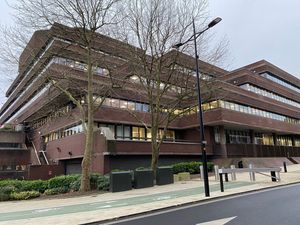
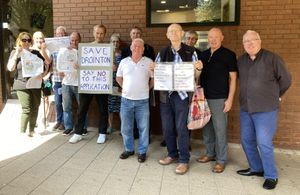
Residents opposing the development turned out in force for the planning inquiry at Stafford Borough Council’s Civic Centre in January. They brought protest placards with them and highlighted the number of similar applications being proposed for the area.
Stowe by Chartley parish councillor Richard Rayson said: “We are aware of at least half a dozen applications for solar farms in the boroughs of Stafford and East Staffordshire, very close to this development. We have concerns for the size and location of the battery energy storage system, located directly adjacent to an historic woodland which is combustible material.
“We believe there has not been due diligence in terms of how the applicant is proposing to site this system and location of the solar farm in proximity to Drointon, Grindley and Lea Heath. We feel it is an inappropriate site to locate a solar farm.”
Adam Day, who spoke on behalf of the appellant at the hearing in January, said that just eight per cent of the site was considered best and most versatile agricultural land. He added: “The proposal is inherently temporary for 40 years; after the use the site will be restored to its former agricultural use.”
Richard Turner, who also spoke in support of the proposals, said: “The biggest threat to food security is climate change. Reducing carbon emissions requires a collective effort from communities across the UK to host projects, whether they are solar panels or wind turbines.
“The NFU states solar farms don’t present a risk to UK food security. We understand that people don’t like to see change in the countryside, but you will have seen a 74m high wind turbine at Manor Farm which is now built and an accepted as a feature in the landscape.”