Benefits Street: The West Midlands neighbourhoods where 1 in 8 people claim disability benefits, and those with the lowest rates
Walsall, Sandwell and Telford are the disability hotspots of the West Midlands, with one in eight people claiming benefits.
New figures show how the number of people claiming Personal Independence Payments (Pip) in the West Midlands have near-doubled since the outbreak of coronavirus, with thousands of new claimants across the region.
But they also show significant regional variations in both the number of people claiming the benefit, and how the rate has increased.
Pip provides financial support to people with long-term disabilities or health conditions, and unlike some other benefits, is available to people in work. The Government's Welfare Reform Bill had originally proposed to tighten the criteria for the payments, but has now been delayed until next year pending a review.
Breaking the figures down by local authority, Sandwell had the highest number of claimants in our region, with 27,129 in receipt of the benefit - a rise of 80 per cent compared to January 2019, when the figure stood at 15,072.
More significantly, the claim rate per 1,000 people stood at 123.68, meaning just under one in eight people are now claiming the benefit, compared to 70.43 in January 2014, or one in 14.
However, the highest claim rate in the region came in Walsall, where just over 130 people in every 1,000 were in receipt of the benefit - more than one in eight. The increase over the past six years is also higher than Sandwell, rising from 11,657 in January 2019 to 22,933 in April this year - a rise of 96.7 per cent.
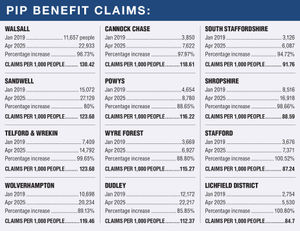
In Telford and Wrekin tied with Sandwell for the second highest claim rate, with 123.68 people per thousand claiming the benefit. But the rate of the increase has been much more rapid, with the number of people claiming the benefit almost doubling from 7,409 in 2019 to 14,792 this year.
The areas with the lowest claim rates were Lichfield district, Stafford, and the Shropshire unitary authority where approximately one in 11 people were on the benefit.
Perhaps surprisingly, the likelihood of people claiming the benefit appears to be inversely related to the average age in the local authority areas.
Despite having the highest claimant rates, Sandwell, Walsall, and Telford & Wrekin are among the youngest local authorities in the area, with average ages of 37, 38 and 39.9, By contrast, Shropshire, Lichfield and Stafford had older age profiles, with average ages of 48, 46, and 45.4, but lower claimant rates.
However, Lichfield and Stafford did see the biggest percentage increases in people claiming the benefit, with the number of cases more than doubling in both cases, rising in Lichfield from 2,754 to 5,530, and in Stafford from 3,676 to 7,371. One explanation may be that the coronavirus had a bigger impact on the populations in these areas.
In Dudley, the number of people claiming Pip rose from 12,172 in 2019, to 22,217 in April this year, a rise of just under 86 per cent, with the claim-rate increasing from 62.42 per 1,000 people to 112.37.
In Wolverhampton, the number of claimants rose from 10,698 to 20,234 over the same time period, an increase of 89 per cent. The claim rate per 1,000 was a little higher rising from 64.96 in January 2019 to 119.46 in April this year.
In South Staffordshire, the number of claimants rose by 94.7 per cent, from 3,126 in 2019 to 6,087 this year, with the claim rate increasing from 47.31 per 1,000 to 91.76.
In Cannock Chase the number of claims saw a 98 per cent increase from 3,850 at the start of 2019, to 7,622 by April this year, with the number of claims per 1,000 rising from 62.01 to 118.61.
The figures have been collated by the Taxpayer's Alliance, which also revealed that people with conditions such as acne, food intolerance and 'factitious disorders' - a mental condition which causes people to feign illnesses - were being granted the 'Enhanced Pip', which also entitles them to a free car through the Motability scheme.
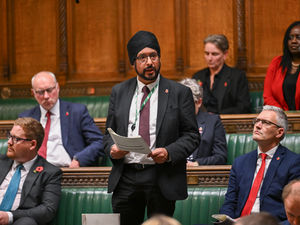
The big rise in Pip payments has helped fuel a drive by Chancellor Rachel Reeves to cut the benefits bill, which last week led to chaotic scenes in the Commons as ministers hastily watered down plans in order to see off a revolt by their own backbenchers.
While the controversial bill passed its second reading, the saga has exposed tensions between No 10 and Labour backbenchers and created a huge headache for Rachel Reeves, the chancellor, who will now have to find a further £2.5 billion of savings at her autumn budget.
John O’Connell, chief executive of the Alliance, said: "It’s as clear as night follows day that the benefits system is being significantly abused.
“While England is a sicker country than it was before the pandemic, the size of the increases for many of these conditions surely cannot be believed by even the most gullible of MPs.
“Britain is in desperate need of a politician who has the courage to tackle this system head on to ensure that taxpayers’ money is being protected while those who genuinely need help receive it.”
A total of 49 Labour MPs voted against the Bill's second reading on Tuesday, the Government's biggest rebellion to date. on an amendment to the planning and infrastructure bill last month. The universal credit and personal independence payment bill passed it second reading on Tuesday by 335 votes to 260, a majority of 75.
MPs were particularly concerned that the government’s own poverty analysis showed that, even after a series of concessions, 150,000 of the most vulnerable people would end up in relative poverty as a result. Officials said the modelling did not take into account the changes being made to the NHS and back-to-work schemes.