Dudley retro: 16 images from 1969 capturing life in and around the town

This collection of photographs offers a glimpse in and around our town as it was more than half a century ago.

Published
Last updated

From scenes of long-gone industrial works to familiar sights that have since disappeared, these images capture moments from a past now fading from view.

Join us as we look back at some of these memorable scenes from the Express & Star's archive — snapshots of history we hope you’ll enjoy. 

  • You can enjoy this and more with our weekly FREE Nostalgia Newsletter - with scores of archive pictures and exclusive features on the history of Wolverhampton, Staffordshire and the Black Country - all sent to your inbox every Friday. Sign up here
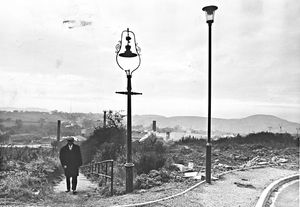
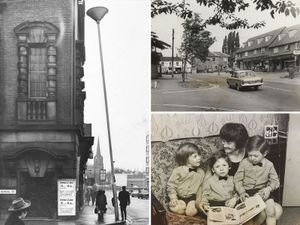
The Delph, Brierley Hill, November 1979. 'Side by side stand the old and the new...the "ancient" ornamental gas lamp and the sleek, highly practical modern electric light....Old Bill Wood (pictured), a former miner of these parts, seen on the steps, remembers well those shifts of darkness, but they are just stories to the new generation.'
The Delph, Brierley Hill, November 1969. 'Side by side stand the old and the new...the "ancient" ornamental gas lamp and the sleek, highly practical modern electric light....Old Bill Wood (pictured), a former miner of these parts, seen on the steps, remembers well those shifts of darkness, but they are just stories to the new generation.'
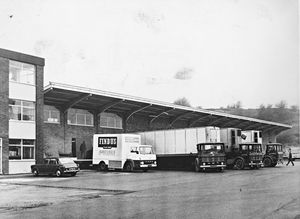
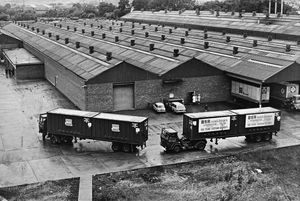
'The loading and unloading bay at Ashfords' new £130,000 cold store at Lowndes-road, Stourbridge.' Here we see three big refrigerated articulated trailers for delivering and importing frozen foods - April 1969.
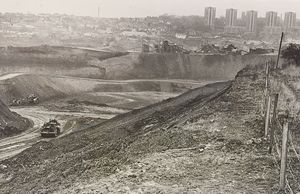
'The opencast working off Ambelcote-road, Brierley Hill' - February 6, 1969.
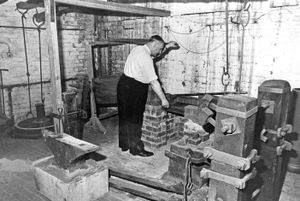
August 1969. The type of small forge used in nail-making and chain-making around the Black Country has been built in what was a metalwork room in Dudley Art Gallery. It has a brick hearth, an Oliver and hand anvils. When it is completed, people visiting the gallery will be able to see it in use.
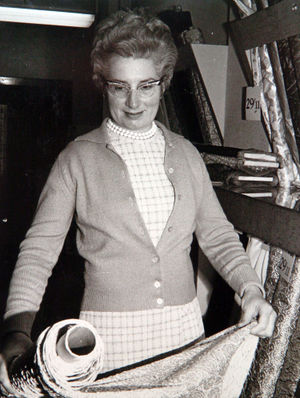
F.W. Cook department store which used to be in Dudley High Street. Pictured is Mrs Eldridge, who was manageress in 1969.
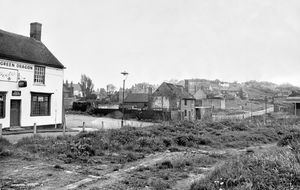
The Kates Hill area of Dudley in May 1969. The story begins: 'A Dudley trader is calling for a meeting to be arranged by the local council to explain redevelopment proposals for what he fears might become a 'ghost town.' He is sub-postmaster Mr W G Smallwood of Tansley Hill Road, Dudley, who has had a shop in St John's Road, Kates Hill, for 23 years. So far, he says, local traders have been neglected in that there has been no official information for them on the future of the area. Mr Smallwood, whose shop is one of five along that stretch of St John's Road, said that with demolition going on in the area it was 'more than an eyesore.' There was no sign of a start to redevelopment and he would like to have a meeting of all interested parties so that they could make their voices heard...' The pub on the left is the Green Dragon, a Joule's pub. According to a history website it was at 7 St John's Street (note discrepancy, story gives the name as St John's Road).
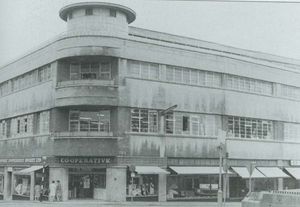
The improving co-operative store at the top of Dudley High Street in 1969
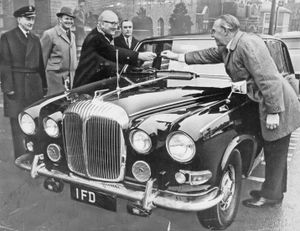
December 1969: Dudley's new mayoral car, an eight-seat, four-litre Daimler limousine - is handed over. But the mayor, Councillor Bill Henley, wasn't at the ceremony - he was in bed with flu. Instead, his deputy, Councillor Joe Rowley, received the keys from Mr J B Parker, group charman of P J Evans Ltd. Also in the picture are chauffeur Frank Hoffman (left) and next to him is town clerk Mr P D Wadsworth. Behind the car is Day and Mansell general manager Mr W B Clapcotet. Mr Rowley said later: 'It's a very nice job and not over-elaborate. It was an absolute necessity because the previous car was repeatedly breaking down and leaving the mayor stranded.' The cost of the new car: £5,000.
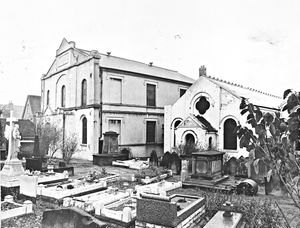
November 1969: 'Brierley Hill is to lose one of its landmarks - the Methodist church in Bank-street which has dominated the local landscape for 140 years... but a new Methodist church will be built on the same site.'
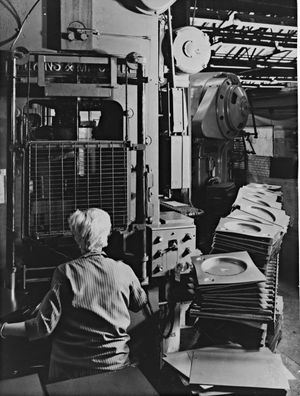
Birmingham Sound Reproducers (B.S.R.), record players, Stourbridge, June 1969. 'Main plates for the BSR record changer being produced at the Stourbridge factory.'
Freight containers carrying record changers leaving for Japan via Russia on the Trans-Siberian Railway - July 1969.
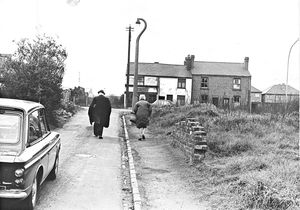
'Terrace-street, Hart's Hill, May 1969.
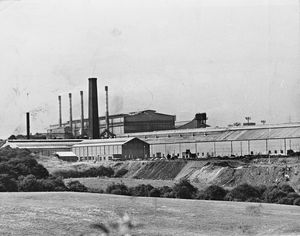
The Round Oak steelworks at Brierley Hill - a Black Country landmark, and now the centre of the latest major natural gas deal to be announced by the West Midlands Gas Board.'
July 1969: The Round Oak steelworks at Brierley Hill - a Black Country landmark, and now the centre of the latest major natural gas deal to be announced by the West Midlands Gas Board.'
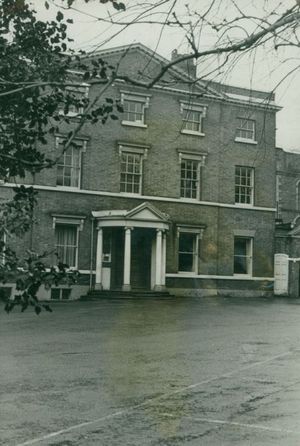
Members of an archaeological and historical society criticised plans to demolish an 18th Century Dudley building in May, 1969. The proposals were to replace the Dudley Conservative Club at Castle Hill, seen in this photograph, with what the group called an office block and showroom in a 'modern square box, glass and concrete' style. They claimed the building would be unsightly and spoil a pleasant aspect of Dudley Castle's grounds when viewed from the Birmingham Street bus station.
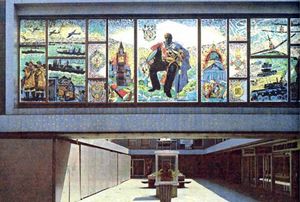
Dudley's new Churchill Precinct was a riot of colour when this photograph was taken in August, 13, 1969. The 39ft screen, in memory of Britain's wartime prime minister, was made of 17 pieces of glass at a cost of £10,000. The screen was removed when the precinct was converted into a covered shopping mall in the early 1990s.
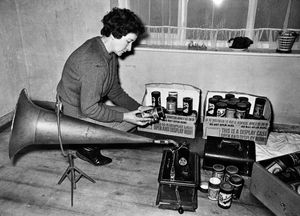
January 1969. 'We tasted the delightful magic of the phonogram on a rain-filled afternoon at Dudley. Thomas Edison in 1877 invented the first machine to record and reproduce sound and called it a phonogram. The machine we tried, at the home of Mr and Mrs J. Nock, of Garden Walk, Lower Gornal, was new at about the turn of the century and must have been the status symbol of its time... This is perhaps the first time this machine has been played in 40 to 50 years...' The story does not say who the lady on the picture is but it is Mrs Nock as written on the print is 'Mrs I. (sic) Nock and cylinder phonograph.'

Share your memories in the comments below...