40 years of the Merry Hill centre: How it has changed the face of the Black Country
Hand towels 99p each. Curtains £3.99 a yard. Pillowcases £2.50 a pair.
It was hardly the sale to end all post-Christmas sales.
But the people who turned out for cheap homewares at the Texstyle World sale, 40 years ago this week, were at the centre of something that - for better or worse - was about to shake the Black Country to its core.
The Merry Hill retail park did not exactly arrive with a fanfare. The first business, a branch of flat-pack furniture retailer MFI, had opened about October 1985. A few weeks later it was followed by Atlantis Electrical, Queensway furniture, and Texstyle World. By Christmas, Asda also had a branch there, but its advertising merely described it as being in 'Pedmore Road, Dudley', with no reference to the embryonic 'shopping city'. The opening of Halfords and B&Q followed, but even at that time there was little indication of what lay around the corner.
The story had begun some seven years earlier in the summer of 1978, when the then shadow treasury spokesman Geoffrey Howe delivered a speech in an East London pub. He told members of a think-tank about the need for a new approach to eradicating inner-city deprivation and unemployment. He suggested run-down areas such as London's Isle of Dogs, where he was giving his speech, should become 'Crown colonies' like Hong Kong, freed from state planning regulations and with a low-tax regime to stimulate enterprise. At this stage, this was little more than an intellectual debate, but two years later, when Howe was Chancellor of the Exchequer in Margaret Thatcher's Government, a slightly more nuanced version of the policy was announced.
The 'Crown colonies' would become 'enterprise zones', 11 strategically selected areas which would benefit from targeted government funding, a relaxed planning regime, no land taxes, and crucially, 10 years' free rates. The Government invited local authorities to propose suitable sites. Wolverhampton Council proposed the former Bilston Steelworks, while Dudley Council proposed the Blackbrook Valley. a 540-acre site including Merry Hill urban farm. On January 20, 1981, it was announced that Dudley would be the only enterprise zone in the West Midlands.
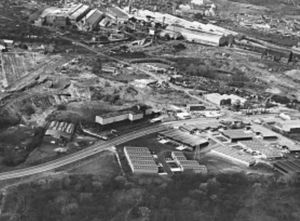
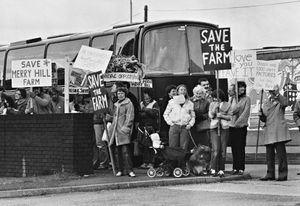
Industrial parks occupied by small and mid-sized works began to appear, but there was little sign of the manufacturing powerhouses the Government had hoped to attract. The Oldbury-based Richardson group, headed by twin brothers Don and Roy Richardson, acquired Merry Hill farm in 1983, sparking a 5,000-signature petition calling for the site to be preserved as a wildlife haven.