Suzuki's new Swift sets its sights on rivals
With the new Swift, Suzuki will take on the likes of the Skoda Fabia and Hyundai i20. Simon Davis gets behind the wheel to find out if it’s any good.
What’s new?
Suzuki is hoping that its new third-generation Swift will be something of a giant-slayer. With it, the Japanese firm is looking to break into the top-10 portion of the B-segment market, and has the likes of the Seat Ibiza, Skoda Fabia and Hyundai i20 set firmly in its sights.
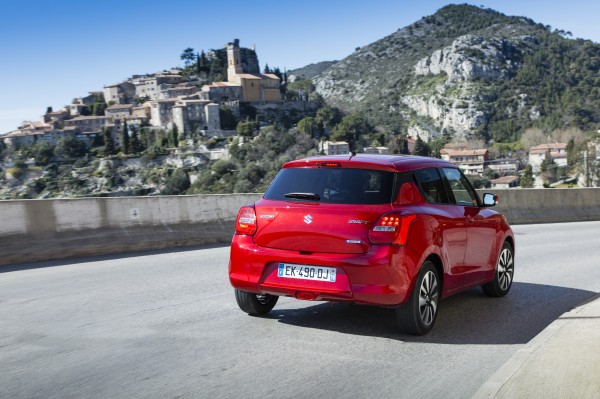
To give the refreshed and revised supermini a fighting chance, Suzuki has really gone to town on the new Swift. The 1.0-litre Boosterjet engine that first appeared in the Baleno and S-Cross is available for the first time, standard equipment levels have been improved and the Swift has lost a considerable 120kg in bodyweight.
Looks and image
When the first images of the new Swift were released, it wasn’t exactly met with a warm reception. To many, the character of the earlier models had been lost, leaving a rather sober-looking and soulless hatchback in their place.
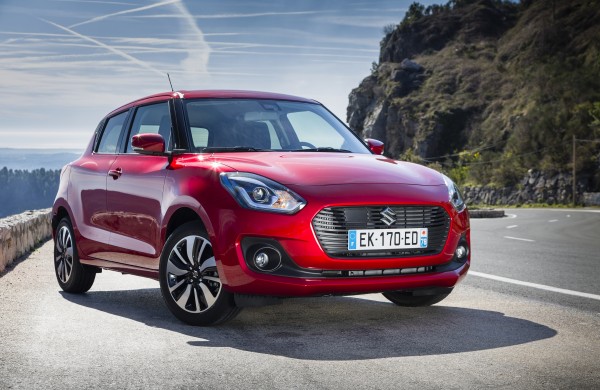
The good news is that in the metal, the Swift is a car that quickly grows on you. The more time you spend with it, the more you come to like its new aesthetic. While it might not be sort of car that tugs on your heartstrings and inspires on overwhelming sense of desire when you first cast your eyes upon it, it’s still an attractive little car.
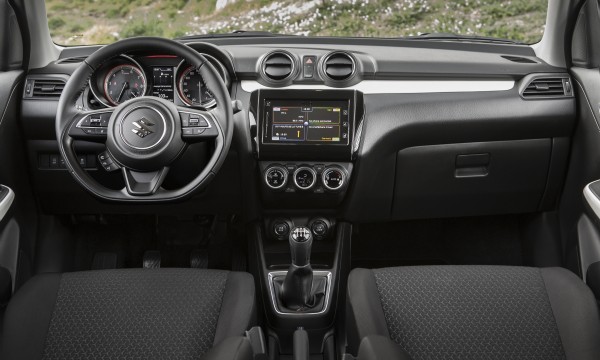
If you were to sum the feel of the Swift’s cabin up in one word, it would have to be ‘unpretentious’. It’s not the sort of car that’s gunning for the position of best in class as far as its interior is concerned, which means you can forgive the abundance of scratchy plastics that are used throughout.
Space and practicality
The Swift won’t be the subject of many complaints as far as interior space is concerned – particularly in the front. Headroom is plentiful, and while the Suzuki is a fairly compact little car, it certainly doesn’t feel cramped.
Family buyers will be pleased to hear that a similar theme continues in the back seats, too. Although the new Swift might be 10mm shorter than its predecessor, headroom has not been compromised in the rear, and adults will be able to sit in comfort even if they find themselves behind a taller front passenger.
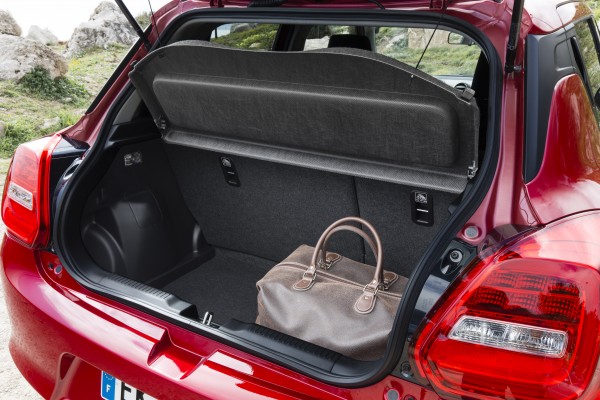
At 254 litres, boot space is hardly class leading, but it will easily swallow a couple of weekend bags and still leave a fair amount of space to spare.
What’s under the bonnet?
Suzuki offers the Swift with a choice of two different petrol engines. The first is the 1.0-litre, three-cylinder Boosterjet unit that has appeared in the likes of the Baleno and S-Cross and was fitted to our test car. In standard guise, it produces 110bhp and 170Nm of torque, and is capable of shifting the Suzuki from 0-60mph in a not-so-swift 10.4 seconds when paired with a manual transmission.
Our test car featured Suzuki’s ‘mild hybrid’ system, known as SHVS. This offers a slight – although barely noticeable – boost in performance over the regular engine, while fuel economy improves from 61.4mpg to 65.7mpg. CO2 emissions stand at 97g/km with SHVS, compared with the standard engine’s 104g/km.
While the Boosterjet is certainly a competent little motor, and does a good job of getting the Swift up to speed in a respectable fashion, under hard acceleration it does sound strained.
A larger 1.2-litre four-cylinder engine is also available with the Swift. It produces 89bhp and 120Nm of torque for a 0-60mph time of 11.7 seconds. This engine is also available with the SHVS system, which allows for CO2 emissions of 101g/km, while fuel economy stands at 62.8mpg on the combined cycle.
Behind the wheel
While the Swift is by no means a hugely powerful car, thanks to its small size and the fact that it weighs just 840kg, on a windy road it feels like a little go-kart. The steering is light and allows you to point the Swift where you want with ease, while the notchy five-speed manual has a purposeful feel to it.
There is a fair amount of body roll through the corners, but as far as grip is concerned, the Swift feels planted. Rough surfaces – which were fairly few and far between on the French roads we tested it on – can cause it to bounce around a bit, however, so it will be interesting to see how it copes on British tarmac.
The Swift was well-mannered on the motorway, and didn’t feel at all unstable at cruising speeds. While there was a fair amount of wind noise, it isn’t enough to make a long journey exhausting. In town, its small proportions made navigating tight, busy streets much easier, as did its light controls.
Value for money
Unfortunately, Suzuki is yet to announce the official prices for the new Swift range, which does make gauging it in terms of value for money a tad difficult.
Trim levels follow the typical Suzuki format – there’s the entry-level SZ3, followed by the SZ-T and the top-of-the-line SZ5. Base-spec cars benefit from standard equipment such as Bluetooth connectivity, DAB radio, daytime running lights, air conditioning and privacy glass, while SZ-T models add a rear-view camera, front fog lamps, 16-inch alloys and a smartphone link audio display. Suzuki is predicting that this mid-level model will be the most popular Swift variant in the UK.
Top-spec SZ5 models gain satellite navigation, automatic air conditioning, LED headlights, rear electric windows, adaptive cruise control and dual sensor brake support.
Who would buy one?
While Suzuki’s ideal Swift buyer seems to be young, trendy, urban-dwelling types, in reality this is a vehicle that has to appeal to people from all walks of life – particularly if Suzuki plans on it being included in the list of top-10 best-selling B-segment cars. Beginner drivers will appreciate its unintimidating character as well as the fact that it’s easy to operate, while family buyers will also find it to be a weapon on the school run front.
Verdict
Suzuki can consider the new Swift a job well done. It’s certainly not the most exciting car on the market, or the most luxurious, but there was something rather charming about its unpretentious, no-nonsense manner. The only things that remains to be seen now is how well it deals with British roads, and id Suzuki can get it right as far as pricing is concerned. If it does well on both fronts, the Swift is shaping up to be quite the success.
FACTS AT A GLANCE
Model: Suzuki Swift SZ5 1.0 Boosterjet SHVS
Price as tested: TBA
Engine: 1.0 Boosterjet SHVS
Power: 110bhp
Torque: 170Nm
Max speed: 121mph
0-60mph: 10.4 seconds
MPG: 65.7 combined
Emissions: 97g/km