Prototype Drive: The Volkswagen ID.Cross is a step in the right direction for the firm’s EV future
The ID.Cross forms part of the Volkswagen Group’s quartet of new EVs, and Cameron Richards has driven an early prototype version.
What is it?

The compact electric crossover market is bustling with choice and it’s set to get even more competitive.
Volkswagen Group is aiming to take over the affordable EV segment with the Cupra Raval, Skoda Epiq, Volkswagen ID.Polo, and now, the ID.Cross – a small electric family car that promises to offer lots of interior space, while going back to basics when it comes to usability, design and price.
So, is the ID.Cross a step in the right direction for Volkswagen? We’ve been to Amsterdam to drive an early prototype version to find out.
What’s new?

The ID.Cross sits on the Volkswagen Group’s new ‘MEB+’ platform, shared with the Cupra Raval, Skoda Epiq and Volkswagen ID.Polo.
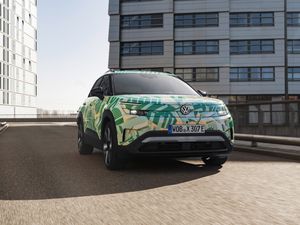
The exterior of the car uses the firm’s new ‘Pure Positive’ design language while the interior is taken from the ID.Polo – bringing back physical buttons and making the user experience more intuitive. Of course, our images show the car in camouflage – we’ll have to wait a little longer to see a fully uncovered version.
There will be a choice of battery packs with different power outputs and now, unlike other electric Volkswagens, the ID.Cross features a front-wheel drive setup.
What’s under the bonnet?

The ID.Cross will be available with two battery packs, consisting of 37kWh and 52kWh options.
We’re driving the larger 52kWh unit that is paired to a single electric motor to make 208bhp. Torque and 0-60mph figures are yet to be confirmed at this stage, though the car will reach a top speed of 99mph.
Volkswagen claims that this setup can travel 271 miles on a single charge and 105kW DC rapid-charging is compatible, allowing 10 to 80 per cent to be completed in 24 minutes.
The smaller 37kWh unit is available with 114bhp and 133bhp power outputs, while the manufacturer claims this model can travel up to 196 miles between trips to the plug and 90kW DC rapid-charging allows for a 10 to 80 per cent top-up to take 27 minutes.
What’s it like to drive?
First impressions of the ID.Cross reveals that it provides a smooth and comfortable driving experience – similar to the Skoda Epiq.
Around town, the car is easy to drive thanks to its nicely weighted steering and spritely acceleration courtesy of that electric motor.
The ID.Cross boasts Volkswagen’s latest ‘connected travel assist’ systems, which can automatically apply the car’s brakes when approaching a red traffic light.
There is also a one-pedal drive mode, which takes the strain out of stop-start city driving while the ride does a good job of managing to be supple without being too fidgety over uneven road surfaces.
How does it look?

Despite our test car’s camouflage look, the ID.Cross will utilise Volkswagen’s new ‘Pure Positive’ design language.
The manufacturer claims this new design gives a ‘friendly’ appearance with the ID.Cross featuring a double-stacked front headlight design, chunky lower-body mouldings, wheel arch extensions and roofbars for a more soft-roader rather than off-roader look.
The side profile also features what Volkswagen calls the ‘flying roof’ and C-pillars, which hark back to models such as the first-generation Golf and the firm’s Type One Bus from the 1950s.
At the back, there is an illuminated Volkswagen logo, a curved roof spoiler and LED taillights that wrap around the tailgate into the side profile.
What’s it like inside?

Our prototype test car has many covers obscuring lots of interior details before the final production car is revealed, though most of the dashboard design is lifted from the ID.Polo.
There is a two-spoke steering wheel with physical buttons, a centrally-mounted touchscreen system with further physical dials and even the internal door handles are flush-fitted into the door panel.
There is a customisable digital driver’s display where the dials can be transformed from a digital readout into a retro look that harks back to the original Golf hatchback.
In terms of space, there is a decent amount of storage with large door bins, a cutout under the floating centre console and cupholders.
Rear occupants will have plenty of leg and headroom, and the boot packs an impressive 435 litres of space, which is 50 litres more than the Volkswagen ID.3. The rear seats also fold down to make 1,340 litres of room while a 22-litre ‘frunk’ provides ample storage space for the charging cables.
What’s the spec like?

Prices and specifications for the UK market have not been revealed at this stage, although it’s anticipated that the range will start at around £24,000 and will rise to £37,000 for the 52kWh variant. That will put it on par with cars such as the Renault 4 in terms of value for money.
The ID.Cross is also available with a vehicle-to-load (V2L) function, which allows electrical appliances such as a hair dryer to be plugged in using the car’s battery. There will also be a vehicle-to-home (V2H) function, where electricity can be exchanged between the car and your home, turning the car into a mobile power supply.
Verdict
This early drive of Volkswagen’s ID.Cross shows a lot of hope for this compact electric SUV.
Its smooth powertrain, composed ride quality and intuitive interior design make this a strong contender next to the likes of the Renault 4 and its sister car, the Skoda Epiq.
It offers lots of space inside for occupants, and with a 475-litre boot capacity, it should be an easy car to live with.
It’s not the most exciting offering in this segment, but we’ll have to wait until the full-production car is revealed later this year for us to decide whether this is the benchmark model from Volkswagen Group’s quartet of new electric vehicles.