Prototype Drive: Skoda could be onto a winner with the new Epiq
The Epiq is Skoda’s B-segment electric crossover, and Cameron Richards has been to Portugal to drive an early prototype to see what it’s like.
What is it?

The Volkswagen Group is really stretching its legs in terms of compact EVs.
Last year, the European giant gave us a hint of what to expect from its brands in the next few years, and Skoda is about to kickstart its role in that strategy.
Introducing the Epiq, a compact crossover, designed to be an electric counterpart to the firm’s Kamiq SUV, and one that will sit on a completely new electric vehicle platform.
The Epiq will be going up against the Renault 4 and Kia EV2 when it arrives in showrooms at the beginning of next year. So, is Skoda going in the right direction with this new model? We’ve been given an early look via a prototype drive in Portugal to find out.
What’s new?

The Epiq is the first Skoda to sit on the Volkswagen Group’s ‘MEB+’ platform, which will share its underpinnings with cars such as the Volkswagen ID.Polo, Volkswagen ID.Cross and Cupra Raval.
Compared to the petrol-powered Kamiq, the Epiq is 10cm shorter and has a 47mm taller roofline, which is designed to maximise interior space, while still providing a compact exterior design.
The car will adopt Skoda’s ‘Modern Solid’ design language, which was first seen on the larger Elroq and Enyaq electric SUVs, while there will be a choice of battery packs and electric motors with several power outputs.
What’s under the bonnet?

We’re driving the ‘55’ model, which is hooked up to a 55kWh battery pack with a single electric motor. It develops a total of 208bhp and 290Nm of torque, while 60mph takes 7.2 seconds and the top speed is 99mph.
Skoda claims this model can travel up to 267 miles on a single charge, while 133kW DC rapid-charging is compatible, allowing for a 10 to 80 per cent top-up in 23 minutes.
The smaller 38.5kWh battery is available on ‘30’ and ‘40’ variants of the car, which produce power outputs of 114bhp and 132bhp, respectively. These models produce the same 267Nm of torque, and provide the same claimed range of 193 miles between trips to the plug.
What’s it like to drive?
First impressions of the Epiq are promising. Our test route consisted of narrow city streets and motorways, which felt like the little Skoda’s natural environment.
The car’s excellent blend of comfort and refinement will surely make it an ideal companion for longer trips, while the tight turning circle is useful when driving in town.
Our test car’s more powerful ‘55’ setup provides a smooth power delivery, and it has more than enough grunt at higher speeds.
The suspension also does a great job of ironing out the harshest of potholes and the two levels of regenerative braking allow for one-pedal driving in stop-start city driving, on the higher setting.
However, the car’s light steering does lack feel, which takes away the engagement you’d get from a Renault 4, making the Epiq not the most riveting car to drive in its prototype guise.
How does it look?

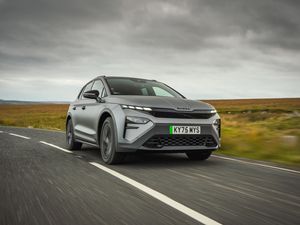
Despite our test car’s heavily camouflaged exterior, the Epiq will utilise Skoda’s ‘Modern Solid’ design language, with the front bumper featuring O-shaped air intakes, T-shaped front headlights and the firm’s ‘Tech-Deck’ front end.
Down the side profile, the car retains a bold stance with the brand-specific lettering featured on the C-pillars and thick plastic wheel arch claddings give it a more rugged look.
At the back, there are vertical T-shaped taillights, and the O-shaped air intakes make their way into the rear bumper, but are closed off.
What’s it like inside?

Just like its exterior, the interior of our test car is hiding lots of key design elements before the final production car is revealed.
We did get a good idea of what to expect, however, thanks to a 13-inch infotainment screen, a 5.3-inch digital driver’s display, physical shortcut buttons on the dashboard and plenty of cubby holes for storage. All of the car’s seat upholstery and plastics are made from recycled materials, too.
Space in the back is good as well, with the car’s flat floor making it more than manageable for three to sit abreast comfortably, the car’s taller roofline provides plenty of headroom and there is more than enough knee room.
The car’s standard 475-litre boot capacity is 75 litres larger than the one in the petrol-powered Kamiq, while the rear seats fold to extend that space to 1,344 litres. There are many practical Skoda features to complement the space, with a variable boot floor, a detachable bag for your charging cables and an ice scraper located in the boot lid.
As an option, the Epiq will be available with an 18-litre frunk, to give it even more flexibility when it comes to space.
What’s the spec like?

Prices and UK specifications have not been revealed at this stage, though it’s anticipated that the car will be on price parity with the firm’s Kamiq, which starts at just over £25,500.
At that price, that will put the Epiq inline with cars such as the Kia EV2, Fiat Grande Panda Electric and Renault 4.
In terms of equipment, all Epiqs will feature a digital driver’s display and the 13-inch infotainment screen, while there will be the option of a vehicle-to-load (V2L) function, allowing electrical appliances such as an air pump or even a coffee machine to be plugged in and powered using the car’s battery.
There will also be a vehicle-to-home (V2H) function, at an additional cost. This enables electricity to be exchanged between the car and a home, effectively turning the vehicle into a mobile power supply.
Verdict
To conclude, a prototype can only reveal so much about a car, although initially, we have high hopes for the Skoda Epiq.
Its composed driving dynamics, practical interior and clever use of space make this a hot contender in the overcrowded world of B-segment electric crossovers.
Once prices and specifications have been revealed, we will know if the Epiq is going to succeed in the UK. However, at first glance, it looks like Skoda could be onto a winner in this highly competitive market.