Army maid-of-all-work to a luxury off-roader
It's as American as Uncle Sam, but the name Jeep is an automotive icon the world over.
What began as a rather rushed solution to a wartime problem became so successful it effectively made the transition into civilian life and went from strength to strength creating a whole new segment in the motor industry – and this year marks its 75 th birthday.
It was originally intended as a light reconaissance vehicle, ordered by the US government in 1940 as World War II raged in Europe, but quickly became adept at a whole range of roles wherever the fighting took place, including the Russian front.
There are a number of theories about the origins of the Jeep name, the most common being a slurring of the designation GP or general purpose.
An individual Jeep was not expected to last more than two weeks in combat, but enough did survive to be lovingly restored and highly prized by enthusiasts and collectors today, with Shropshire at the hub of the preservation movement.
It was a bonus for Jeep enthusiast Adam Teecey, for example, that when it came to restoring his 1945 example that the main parts supplier is Jeeparts UK, based just a few miles from his home on the Atcham Industrial Estate.
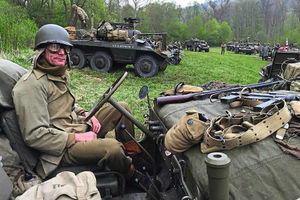
Adam, managing director of Fields Estate Agents in Shifnal, is a member of the living history group the 2nd Armoured in Europe, whose members keep a whole range of historic military vehicles from motorcycles to tanks on active service.
Dressed in period uniforms, and living the daily lives of 1940s servicemen, they attend numerous commemoration and remembrance events all over Europe.
"I'm not into army, or into guns, it is the history which is important," said Adam, whose last mission was a two week commemoration with the 2nd Armour in the Czech Republic. Based in Pilsen, they live as close as possible to WWII conditions as they toured towns and villages in the north of the country to an enthusiastic reception from the inhabitants.
Although the initial US Government contract was won, in the face of competition from 135 car makers, by Willys-Overland, it could not turn out enough vehicles to meet wartime demand.
Therefore production of the 650,000 which were eventually made was shared with Ford.
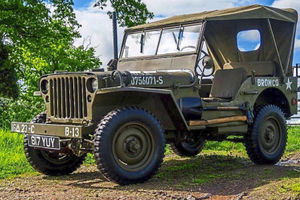
Adam's Jeep, 'Bronco' was one of the Ford-made examples although as it was made under licence it bears the original Willys-Overland badging. Adam is still researching the history of his particular Jeep, although it appears likely it did appear in the 2014 film Fury starring Brad Pitt: the 2nd Armoured is a vital resource for film producers in search of authentic historic vehicles.
Since owning the vehicle, Adam has had it professionally restored – including repairing the mistakes of previous preservation attempts – to make it a a truly authentic piece of automotive and military history. This includes a complete engine rebuild.
"I've spared no expense – after all, it is 71 years old – but it's running very nicely now," he said. It includes a genuine carbine holder (strategically fitted atop the dash for a rapid response by the driver if ambushed) and even an originally, Jeep-stamped hand pump for blowing up the tyres.
One drawback of a 71-year- old vehicle though is that the windscreen wipers are also hand operated – no electric motor!
The Jeep is powered by a 2.2 litre petrol engine with selectable four wheel drive and low range gears which, combined with its relatively light weight (under 600kg), contributed to its excellentoff-road performance.
While orginally intended as a light reconnaissance vehicle, the Jeep was the maid of all work in its wartime role, from towing trailers loaded with supplies to the front line, evacuating casualties, carrying senior officers and, despite its lack of armour, being equipped with a range of weapons in the attack role.
Its success, and popularity with the troops, meant that after the war Willys-Overland was quick to adapt it to civilian use, first with the Jeep CJ-2A (CJ for Civilian Jeep) designed mainly for farmers and the first modern, mass production off road vehicle.
This was followed very soon afterwards the Willys Wagon. This seven-seater passenger vehicle, with its versatility, practicality and (by 1949) four wheel drive, can be seen as the ancestor of the modern Sports Utility Vehicle which is the biggest-selling sector of the new car market.
It could be argued that the Jeep was also the inspiration for Britain's own Land Rover in 1947 – indeed, the prototype was built on a Jeep chassis and axles.
Jeep's history of innovation has continued with features such as Quadra-Trac, which offers three different four wheel drive modes automatically, according to road conditions, without the driver having to react. There is also the rear axle disconnect system, designed to save power and fuel when four wheel drive isn't needed.
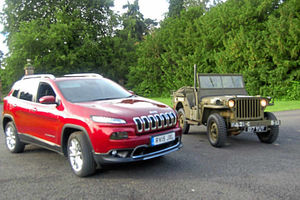
Today the company is part of the giant Fiat Chrysler Automobiles, and produces a range of cars – the Renegade, Wrangler, Cherokee and Grand Cherokee – which offer luxury, off-road excellence or both.
It's interesting to note that the latest engine to join the Cherokee range is, while the original 1941 model, a 2.2 litre unit. But it's diesel, not petrol, and produces 198bhp rather than 60.
And the windscreen wipers are electric as are so many other features which would have shocked those 1940s troopers such as heated and ventilated seats, air conditioning and a whole array of safety features and driving aids.