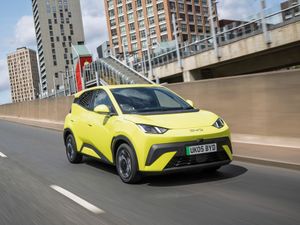
Big car refinement in grown up Corsa
Turbocharging is for hot hatchbacks driven by rally drivers or boy racers who wear their caps back to front – isn't it?
Well, turbos do mean extra performance by forcing more air into the cylinders but it's by no means a one way street to screaming acceleration.
Years ago Saab showed that by turbocharging an engine you could create big engine refinement and torque with a smaller, more economical and more tax efficient power plant.
It's a lesson Vauxhall has clearly taken to heart with its new more mature, more sophisticated Corsa.
The fifth generation of its top-selling model has been launched with a range of familiar but improved petrol and diesel engines plus two new three cylinder, 1-0 litre turbo units which you probably need to try to fully appreciate just what a leap forward they are.
Yes they're quicker but they're almost as economical as a diesel with 64.2mpg for the 90bhp version and 57.6mpg for the most sporty of the new range, the 115bhp model. So just the low tax ratings (and the cheaper cost per litre of fuel) make them worth a serious look.
Although not the only manufacturer to produce a small, three-cylinder turbo Vauxhall is the first to add a contra-rotating balancer shaft, which considerably reduces noise and vibration. A new and slick six-speed gearbox aid acceleration and more refinement for motorway cruising.
Considering the Corsa is now about the same size as, say, a Mark II Astra 0 to 62mph acceleration figures are more than respectable at 11.9 and 10.3 seconds respectively.
0 to 62mph in 10.3 seconds from a sub-1000cc engine in anything other than a go-kart? Never thought I'd see the day.
But it's the relaxed, refined nature of these power plants which is the real fruit of the engineers' work. They drive like a bigger engine, so the driver and passengers are more relaxed too. It's as if the car has grown up.
The proportions of the new car stay much the same as its predecessor, with generous cabin and boot space for this class. But the exterior styling has been sharpened up to give a more contemporary look, while the interior has been transformed with the latest digital displays, high quality materials and matching colour highlights.
And, starting from £8,995, the new Corsa is cheaper than its predecessor despite the improvements, and is priced to undercut its arch-rival the Ford Fiesta.
Another bonus is the improvements mean lower insurance rates for the new car – it has fallen between two and three rates depending on model because of the new front end, which is both better at absorbing impact and easier to repair.
As well as the two new engines, the Corsa range retains the 1.2 litre petrol engine, the 1.4 (either normally aspirated or turbo), and two quieter, new generation 1.3 litre diesels of 75 and 95bhp. The latter is the economy king of the range, capable of averaging more than 88mpg with a staggering low CO2 rating of 85g/km.
A stiffer chassis and the steering are all new, too. The new Corsa sits lower, for added stability and reduced body roll, and the suspension has been improved. The steering geometry has been improved to give the car a sharper response and more driver 'feel', particularly on sports versions which run on larger, 17-inch wheels.
The speed-sensitive power steering has a built-in 'city mode' to make light work of low speed manoeuvring and parking. All models are also equipped with hill start assist.
There are a raft of electronic options you can add too, such as parking sensors and/or a rear view camera, side blind spot alert, park assist, traffic sign recognition, lane departure warning, following distance indicator and forward collision warning.
Whereas the new Corsa retains the dimensions and some visual DNA from its predecessor, the interior has undergone a metamorphosis in terms of quality materials and styling. The soft-padded dash top sits above a completely new instrument panel and centre console, with clear dials and reduced clutter. The lower section is in a contrasting colour, while a colour coded infill panel runs horizontally across the centre.
It's much brighter and less staid than Vauxhalls of old, combining functionality with something of the funky flair you'd associate with French and Italian cars.
On seven of the nine trim levels, Corsa also gets the new Intellilink, first seen on its stablemate the Adam. It's controlled by the central touch screen and uses your smartphone apps for such things as navigation, global radio channels and podcasts.
The cheapest new Corsa, at £8,995, comes with the 1.2 litre four cylinder engine carried over from the previous model. With 70bhp, its official average is 52.3mpg with 126g/km of CO2.
The starting price for five-door models is £9,595 while the new 1.0 litre turbo, in 90bhp guise, starts at £10,995 in Sting R trim.
Basic equipment includes a heated windscreen (another first for the Corsa), electronic stability programme, hill start assist, six airbags, electric front windows, stereo radio and electrically adjustable door mirrors.
The Corsa was overdue a make-over: the previous model was introduced in 2006 although it has had a few nips and tucks since then.
It was still selling well – 83,000 last year – but with competition at its fiercest in the small car market and a raft of new and updated models benefitting from technical advances it was time to do something drastic. And now that's what Vauxhall has done.
While it keeps the Corsa name, virtually everything else is new (even the 'old' engines carried over from the fourth generation model have been made more efficient) and Vauxhall are confident it will go head to head with the best in class.
My choice would be one of the new ecoFlex turbo models, which combine impressive performance, economy and tax efficiency with big car refinement.
Just try one.
By John Griffiths