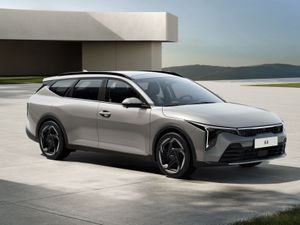
Chrysler enters Euro market
There is no shortage of competition in the European family car segment. Richard M Hammond tests Chrysler's new entry, the Sebring.
There is no shortage of competition in the European segment inhabited by models such as the Ford Mondeo, Toyota Avensis and VW Passat, despite those in the know warning that the market is rapidly shrinking.
Regardless, a piece of the big pie is still worth having, which is why Chrysler has opted to enter into the big arena with its new offering, the Sebring.
It makes sense. For a manufacturer with a relatively small following in the UK and that is continually trying to build up its presence and visibility to a well catered for audience it's daft not to have a stall in the main market place.
But getting a toehold on a crowded cliff face is not an easy task. Chrysler's chosen tactic is to offer something distinctive at a price that undercuts the opposition.
So, while the big names have been attempting to out-mundane each other in the quest for suburban driveway domination, Chrysler has been cooking up an individually styled saloon and then loading it with options to tempt customers into its dealerships.
Chrysler is also adamant about who the new Sebring is aimed at. If you're 55 or over, male, and in the market for a new saloon, you're on Chrysler's radar.
"Old man's car" is often used as a derogatory term, but the US manufacturer clearly believes there's a market for older drivers who are less enthusiastic about being branded with a run-of-the mill company car.
The Sebring certainly offers them something different, firstly in terms of its styling. It's not overtly American, more an American approach to a European saloon with squares and slabs of featureless panel actively avoided. It works from most angles and should attract forecourt attention much like the bigger 300C.
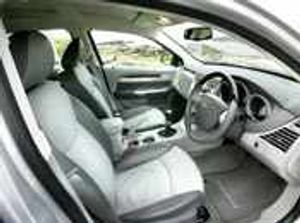
The Sebring isn't short on luxuries either. In the UK the model is only available in Limited guise, which means leather, automatic lights, tyre pressure monitoring, ESP, air con, time delay headlamps, and a heated and cooled drinks holder.
There's also the option of a multimedia system featuring sat nav, a 20GB hard drive, a USB port, a screen able to play movies and display images and a voice recorder complete with a microphone concealed in the rear view mirror.
The engine range is considerably more basic than the entertainment system. A two-litre petrol or two-litre diesel can be had with the five-speed (petrol) or six-speed (diesel) manual transmission, or there's the option of a 2.4-litre petrol automatic.
Although it produces 154bhp using variable valve timing and on paper is quicker to 62mph than the diesel, the 2.0-litre petrol unit feels underpowered in the Sebring and proves particularly flat when climbing.
The diesel is far more promising and, although just under a second slower than the petrol to 62mph, has a superior top speed, considerably more grunt uphill and requires less gear changing. Unsurprisingly, Chrysler expects the diesel unit to account for around 70 per cent of Sebring's sales.
The Sebring drives smoothly at a relaxed pace, but feels less secure when pushed harder. As a motorway cruiser it's comfortable even with the standard 18-inch wheels but engine and wind noise is an unfortunate and constant intrusion.
Chrysler isolated the suspension cross-members from the rest of the body to limit the road noise and vibration to good effect, but the suspension is clearly tuned for a more leisurely lifestyle and feels a little soft on twistier roads. The Sebring is unlikely to offer any surprises behind the wheel, unwanted or otherwise.
Chrysler needed a presence in the D-segment and that's what the Sebring gives them, although it does feel like a token gesture rather than a full-bore attack.
It's an adequate and well-equipped family car that lacks the pizzazz of the successful Crossfire or 300C, but offers a respectable, distinctive and grown-up alternative to the usual suspects.
By Richard M Hammond