Wolverhampton man fears relatives were on boat which capsized off Greek coast, killing at least 78
A Wolverhampton man fears his relatives were on a migrant boat which tragically capsized in Greece earlier this week, causing the deaths of at least 78 people.
The fishing boat was 'overcrowded' with passengers when it sunk in the early hours of Wednesday morning, 45 miles off the coast of Greece.
It is feared this could be the deadliest sinking ever recorded in the central Mediterranean.
So far, 104 people who were on board the boat travelling from Libya to Italy have been rescued.
However, the UN migration agency estimates that the vessel was carrying 700 to 750 people, including at least 40 children, based on interviews with survivors.
Aftab Khan from Wolverhampton flew to Greece as soon as he heard about the tragedy, fearing for three of his relatives.
Aftab told Sky News that three of his cousins had gone missing, and while one had been found alive, there were concerns for the other two.
The Wolverhampton man said: "We've found one relative and he's alive and we're not sure if there are still more.
"We basically don't know where the rest of them are at the moment. We're just trying to find out."
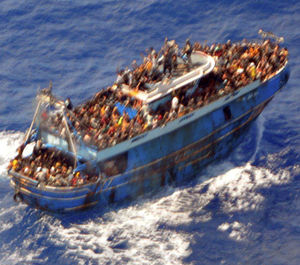
Rescue ships are currently fanning out in search of hundreds of people who are missing, but authorities fear that hundreds of passengers, including many women and children, may have been trapped below deck.
"The chances of finding (more survivors) are minimal," retired Greek coast guard Admiral Nikos Spanos told state-run ERT television.
Erasmia Roumana, head of a United Nations refugee agency delegation, said the survivors were in shock.
She said: "They want to get in touch with their families to tell them they are OK, and they keep asking about the missing. Many have friends and relatives unaccounted for."
Nine survivors have now been arrested on suspicion of belonging to the smuggling ring that arranged the voyage, the coast guard said. ERT TV said the suspects were all Egyptian nationals.
Mohamed Abdi Marwan, who spoke by phone from Kobani, a Kurdish majority town in north-eastern Syria, said five of his relatives were on the boat, including a 14-year-old.
Marwan said he has heard nothing about them since the vessel sank.
He also said that each of his relatives had paid 6,000 dollars for the trip.
He believes his nephew Ali Sheikhi, 29, is alive, after family members spotted him in photos of survivors, but that has not been confirmed.
Marwan said: "Those smugglers were supposed to only have 500 on the boat and now we hear there were 750.
"What is this? Are they cattle or humans? How can they do this?"
Greece has declared three days of mourning, and a Supreme Court prosecutor has now ordered an investigation into the tragedy.
Greek authorities said the vessel appeared to be sailing normally until shortly before it sank and that the ship declined repeated offers of rescue.
However, a network of activists said they received repeated distress calls from the vessel during the same time.
The Greek coast guard said it was notified of the boat's presence late Tuesday morning and observed by helicopter that it was "sailing on a steady course" at 6pm.
A little later, Greek search-and-rescue officials reached someone on the boat by satellite phone, who repeatedly said that passengers needed food and water but wanted to continue sailing to Italy.
Merchant ships delivered supplies and observed the vessel until early Wednesday morning, when the satellite phone user reported a problem with the engine.
About 40 minutes later, according to the coast guard statement, the migrant vessel suddenly began to rock violently and then sank.
Coast guard experts believe the boat may have run out of fuel or experienced engine trouble, with movement of passengers causing it to list and ultimately capsize.
Alarm Phone, a network of activists that provides a hotline for migrants in trouble, said the problems began much earlier in the day.
The network said it was contacted by people on the vessel asking for help shortly after 3pm. They said they "cannot survive the night".
Around 6.20pm, Alarm Phone wrote, migrants reported the vessel was not moving and that the captain had abandoned the ship on a small boat.
The two accounts could not immediately be reconciled.
Experts said maritime law would have required Greek authorities to attempt a rescue if the boat was unsafe, regardless of whether passengers requested it.
Search and rescue "is not a two-way contract. You don't need consent," retired Italian coast guard Admiral Vittorio Alessandro said.
An aerial photograph of the vessel before it sank released by Greek authorities showed people crammed on the deck.
Most were not wearing life jackets.
Overcrowding, a lack of life vests, or the absence of a captain would have all been reasons to intervene, Mr Alessandro said.