Plans to prepare former Saint-Gobain factory site for regeneration go on show
Plans to prepare a former factory site in Stafford for future regeneration are set to be submitted to Staffordshire County Council this month.
The former Saint-Gobain manufacturing site off Doxey Road is set to be transformed in the coming years to provide new housing and commercial space – but before this can take place, work is required to make the land ready for redevelopment.
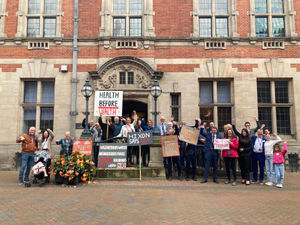
Staffordshire County Council, which acquired the land in 2018 as part of the Stafford Western Access Route (SWAR) project, will be putting forward a planning application for the enabling works in the coming weeks. On Friday (February 27) the authority hosted an information event at Doxey’s St Thomas and St Andrews’ Church for residents to find out more about the land reclamation scheme, which was attended by around 60 people.
Rebecca Wilson, economic growth project officer at Staffordshire County Council, said: “We’re sharing our plans to reclaim the site at Doxey from its former use. It’s about what we are doing to treat the land, to make it free from contamination, ready for a developer to come on board.
“We had a lot of ground investigation take place last year, to dig down and see how the ground conditions were, and the findings are being put forward. A lot of surveys – ground investigation, flood risk and ecology – have happened in preparation.
“We are doing a ‘Regulation 3’ application (to be determined by the county council, rather than Stafford Borough Council), because it made more sense to do it as a Regulation 3 matter to the county council. The longer-term plans for redevelopment will go to the borough council.”
It is hoped that planning permission will be secured later this year for the reclamation works. On-site works are due to start around the end of this year or in early 2027 and will include the realignment of the Doxey Drain that runs through the site, into an open watercourse.
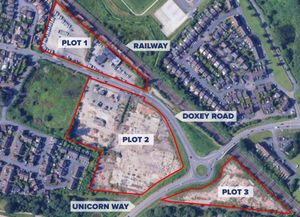
The site comprises three plots of land. Plot one, north of Doxey Road and approximately 0.9 hectares (2.2 acres) in size, is intended for light industrial use in the future. It was previously home to a car maintenance garage, which has since been relocated to a new site in Tollgate Drive, as well as being used as parking for community transport vehicles.
Plots two and three were previously occupied by industrial buildings, which were demolished in 2019, and are now earmarked for housing. Plot two, south of Doxey Road and north of Unicorn Way, is approximately three hectares (7.4 acres) in size, while plot three, to the southeast, is approximately 1.2 hectares (three acres).
All three plots are earmarked for redevelopment as part of the Stafford Station Gateway Project involving Stafford Borough Council and the county council. The borough council secured £20m from the Government’s Levelling Up Fund towards the scheme – and up to £16.5m of this will be used for the work at Doxey Road.
Ali Yeganeh, project manager at Staffordshire County Council, said: “The plot one surface is Tarmac. The factory operation site was on plots two and three and the surface is very thick – a 300-400mm reinforced concrete slab.
“We’ve got to get that out, which requires quite a lot of excavation of hard material surfacing, crushing the concrete chunks. Then you go down by another 600mm, so we excavate one metre.
“Whatever we get from the top layer will be mixed with whatever we find underneath and it becomes much better value land. Levels will be very much like for like.
“We have recently done a trial excavation and ground investigation and we found a lot of oil and hydrocarbon. The plan is, in phase one of the works we make sure that is taken out within the one metre so that contamination doesn’t reach the water table.
“There won’t be any drilling – the noisiest operation will be crushing and excavating the slab, crushing it into smaller pieces. In the trial excavation we carried out a couple of weeks ago, we replicated the work and put noise vibration and noise engineers on site and we have passed onto the contractor that they have to put management measures in to bring down noise and vibration.
“The work should take about 12 to 18 months. These type of schemes don’t come about very often.”