
MPs mark Staffordshire Day with special debate on county's contribution to nature's culture



An MP called on the Government to consider moving some of its cultural institutions from London to Staffordshire during a debate on the county's contribution to Britain's creative scene.
Sir Gavin Williamson made the call during a debate to celebrate Staffordshire Day, organised by Stafford MP Leigh Ingham.
MPs put aside their political rivalries as they celebrated their county's heritage during the Westminster Hall debate on the county's cultural contribution.
Sir Gavin, a former education secretary, said Staffordshire was a 'proper county', unlike the metropolitan creations of the 1970s such as the West Midlands, Merseyside and Humberside.

"It was forged in the Anglo-Saxon era when Queen Aethelflaed, the Lady of the Mercians, created the forts in Tamworth and Stafford. We forget that that was part of Staffordshire, as was Wednesbury, because what we see as the Black Country was all part of a great historical county of Staffordshire."
He asked government whip Vicky Foxcroft to approach Sir Chris Bryant, minister for creative industries, arts and tourism, about bringing some of Britain's cultural institutions out of London to places such as Staffordshire. Miss Foxcroft said she would take back his request to the minister.
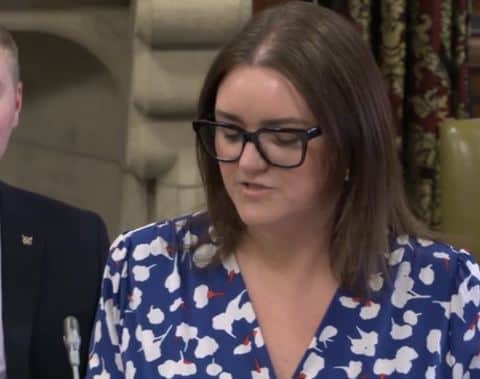
Miss Ingham said Staffordshire was a county where culture was carved in clay, sung on local stages and carried proudly in the stories of its people.
"Its legacy is rich and alive, and today I rise to champion our region and its contribution," she told the debate.
She said Stafford town centre was crucial to the county's history, and praised the Soup Kitchen cafe, which dated back to the 16th century, and the historic churches of St Mary’s and St Chad’s.
"People can take in the interior and exterior of the Ancient High House, which is haunted by a ghost called George and is known for being the largest surviving timber-framed townhouse in England," she added. "We also have Stafford castle, which has dominated the skyline in Stafford for over 900 years.
"There is the Stafford Gatehouse theatre, famous for its Shakespeare festival and for its hilarious pantomimes every Christmas, which bring audiences from across the county to Stafford.
"The Gatehouse also provides a space for actors, artists and writers to hone their craft with its hugely popular youth theatre."
Mike Wood, MP for Kingswinford and South Staffordshire, said Swindon forge produced the wrought iron that drove the early Industrial Revolution in the 17th century.
He told how the Gunpowder Plotters fled through Himley Woods in 1605, and said Kinver's rock houses were a testament to the resourcefulness of past generations, as well as a major tourist attraction.
Josh Newbury, MP for Cannock Chase, spoke of his sadness at this week's closure of the Prince of Wales, describing it as 'the cornerstone of our local cultural life'.
He said he hoped it would reopen soon.
"We have also, with great sadness, seen the Museum of Cannock Chase close its doors," he added.
"Such venues are not just buildings but homes for local talent, heritage and the collective memory of our communities. Thousands of schoolchildren have come through their doors to experience the rich heritage of our area; they leave with a sense of pride in where they are from, inspired to shape its future."
Mr Newbury said he was supporting two charitable groups that had been working non-stop for the last six months to reopen these venues.
"Staffordshire’s cultural contributions are about not just the past but the future that we want to build: a future where our children can grow their creativity in schools, local groups, grassroots museums, and on stages big and small. "
Comment Guidelines
Iconic Media encourages reader discussion on our stories. User feedback, insights and back-and-forth exchanges add a rich layer of context to reporting. Please review our Community Guidelines before commenting.