Held at gunpoint by guerillas, and locked up by customs: E&S man's Afghan adventure with just £4,000 and a suitcase
Express & Star legend Tony Bishop has written a new book looking back on his 65 years in journalism. In the first of three features, Mark Andrews looks back at his adventures in Soviet-occupied Afghanistan
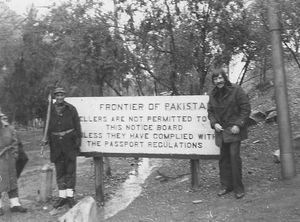
Tony Bishop describes stumbling his way across a dimly lit courtyard on the border between Afghanistan and Pakistan.
Sign up to our free newsletter today
"Suddenly a Sten gun barrel was pointing at my chest," he says.
"A muffled voice said 'Press?', so I nodded, and handed over my security pass. He had seen it all before, I was just another on the well-trodden journalistic trail in downtown Peshawar.
Days earlier, on a wintry afternoon in Wolverhampton, Bishop was summoned to the editor's office to discuss a foreign trip.
"A few weeks in the sun would be rather pleasant," he mused to himself. In January 1980, the rebel British colony of Rhodesia was in the process of acquiring independence to become Zimbabwe, so a nice couple of weeks in Africa sounded quite alluring.
His initial reaction when asked about how he felt travelling unaccompanied to a war zone was that his boss was having a joke, but he quickly realised he wasn't.
Insurance was out of the question, the father-of-two was told in a matter-of-fact fashion. But should he come to any harm, the Express & Star would 'look after the family'.
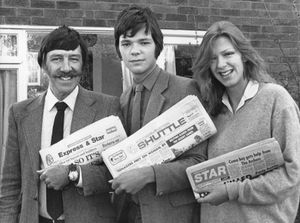
Bishop's adventure in the badlands of the Middle East is just one of the escapades outlined in his new book, Deadlines and Destiny, which chronicles a colourful career spanning 65 years, the majority of it writing for the Express & Star. Bishop, now 91, from Hartlebury, retired in 2016, and on his last day in court, a barrister likened the occasion to the ravens leaving the Tower of London.
Today, such a trip would probably mean being embedded with the Army on an organised visit, accompanied by fellow journalists and English-speaking press officers. In 1980 it meant taking a notepad, a plane ticket to Pakistan, and a small suitcase and £4,000 in travellers' cheques to a place he had only seen on television.
"The idea was to reach the Pakistan border, step into Afghanistan, and then file copy," he says. "The idiocy of this suggestion dawned on me when I reached the border. Apart from the impossibility of scaling the barbed wire and razor wire entanglements, there was the formidable task of evading the armed guards."
The solution, he concluded was to buy a traditional hat and mingle with chicken-carrying locals on the 'Silver Bullet' bus service into Kabul, which was allowed safe passage because of the aid that Pakistan was giving to refugees.
"We were advised to avoid the Afghan bus, which was often shot at by tribesman," he says.
'Safe passage' turned out to be a relative concept though, with even the bus driver reluctant to make the journey past the burned-out German lorries and the deadly cliff-edges. It was only the even scarier prospect of a crowd of angry passengers that persuaded the man to reluctantly step into the cab.
While the Afghan guerillas actually turned out to be quite friendly once the formality of the security checks were out the way, he recalls award-winning war correspondent Robert Fisk, then with The Times, was less welcoming.
"I was regarded as a 'spook', a spy, for a time by the other journalists," he says. "They felt the authorities had sent in someone to keep an eye on the Press and to report what we were doing."
Fisk asked Bishop which paper he was from.
"I deliberately replied, in a broad Black Country accent, 'the Express & Star, Wolverhampton'.
"'Bloody hell, we shall have the Exchange & Mart out here soon,' he spluttered."
The route out of Kabul, would be even more eventful, when he cadged a lift with a British lorry driver who managed to overturn his 32-ton vehicle while distracted on a deadly mountain road road. As they pondered what to do next, before darkness fell and the area became taken over by anarchy as the police finished their shift for the night, a friendly customs official took pity on them as he drove past. The staff at his hotel in Pakistan could scarcely believe his good fortune in surviving the journey.
He returned to the hotel on his 45th birthday, where the manager and chef presented him with a cake to mark the occasion. The gesture touched him so much that he even forgave the pair for an upset stomach caused by the hotel catering.
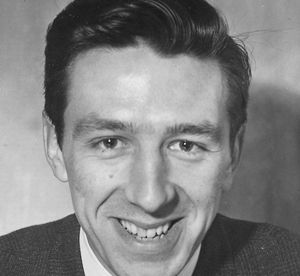
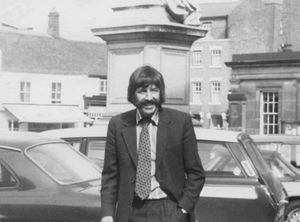
Bishop's handlebar moustache, which he originally grew for an Edwardian fancy-dress ball, meant he was easily recognised everywhere he went. But even he was surprised to be greeted by a tall, dark stranger, as he prepared for the flight home.
"Are you from England," asked the man. When Bishop replied that he was, the man asked if he knew Lye.
"I think I have seen you a the mosque," he replied. The man turned out to be a former Pakistani ambassador to Birmingham, who had seen Bishop attending meetings at the mosque in Lye High Street, remembering him from his distinctive moustache.
"Thereafter, when I returned home, people from Lye always asked for the 'moustache man' when they came to the office."
Not that his return flight home went entirely smoothly. At the start of his stay, struggling to make contact with the newspaper's head office in Wolverhampton, Bishop headed into a town called Dara, which he likened to the Wild West of the United States, 'a main street flanked by gun shops where customers were allowed to fire into the air, or at the nearest wall'.
"I was invited into several shops, served with green tea, and pressured to buy," he said. "Eventually I agreed on a pen gun."
Intending to give it as a souvenir for his son, Chris, he left it in his inside pocket, and forgot about it until he was searched and seized at customs.
"My passport was confiscated, and I was thrown into a cell," he says.
"Sometime later, it seemed like hours, a senior customs officer arrived to grill me. From the papers he had seized, he deduced that I was a British journalist. I confessed that I have visited a gunsmiths in Dara, and bought the pen as a souvenir. He announced that he would be confiscating it, and dismissed my argument that it could be handed to the pilot, for return at the end of the flight.
"I didn't argue too much, in case he searched my case, and found a 0.22 bullet hidden in a sock."