New student flats in Birmingham city centre refused amid concerns over 'incremental impact' of development
Major proposals to build a student accommodation block have been refused amid fears over the potential impact on historic city centre buildings.
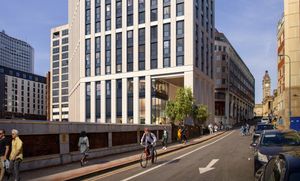
Developers were seeking permission for a 16-storey building with 263 student bed spaces at the former site of the old Golden Eagle pub.
Those behind the proposed scheme said it would respect the site’s history and provide an array of economic, social and environmental benefits.
But last month, members of Birmingham Council’s planning committee remained uneasy amid heritage concerns and ultimately voted to refuse the proposals.
A council report had previously acknowledged that the plans could cause “less than substantial/low level” harm to buildings such as the Town Hall and the former General Post Office.
Ahead of a meeting on Thursday (December 18), a council officer argued there were “enough public benefits to outweigh that [heritage] harm, including a demonstrated need for purpose-build student accommodation".
They also said the applicant had sought the legal advice of a barrister who advised that the judgement of ‘less than substantial’ harm is “entirely appropriate”.
But the proposed development still failed to win over councillors at Thursday’s planning meeting.
“My position has remained unchanged on this matter,” Councillor Gareth Moore said. “There’s clear heritage harm [and] there isn’t a need for more student accommodation.
“The city is not awash with homeless students therefore we should actually focus on what the genuine housing need of this city is.
“As [the proposal] is for purpose-built student accommodation, that does not outweigh the heritage harm.”
Councillor Philip Davis said: “Although you might say the impact [on heritage] here in minimal, the incremental impact is the concern.
“That’s how the local environment is degraded, particularly for heritage assets.
“When you go to New York, what you see are heritage buildings totally enclosed by massive skyscrapers.
“I’m not saying we’re on the verge of that yet in Birmingham but the problem is the absence of a proper framework to manage that.”
But Councillor Lee Marsham, chair of the planning committee, argued: “This is a brownfield site next to a train station – if we’re not going to build here, where are we going to build?”
A council officer told the meeting that they had considered accumulative impacts but continued: “The way that planning system operates is that we have to consider the impact of this application as it sits before us.”
But the planning committee went on to refuse the plans after taking a vote.
‘Enough benefits to outweigh the harm’
A council report previously acknowledged that the ‘designated heritage assets’ hold historic significance.
“The less than substantial harm which would be caused to their significance by the development is considered by conservation colleagues to reach low levels in all cases,” it said.
“In my view, I consider there are enough benefits associated with this proposal to outweigh the heritage harm.”
A council officer also previously confirmed that the developers had demonstrated a need for student accommodation.
“We have to consider what’s in front of us,” he said last month. “We can’t theorise about whether a residential scheme would or wouldn’t be viable.
“This scheme, when it came to us, was 45 storeys tall and the scheme in front of you now is very much led by minimising as much as we possibly can to a point where we still have a viable scheme.
“Yes, there is heritage harm […] and officers have been mindful of that all the way through this.”
The report also said the scheme would contribute “towards the regeneration aspirations for this part of the city centre”.