Midlands Air Ambulance talks about strong service provision and providing high service of care after taking part in national survey
The region's Air Ambulance charity has spoken about the scale of service it can provide after a national study showed the differences in services across the country.
The Midlands Air Ambulance Charity joined the 20 other services across the country in being audited by experts from Barts and The London School of Medicine and Dentistry, Barts Health NHS Trust and Imperial College London.
All 21 services responded to a survey about the care they provide, marking the first audit since 2009.
The researchers found services providing “consistent 24/7 physician-based pre-hospital teams” increased from one in 2009 to 11 in 2024, with the East of England having the highest 24/7 availability, with Northern Ireland, South West England and northern England the least.
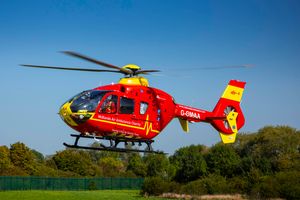
Richard Apps, Head of Strategic Partnerships & Service Development at Midlands Air Ambulance spoke about the services the charity provided and the work its crews did.
He said: "Midlands Air Ambulance Charity is now in its 35th year and our service has developed significantly over this time.
"We operate three helicopters, covering the counties of Staffordshire, Shropshire, West Midlands, Worcestershire, Herefordshire and Gloucestershire, and provide secondary cover to areas beyond this.
"The charity is rated ‘Outstanding’ by the Care Quality Commission (CQC) following inspections its three airbases.
"We operate 24/7, by helicopter during the day, and by critical care car overnight, from strategically located airbases at Cosford, on the Shropshire/West Midlands border, Tatenhill in Staffordshire, and Strensham Services on the M5 near the Gloucestershire/Worcestershire border.
"From 2025 we commenced daylight tracking, where we extend our flying hours during the spring and summer months to maximise our response by air.
"Our resources are manned by experienced Critical Care Paramedics and Pre-hospital Emergency Medicine (PHEM) Doctors (predominantly Consultants in Emergency medicine or Anaesthetics, many of which have the sub speciality of PHEM).
The researchers also found that variation persists between which procedures and interventions the services can offer.
Nine in 10 (90 per cent) of services offered blood transfusions, with just one offering “resuscitative balloon occlusion of the aorta”, a procedure which reduces severe bleeding and stabilises blood pressure.
The authors wrote: “There has been an increase in the number of physician-based HEMS teams compared with 2009 but significant variation remains.
“There has been an improvement since 2009 with 11 physician-based teams available 24/7 compared with only one in 2009.
“However, even within this provision, variation exists in terms of interventions provided such as the provision of blood products or regional anaesthesia.”
Meanwhile, separate research published in the same journal found that air ambulance support means patients are more likely to survive a serious injury.
They found that air ambulance care is linked with saving five more lives than would be expected in every 100 major trauma cases.
This equates to 115 additional lives saved each year, based on the numbers who are cared for by the service, the authors said.
The research team said the greatest effect on survival was among severely injured patients with “moderate survival probability”.
Richard Apps said the Midlands Air Ambulance Charity had processes and procedures in place to provide a large range of treatments.
He said: "The range of equipment, skills and knowledge available to our crews enable them to provide treatments ranging from prehospital emergency anaesthesia (PHEA), administration of blood products and surgical interventions including emergency hysteromy.
"We are committed to providing the highest standards of care and can provide most treatments mentioned within this audit.
"We continually review our operational model, to ensure we optimise the care and treatment provided to our patients to give them the best chances of survival and recovery."
Helicopter emergency medical services (HEMS), also known as air ambulances, are dispatched via NHS ambulance services to the most unwell medical and trauma patients.
The majority of air ambulances operating in Britain rely on charitable donations for funding.
“So it is reasonable to expect some ongoing variation between services,” experts wrote in the Emergency Medical Journal.
Services in Wales, Scotland and Northern Ireland are completely or partially given government funding.
In England, six out of 19 services received partial government funding and none were fully funded.