Could under--threat Dudley clinic be the start of a PFI timebomb for the NHS? This is what minister Kinnock says
The Health Secretary beamed as she cut the ribbon on the gleaming, £10 million new health centre, the local MP was as proud as punch too.
The new building, with its airy atrium was in a different league to the small, 1960s clinic it had replaced. It also included a new library, which again was a big upgrade on the single-storey, flat-roofed building that went before. Back in 2001, the Ladies' Walk Centre in Sedgley, epitomised Tony Blair's vision of a National Health Service fit for the 20th century. And best of all, the initial cost to the taxpayer was miniscule.
Sign up to our free newsletter today
If a week is a long time in politics, a quarter of a century seems like another world. Today, the future of the clinic and health centre hangs in the balance, as the NHS and Dudley Council attempt to renegotiate a lease. More than 200 people packed out last month's public meeting in the parish church, about 1,600 have signed a petition calling for the centre to be saved. Conspiracy theories about the future of the building have spread like wildfire in the meantime.
But looking further afield from the unassuming commuter village on the fringes of Dudley, the real question may be - could this be the tip of the iceberg?
At the turn of the century, the Private Finance Initiative was all the rage, seen as the silver bullet to generate massive investment in health infrastructure. NHS buildings such as hospitals and clinics were handed over to private developers, who would invest hundreds of millions of pounds, and then lease them back to the NHS on long-term contracts. In many cases the support services, such as cleaning and maintenance staff, were also contracted out, leading to a confrontation with public sector union Unison. In Dudley, veteran Labour councillor Jack Wilson warned that this would be a 'gravy train' for building companies, but his voice was very much in the minority. The Blairite consensus was that PFI deals were essential to attract the type of investment that the Treasury could not provide.
The questions about the future of the Ladies Walk Centre surfaced late last year, when it was revealed that the 25-year lease on the library would come to an end in 2026, and that the council had failed to come to an agreement with owner Aviva about an extension. A few months later it emerged that the clinic was leased on similar terms, and was similarly at risk.

The burning question is how many public buildings built under PFI schemes in the early 2000s, could be facing similar fate?
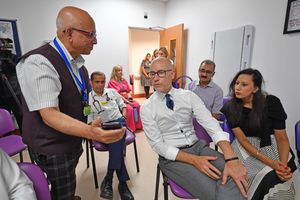
Back in Dudley, health minister Stephen Kinnock is visiting Russells Hall Hospital, where he is being shown how advances in AI are transforming the way strokes are diagnosed and how children can be treated in the home. He is joined by new Dudley MP Sonia Kumar, who has been campaigning to keep Ladies Walk open, and has presented a 1,600 -signature petition to Speaker Sir Lindsay Hoyle.
Russells Hall, which originally opened in 1984, itself underwent a massive expansion in the early 2000s as part of a controversial PFI scheme which led to a 10-month strike by Unison members. Given that the hospital is on a 40-year lease, its future should be assured for the next 16 years - but does Mr Kinnock fear this is going to be a growing headache for the NHS in years to come?
"We absolutely have to be vigilant," he says. "It is an issue we need to be really across, and make sure that we've got support in place for each of those clinics or health centres, wherever it might be.

"But I am confident that we've got a strategy in place now, with a team in the Department of Health and Social Care, that is looking at using public private partnerships as the model for supporting both in terms of current infrastructure, and making sure that they can roll over from their current financing arrangements to the new ones."
PFI contracts were formally abolished by then chancellor Philip Hammond in 2018, who claimed they had left the Government with a £200 billion bill. By that time the deals had been in sharp decline for some years, having hit a peak in 2004.
Mr Hammond said in his 2018 budget speech: "I remain committed to the use of public-private partnership where it delivers value for the taxpayer and genuinely transfers risk to the private sector, but there is compelling evidence that the private finance initiative does neither."
Mr Kinnock, too says some form of public-private partnership will be necessary to secure the type of funding that the NHS requires.
"I think it's really important that we are ready to work in terms of long-term capital investment with the private sector, because there is no way that the entire renovation of the NHS infrastructure can be done purely on the basis of what the public sector can put in," he says.
"There needs to be a partnership. We need to crowd private-sector investment and that needs to be done on a partnership basis.
"As soon as all the dust has settled on a comprehensive spending review, and we've got our clear financial envelope, there's a team that's going to be working on or looking at all kinds of financial models."
He says the Government has increased the NHS infrastructure budget by £1.8 billion for the current financial year.
"That is going to be a really important tool that we're going to use to start to bring more private-sector money into the infrastructure investments that we need."
That is all about future investment, though. The question remains about whether the Ladies Walk Centre is just an unfortunate outlier - or whether it could mark the beginning of a ticking timebomb, as more and more of these contracts expire.