'Hundreds of appointments cancelled' at Wolverhampton NHS trust amid resident doctors strikes
There were hundreds of appointment cancellations, including a large number of operations, as resident doctors downed tools on the first of five days of strike action.
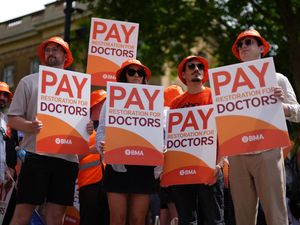
Hospitals across the West Midlands were forced to put in contingency measures to cover a disruption to services after resident doctors, formerly known as junior doctors, went on strike over a pay dispute with the Government.
The Government awarded doctors a 5.4 per cent pay rise for this financial year, but the British Medical Association (BMA), which organised the walkout, said wages were still about 20 per cent lower in real terms than in 2008.
The walkout by resident doctors began at 7am on Friday and is set to last until 7am on Wednesday (July 30).
The Royal Wolverhampton NHS Trust told the BBC there had been 236 appointment cancellations for patients, 110 of which were operations, at New Cross Hospital in Wolverhampton and Cannock Chase Hospital.
The trust had urged patients and people with appointments to follow advice published on its website, while consultants and senior doctors were covering for resident doctors.
Dr Brian McCaig, chief medical officer at the trust, told the BBC they had been through a number of strikes before and the hospital needed to prioritise emergency medical care.
He said: "In terms of planning, we need to first of all prioritise urgent and emergency care and obviously time critical work, such as cancer work and priority operations.
"Once we've been able to cover those, we then see what activity we can continue with but inevitably, with the industrial action we do need to cancel some activity."
Simon Constable, chief executive of University Hospitals North Midlands said: “We would like to reassure our patients that, despite industrial action, urgent and emergency services will continue to operate and we have done all we can to maintain as much planned care as possible.
"It is vital that anyone who is seriously ill or injured, or whose life may be at risk, continues to seek medical help as normal.
“Every effort has and will continue to be made to minimise the impact of strike action but it is inevitable there will be some disruption.
We have had to rearrange some appointments where necessary to ensure we can prioritise urgent and emergency care and any of our urgent planned care.
"We are asking patients to attend their appointments as planned if they have not been contacted by us directly.”
Diane Wake, group chief executive at Sandwell and West Birmingham NHS Trust and Dudley Group NHS Foundation Trust which covers Russells Hall and Midland Metropolitan University Hospital said: “We have plans in place to provide a safe service for patients requiring emergency care and continue with urgent planned care during the industrial action by resident doctors.
"Patients should keep their appointments unless we have contacted them to rearrange. In a small number of cases, we have rescheduled clinics to see patients quickly following the strike.
“Our staff are pulling together in the interests of our patients to provide safe care during the next five days, and we will be reviewing activity on a regular basis throughout this period so we can respond appropriately.
"To help us continue to treat those who need emergency care, please get advice on where to get help through NHS111 as a first port of call, or 999 and A&E in an emergency.”
Labour's health secretary Wes Streeting said the NHS was facing a challenging few days during the doctors strike in England as it attempts to keep as many services as possible running.
Mr Streeting said that while it was not possible to eliminate disruption from the five-day strike by resident doctors, it was being kept to a minimum.