Futuristic new unit opens at New Cross Hospital
It houses arguably the world's most expensive "sushi bar" and a drinks machine from the future, as well as a room so secure it was approved by MI5 experts.
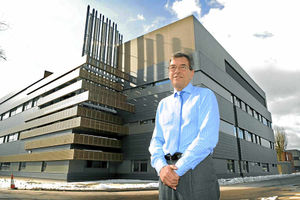
Welcome to New Cross Hospital's new £16million pathology building, which officially opens this week.
The state-of-the-art department is better than anything in Europe, health chiefs claim, and will reduce patient waiting times by a third as they wait for blood and other samples to be analysed.
Four separate pathology departments have been condensed into one large, eco-friendly, three-storey building which has been designed to tailor perfectly for the needs of its 120 staff.
And it could be worth £50m to the Royal Wolverhampton NHS Trust if a contract for the GP pathology workload for the entire West Midlands – for which the trust is competing against private firms – is secured.
Overseeing the move into the new department is services manager Graham Danks, a New Cross veteran of 29 years.
He said there were a huge amount of benefits which patients and staff would all feel.
"I can't emphasise enough that the equipment here is of the highest possible standard," Mr Danks said.
"We've almost created our own independent pathology business unit here – it's up there with the very best in Europe."
The building is split into three colour-coded floors (everything from doors to furniture and even vacuum cleaners are the same colour), which are all connected via a hoist system which can transport samples up and down the levels.
And a special pneumatic chute connects every single building in the hospital – samples take three minutes to come in from A&E. First up is the haematology section – for blood and clotting disorders – which is appropriately coloured red.
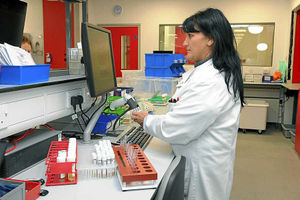
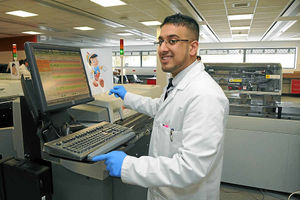
Here, all specimens and samples are brought in and loaded onto a sushi bar-style moving conveyor belt – worth a cool £1.5m – and from this point they're not touched by a human hand again.
Tests will be done for metabolic disorders, diabetes and hormones via the aid of machines named after Disney characters so the staff can remember them easily.
But aside from the modern technology, the key aspect of the efficient unit is the reduction in waiting times for patients.
Before, it would take an average of 90 minutes to give patients results from analysed blood samples – that will now take around an hour.
Mr Danks added: "Fifty per cent of the workload we do here is hospital-based and patients will get their results far quicker.
"By integrating into one department we've shaved 35 minutes off the waiting time. It's a significant saving, especially when you're trying to discharge patients as quickly as possible." The blue-coloured second floor is home to microbiology (germs) analysis.
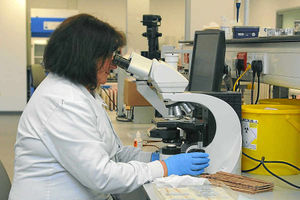
Tests for norovirus, hepatitis, HIV, chlamydia and cervical cancer are taken and analysed in sophisticated machines costing hundreds of thousands of pounds.
One such £150,000 mass spec machine, which looks exactly like a drinks vending machine, sees laser beams fire at bacteria, which is broken into particles and what's left is then detected.
This process would previously have taken 24 hours but it's been cut to a few minutes.
Also on the microbiology floor is a separate room specially designed to test for dangerous contagious diseases such as anthrax or tuberculosis. The room was tested by advisers from MI5 to make it as secure as possible and is surrounded by reinforced doors and walls.
The final green floor specialises in cancer diagnosis. Samples from tumours, biopsies and tissue taken from surgery and are cut up and prepared for consultants to analyse.
Ninety-five per cent of samples will be tested within five days and a tissue room with two processors costing £70,000 each will reduce analysis time down to four to five hours, instead of overnight.
Mr Danks said: "We're reduced the amount of time it takes to diagnose cancers by two to three days. The national target is 62 days and we're already under it."
Work from Walsall's Manor Hospital has been secured for the £16m pathology building.