A television for under 50p? Don't get too excited, because there are a number of snags.
A Wolverhampton television fan created bargain priced set - but the picture was rubbish
The picture is rubbish, you can't access any programmes, and we are talking 1933 prices.
Nevertheless, in this 100th anniversary year of John Logie Baird's demonstration of a working television, let's celebrate the enthusiasm and innovation of George Jones of Wolverhampton, an early television fan who created a TV set for a bargain price of just 8 shillings and six pence.
For perspective, at the time a telly would set you back around £26, the equivalent of the region of £2,000 in modern money.
Baird had taken the world into the television age with a mechanical system, using a rotating disc, and Mr Jones, who lived at 8 Rosebery Street, followed in his footsteps as he conducted his own experiments to see how cheaply he could build a set.

His results were demonstrated to an Express and Star correspondent called "Valcrys" and written up in the paper on August 3, 1933.
Unfortunately we haven't got a photo of George, but we can bring you the picture of his contraption which was used in the paper at the time. The quality isn't very good, but at least it's better than the reception from his TV.
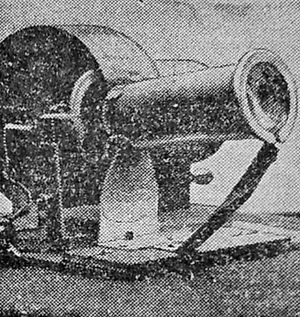
Valcrys reported: "The scanning drum is the bottom of an old picnic kettle, with holes punched at appropriate points. This is driven by a clockwork motor which cost 3s. 6d.
"The neon is of the flat plate tell-tale type (2s. 6d.), and the lenses are two cycle lamp fronts (6d. each). The rest of the materials are bits and pieces from the ‘junk box’.
"I have had a demonstration with this apparatus. The results are definitely crude, mainly because of difficulty in retaining the scanning drum at a constant and suitable speed, but now and again pictures are received which are recognisable.

"In any case, Mr Jones did not devise the apparatus with the idea of perfection, and he has achieved all that he set out to do by getting the results he does.
"Incidentally he is at present engaged constructing his own television apparatus of the latest mirror drum type, and, with the possibility of television transmissions from the new Droitwich station, he is hoping for some excellent results."
George Wilmot Jones, who was recorded in the 1921 census as being an electro technical mechanic who worked for the H H Spike electrical, mechanical and technical store in Queen Street and King Street, Wolverhampton, had taken an interest in radio, and then television, from the outset.
Baird had demonstrated his television to scientists in London on January 26, 1926, and experimental programmes were broadcast from 1929. His set, called the Televisor, became commercially available, costing around £26.
The BBC started broadcasting television using his system in 1932, and on November 2, 1936, launched a regular service broadcast from Alexandra Palace to the London area using both Baird's system, and the Marconi-EMI electronic system. The latter was clearly much better, and Baird's system was dropped after three months.
Wartime saw the television service suspended, being resumed in June 1946, although sets remained very expensive and not many people could get a signal anyway as there was only one transmitter, broadcasting from London.
Some fantastical ideas were put forward to extend coverage - one was to have a transmitter mast over a mile high in north London, another was to have an aerial supported by a massive hydrogen balloon.
The most practical answer was to have transmitters across the country and on December 17, 1949, the first regional transmitter, at Sutton Coldfield, became operational, making the service available to a further nine million potential viewers. For Shropshire and the West Midlands, television had finally arrived.