Severn Trent Water's latest water levels as reserves near half empty amid continued drought
Water levels at Severn Trent's reservoirs continue to decline as the 2025 dry spell continues across the country.
Severn Trent's maximum reservoir capacity is 247,708 million litres, but the latest data shows the reservoirs are holding 132,680 million litres - just 53.6 per cent of their maximum capacity.
It's the lowest point the company's water storage capacity has reached since at least January 2023 - when the records begin online.
The lowest point last year saw water levels reach 69.7 per cent in September 2024, and 76.7 per cent the year before.
The record low comes as provisional statistics from the Met Office show that summer 2025 will ‘almost certainly’ be the warmest summer on record for the UK - following what was the driest spring in over 50 years.
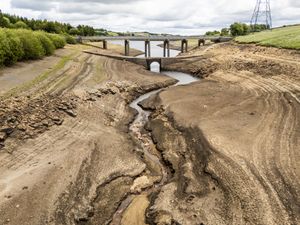
While temperatures have been a little cooler over the last couple of weeks, dry conditions have continued, with England seeing only 1mm of rainfall in the week end August 21.
Over the next few days, it does look like the weather could turn, with the Met Office predicting "changeable and unsettled weather conditions" will bring showers or longer spells of rain across the majority of the country.
But whether or not it will be enough to officially take the West Midlands out of 'drought' status is yet to be seen.
Below is the latest list of Severn Trent's reservoirs and their water storage level:
Elan Valley
The Elan Valley Reservoirs in Wales were at 47.6 per cent of capacity when the latest recording was taken. The reservoirs had 47,402 ML of water, out of a possible whopping 99,500 ML.
Ogston
The reservoir in Derbyshire was at 64.4 per cent of capacity when the latest recording was taken. The reservoir had 3,896 ML out of a possible 6,050 ML.
Tittesworth
The reservoir in Leek, Staffordshire was at 46.1 per cent of capacity on August 18. The reservoir had 2,969 ML of water out of a possible 6,440 ML.
Draycote Water
The reservoir in Warwickshire was at 80.6 per cent of capacity when the latest data was retrieved - the highest figure at any of Severn Trent's reservoirs.
The reservoir had 18,538 ML of water out of a possible 23,000 ML.
Derwent Valley
Severn Trent has three reservoirs at Derwent Valley in Derbyshire. Overall capacity of the three was 43.6 per cent on Monday, August 18 with 20,193 ML of water out of a possible 46,345 ML.
The three reservoirs are:
Howden at 24.9 per cent capacity
Derwent at 42.1 per cent capacity
Ladybower at 50.1 per cent capacity
Carsington Water
Carsington Water is a reservoir operated by Severn Trent in Derbyshire that takes water from the River Derwent.
Carsington Water in Derbyshire was at 59.1 per cent of capacity. The reservoir had 20,193 ML of water out of a possible 36,331 ML.
Dove
The two reservoirs in the Peak District in Derbyshire were at a combined storage level of 66.4 per cent on Monday, August 18. The reservoirs had 13,182 ML of water out of a possible 19,845 ML.
One, Foremark, was at 67.6 per cent capacity, while the other, Staunton, was at 64.1 per cent capacity.
Charnwood Water
The reservoirs in Loughborough were at 31.3 per cent of capacity when the latest recording was taken. The reservoirs had just 1,489 ML of water out of a possible 6,229 ML.
Charnwood includes readings from Swithland (27.9 per cent) and Cropston (34.3 per cent).
Bartley/Frankley
The reservoirs in Birmingham were at 75.4 per cent capacity. The reservoirs had 2,473 ML of water out of a possible 3,281 ML.
Whitacre Combined
The reservoirs had a combined capacity of 49.3 per cent when the latest recording was taken on August 18. The reservoirs had 1,066 ML of water out of a possible 2,160 ML.
Severn Trent's Clywedog Reservoir in Wales is excluded from the company's total water storage capacity as it is not directly used for water supplies, but figures are still published.
The reservoir was at 70 per cent capacity on August 18. The reservoir had 34,955 ML of water out of a possible 49,936 ML.