D-Day June 6: Dawn - 7.30am, Omaha and Utah beaches
The Americans took the western beaches, codenamed Omaha and Utah. Utah fell miraculously easily, with barely a dozen killed by enemy action and about 60 drowned.
But 'Bloody Omaha' was another story. Swept by machine-gun fire and overlooked by gun emplacements on high ground to left and right, Omaha Beach became a three-mile killing field where more than 1,000 Americans perished.
Few Brits had any idea what was going on at Omaha.
One of the few was Arthur Weston, of Oldbury, a 23-year-old radio operator on a wooden motor launch.
As he watched thousands of Americans advancing towards the maelstrom, he was amazed and horrified: "My estimation of the Yanks had been pretty low. But seeing them going in, up the beaches, climbing the cliffs, advancing under a hail of machine-gun fire, my opinion changed dramatically. Some of the Americans fell and stayed down, but the green wave of men carried on. I think they should all have had medals as big as dustbin lids."
At one stage the battle-hardened German defenders reported that they had driven the Americans back into the sea at Omaha. Not so.
As one US colonel told his boys cowering behind the sea wall: "The only people on this beach are the dead and those who are going to die. Now let's get the hell out of here!"
In countless displays of individual courage, young Americans simply got up, crossed the sea wall and moved forward into the gunfire. Sheer guts and relentless shellfire from Allied ships, some coming dangerously close to shore, drove the Germans back.
Sailor Ken Marcham had a grandstand view as the Omaha tragedy unfolded. German guns and mortars tore the American forces apart in scenes later recreated in the movie Saving Private Ryan.
Watching the nightmare from a mile or more at sea were the Royal Navy ships which had escorted the vast US armada. "We could only go so far in because of running aground," recalls Mr Marcham at his home in Bloxwich.
"As the troop carriers went in, we could see some of the lads being seasick. It looked as though they dropped their ramps too soon and, with all those heavy packs, the lads didn't stand a chance. A lot of them drowned. It was a shame to see them going in. They were only kids, like us. I thought it was going to be a disaster."
But as crews in the Allied fleet realised what was happening, they closed on the shore and let fly with every gun on board.
"We blazed away. There were Oerlikon cannons and pom-poms and I'd never seen our four-inch gun so hot. I thought the barrel would melt."
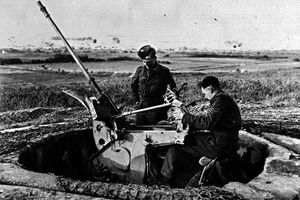
As the navy gunners hammered the German positions, the American troops finally blasted their way through the defences and poured inland.
Landing-craft Coxswain Len Evans, from Wednesbury, recalled the bizarre sight of a French torpedo boat playing The Marseillaise at full blast as he piloted his landing craft into the beach and delivered his cargo of troops: "Some were hit straight away and fell back into the sea. Some were no more than eighteen as I was. One poor lad who had been clearing beach mines floated past us with a perfect hole through his face."
Overloaded with casualties on the return trip, Mr Evans's craft sank beneath him.
The next thing he recalls was being in a casualty station at Southampton. Photographed by the news-hungry local press, he was hailed the next day as the first Midlander to be wounded in D-Day.
Arthur Lloyd, of Wednesfield, was a tank-landing-craft crewman and a veteran of the Sicily and Italian landings. He recalled seasickness among the soldiers as the craft approached the beaches: "A sergeant was having trouble with one of his lads. So we gave him a tot of rum – better than the doctor – and I believe he was first up the beach."
Len Whitehouse, of Bilston, landed on Gold Beach just after 7am amid a scene of dead and dying. "It was just after we got on to the beach, I remember seeing my first dead soldier. That really did knock me back."
The 23-year-old lorry driver with an infantry support unit recalls a fairly straightforward run in to the beach.
"I am still grateful to the person who piloted the landing craft. Some of the landing craft didn't make it in close enough and unloaded men and machines too far from the beach. But our chap got through all of the obstructions and everything and got us right to the beach – I didn't even get my wheels wet. I still don't know who he was but I am grateful to him to this day.
"We grouped up and moved away from the beach to a field area where we were to unload to establish this airstrip. There was a lot of flak flying around but the first few hours were fairly peaceful for us, and our platoon came through all right. There were a few Germans in some woodland near the field but they mainly seemed to be young lads. To be honest I felt a little sorry for them, they looked so down when they were captured. They didn't look like they had much spirit left in them."
David Hall, of Walsall, was a 19-year-old Marine piloting a landing craft full of men into Sword Beach early on D-Day.
"We had a real problem getting the boat down into the water from the HMS Glenearn because it was a very rough day.
"At one point it was hanging on the rear hook because the front had been lowered down and the craft, full of soldiers and equipment, was tipping forward. We had to wait for a wave to come up so we could get the back in the water as well. I turned round and saw that the LCT (landing craft) next to ours had caught it," recalled Mr Hall.
"I got to the beach and was told that my cousin, who was on another landing craft, had caught it as well, although I didn't see him, and that really did knock me back. I got the troops and equipment off the boat and was supposed to go back to the ship to collect another load, but it wouldn't go. So I ended up stuck there on the beach.
"I still get flashbacks and I don't like to recall what I saw there. All I know is that I am here and all my mates are dead and there is no way for me to explain how that feels, what it is like to really hate yourself for being alive."