Birmingham vs Black Country: How industry built two proud but different cultures
Dr Steve McCabe takes a look at the proud differences between the Black Country and Birmingham
In ‘The Canterville Ghost', a humorous short story written by Oscar Wilde and published in February 1887, includes the line "We have really everything in common with America nowadays except, of course, language."
I’m reminded of this in considering the supposed differences that exist between Birmingham and the Black Country, most especially in terms of their citizens.
Whilst language, which I’ll consider shortly, and, of course, culture, are vitally important when considering what constitutes the essence of people, the geographical and/or resources that attracted inhabitants to a particular location must also be recognised.
Like Birmingham, the dominant city in the West Midlands region, what we accept to be the Black Country is widely accepted to be largely defined by the 30-foot seam of coal which is close to or, indeed, comes to the surface.
As such, this would include West Bromwich, Coseley, Oldbury, Blackheath, Cradley Heath, Old Hill, Bilston, Dudley, Tipton, Wednesbury, and parts of Halesowen, Walsall and Smethwick (formerly Warley).
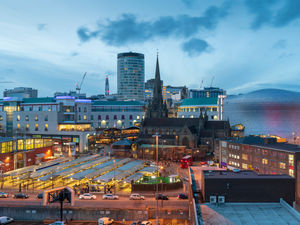
Wolverhampton, which gained city status in 2000, is considered to be in the Black Country precisely because of its critical influence on the trade and industry resulting from the industrial revolution.
The Industrial Revolution, the origins of which are due to the invention of the steam engine using coal –what is known as ‘Newcomen Engine’ was constructed near Dudley in 1712 to pump water from coal mines belonging to Lord Dudley – utterly defines the history of the Black Country.
From the latter part of the 1700s, the abundance of coal as well as iron deposits became the vital elements of the generation of products and wealth that was to ensure employment and growth in the area for the next two centuries.
However, production of coal, coke (made by heating coal in the absence of air), iron, glass, bricks and steel produced high levels of soot and air pollution which, unsurprisingly, made everything, including, all too frequently, people, look dirty and black and led to the area’s name.
The first use of ‘Black Country’ was in the Staffordshire Advertiser as a consequence of the town clerk to Lichfield who, when addressing a Reformer's meeting on 24th November, described a visit he’d made to the "black country" of Staffordshire, Wolverhampton, Bilston and Tipton.
It’s notable that Gavin Jones writing in the Black Country Bugle in April 2013, describes a travelogue originally published in 1860 in which the author explains that the expression ‘Black Country’ as it’s "eminently descriptive, for blackness everywhere prevails; the ground is black, the atmosphere is black, and the underground is honeycombed by mining galleries stretching in utter blackness for many a league."
Equally notably, Elihu Burritt, the American Consul to Birmingham in 1862, described what he saw in the Black Country as “Black by day and red by night.”
This attests to the fact that demand for products made in the Black Country, such as locks for security, nails, chains of all sorts – including those for the Titanic manufactured in Netherton by N. Hingley & Sons Ltd in Netherton – fire clay products, and enamelware was so intense that production continued late into the evening.
Easy access to clay allowed bricks to be produced which, given the rate of building required for housing for workers and new factories springing up, were much in demand.
To be fair, Birmingham at a similar time would not have looked that much cleaner as it was also burning prodigious amounts of coal and its vast number of factories would have been producing equally noxious fumes and pollution.
I’ve seen pictures taken in the centre of Birmingham in the early 1960s looking towards the suburbs clearly showing a grey haze over the inner city in which the majority of factories were located.
Factories in both Birmingham and the Black Country created ‘magnets’ drawing in those in search of regular employment that was viewed as a preferable alternative to the seasonal and subsistence income from ‘working the land’.
Pointedly, towns in the Black Country and Birmingham developed rapidly as demand for products being produced increased exponentially; the experiences of the vast majority of citizens occurred separately.
Whilst the arrival of trains made travel much easier, for most workers in either place, six-day working and the mandatory requirement to attend church on a Sunday meant that there was little time or inclination to travel.
Remember, though The Bank Holidays Act 1871 created the right for workers to have such days off; most workers had to do so without pay.
The right of workers to be able to have one week's holiday with pay only commenced with the passing of Holidays with Pay Act 1938.
Consequently, any mixing between the vast majority of citizens of either Birmingham or the Black Country was so limited as to mean that entirely separate cultures flourished.
And as any sociologist will contend, a major part of culture is language.
As Laura Clark explains in ‘Birmingham vs. Black Country Dialects’
“While Birmingham and the Black Country are geographically close, their dialects exhibit distinct characteristics that reflect their unique histories and cultural identities. Both dialects enrich the linguistic diversity of the West Midlands, offering a fascinating glimpse into the region’s cultural tapestry.”
There are, she continues, pronunciation differences whereby Brummies tend to make the letter r non-rhotic and i is often “oy” whereas those in the Black Country retain the letter r (making it rhotic).
Clark believes Black Country speech to frequently be characterised by being “broader and more rounded compared to Brummie.”
Fascinatingly, she states her view that there is a difference between citizens of Birmingham and the Black Country in intonation and rhythm; the former tending to have a downward inflection making “statements sound like questions to non-locals” and the latter speaking in a way that’s “more musical [when] compared to the Brummie accent, giving it a unique cadence that stands out even within the West Midlands.”
Of course, words or expressions used in each area provide a very useful indicator of which part of the West Midlands the person speaking is from.
Once again Clark explains that though both are characterised by the tendency to drop consonants.
So, according to her, Brummies drop the g from words ending in ing and those from The Black Country have a tendency to drop the h from words beginning with this letter.