Rare George Cross awarded to Wolverhampton war hero who cleared Blitz mines up for auction
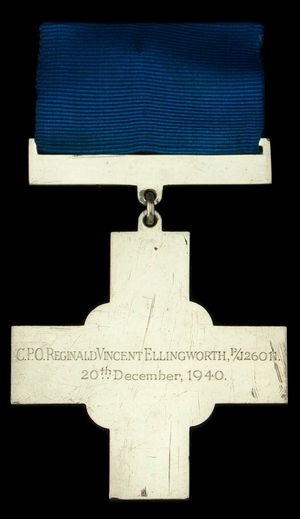
A rare George Cross awarded to a war hero who was killed as he disarmed a mine dropped during the Blitz is to be auctioned for thousands of pounds.
Navy sailor Chief Petty Officer Reginald Vincent Ellingworth, a First World War veteran, was killed on September 21, 1940, alongside Lieutenant-Commander Richard John Hammersley Ryan, as the pair attempted to defuse a parachute mine which had fallen in Dagenham, East London.
The mine exploded and killed both men as they tried to extract its fuse.Former apprentice car body-maker Ellingworth, born in Wolverhampton, was aged 42 and Ryan, from Rotherham, South Yorkshire, was 37.
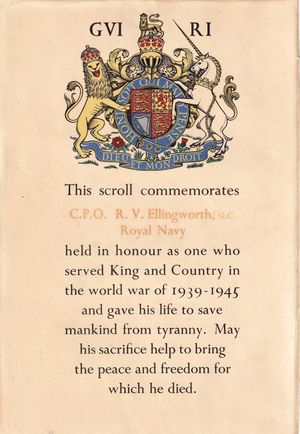
The pair were posthumously awarded the George Cross in December 1940, “for great gallantry and undaunted devotion to duty”.
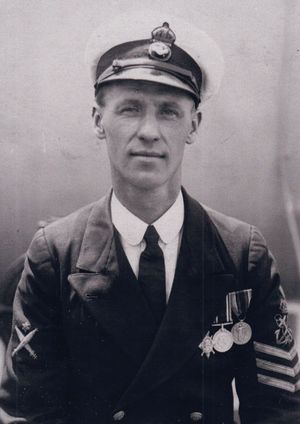
With the award, Ellingworth became the first naval rating – a junior enlisted sailor – to directly receive the prestigious George Cross.
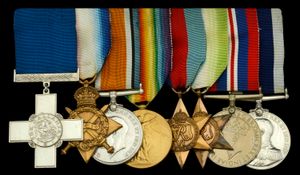
On February 11, his award will be auctioned at Noonans, in Mayfair, as part of a set of eight, with an estimated purchase price of £60,000 to £80,000.
His other awards, being sold by his great grandson and great granddaughter, include those he received in the First World War.
The lot includes his George Cross, a 1914-15 Star, British War and Victory Medals, a 1939-45 Star, Atlantic Star, War Medal 1939-45, and a Royal Navy Long Service & Good Conduct medal.
Christopher Mellor-Hill, of Noonans, said: “A protégé of the pioneering parachute mine disposal specialist Lieutenant-Commander R. J. H. Ryan, G.C., R.N., he helped render safe just such devices, including the "First ‘C’ Type, the whole at a time when preferred expertise and knowledge were at a minimum.
“Nonetheless, on approaching a challenging parachute mine at Dagenham on 21 September 1940, an eyewitness saw the pair of them ‘upright, striding confidently’ towards the entrance of the building from which it was dangling from the roof.
“Shortly afterwards, as they commenced work on extracting the fuse, it sprang into action, the resultant explosion causing instantaneous death and destruction.”
Recalling his last meeting with his father, Donald Ellingworth said: “At the time I was 20 and in the Royal Corps of Signals, so I saw my father only during my infrequent leaves home to Portsmouth
.“But I distinctly remember our last conversation. It was July 1940 and I had turned up after Dunkirk, where, in the chaotic evacuation, I had been posted ‘Missing, Believed Lost in Action’.
“My father must have been relieved to see me because he gave me an enormous hug. I was a little taken back. It certainly broke the ice and, for the first time, we spoke man-to-man as we shared a pint and our experiences.
“I talked of France while he discussed the daily dangers he encountered. ‘One thing is certain, son,’ he warned me: ‘If anything does go wrong, I won’t know anything about it.’
“I had never felt closer to my father and when we parted, I left with a heavy heart. With German bombs dropping over England, I realised it was only a matter of time before his selfless courage would cost him his life.
"Seven weeks later he was killed.”
Ellingworth was buried at Milton Cemetery, in Portsmouth.His Commonwealth War Graves Commission headstone bears the following epitaph: “In Everlasting Memory of our Beloved, Killed by Enemy Action. Duty Nobly Done.’
”The George Cross is a rare award with only circa 160 directly awarded (some 244 have been exchanged for Empire Gallantry, Albert and Edward Medals as these awards no longer exist), according to the Royal Signals Museum website.