Watch as first of three canal boats left stranded in Midlands canal breach refloated
One of the three canal boats that were left stranded following the collapse of a canal embankment has been refloated and has rejoined the Llangollen Canal.
The narrowboat Pacemaker was left hanging precariously over the precipice of a 50-metre-long hole following a disaster along the Llangollen Canal in Whitchurch, Shropshire, on Monday, December 22.
In the early hours, a breach in the canal embankment in the Chemistry area of Whitchurch saw millions of gallons of water from more than 30 kilometres of canal pour out into neighbouring fields.
For the boats moored nearby, the result was devastating: two boats were completely washed into the hole created by the breach alongside Pacemaker, which was just a couple of feet away from the same fate.
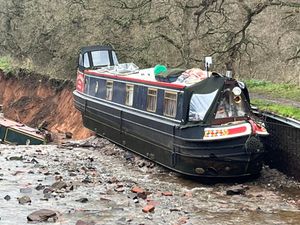
Pacemaker's owner, Paul Stowe and his family had been left with nothing but the clothes on their backs when they escaped their floating home, barefoot, in the early hours of Monday, December 22.
On Christmas Eve, Pacemaker was winched out of the immediate breach area and away from danger.
Three weeks later, on Tuesday (January 13), Paul joined staff from the Canal & River Trust and various contractors and rescue services as they pulled the boat further away from the breach and installed a series of dams around the boat to create a small marina.
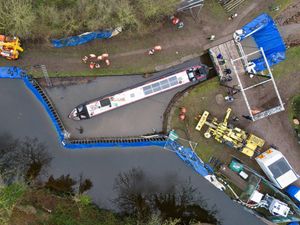
Water was then let in from the canal and the boat slowly began to rise.
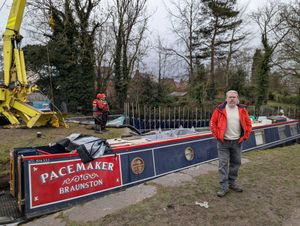
Watching water pour around his boat with bated breath, Paul said: "I'm nervous, it's worrying. Everyone keeps telling me it'll be okay, but I just don't know, even if it floats the pipes could have frozen and burst, or there could be a leak. I don't want to open those doors."
After around an hour, the water levels within the marina were level with the canal, the temporary dams were removed and Pacemaker officially rejoined the Llangollen Canal.
It's not the end of the road for Paul and his family, who are having the boat craned out of the water next week. From there, it'll be taken to a dry dock for a full inspection.
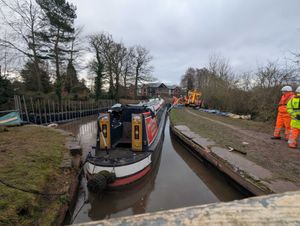
"I know they're hardy things - but I've got to put my family back on there," said Paul, who explained the family intended to live back aboard once any repairs had taken place.
"Canal life is a pleasant and slow way of being and before, when we wanted to moor up, we'd look for somewhere that had a lovely view.
"Now there will always be a part of me that's thinking about how safe we are, if there is an embankment or a culvert. That'll never leave me."
This week, the team will begin scraping out the main breach area to create a ramp to aid in the rescue of the other two boats. Like Pacemaker, they will be pulled out of the breach along the canal floor.
Canal & River Trust's chief operating officer, Julie Sharman, said: "At the moment, the edge of the breach is a bit of a cliff edge, so we'll create a ramp in order to pull the boats back towards the canal.
"It's an expert task, we want to make sure these boats don't come under any more stress. We want them floating away.
"We also want to do this as quickly as possible because these are people's homes - we want to get them back to their owners."
Investigation work is still underway to try and determine what caused the breach, but with much of the evidence now under tonnes of earth and sand, the team may never know for certain.