I watched Channel 4's The Jury and was dumbfounded how blasé they were about a lynchpin of our free society
Channel 4's The Jury wanted to find out whether 'the jury system was fit for purpose' but instead turned the serious business of justice into a pantomime.
At the end of the latest series a juror said 'it should be someone's actual job' to decide a defendant's fate. As a court reporter this sent shivers down my spine.
In one sentence she scrapped a 1200-year-old lynchpin of our free society, that a citizen has the right to be judged by 12 of their peers.
You know, what happens in a democracy. However, her sheer lack of awareness her plan confirms long-standing fears our juries are becoming more stupid. She probably thinks the Magna Carta is a protein drink.
If a juror was 'a job', then who would pay them? And how much? It would have to be the Government so motives other than straight forward justice would enter the jury room. State-employed jurors would make decisions to keep their job instead of the evidence before them. Bringing politics into judiciary is the start of a slippery slope to American style elections of sheriffs who build prison camps in the desert.
As a court reporter I believe the jury decision is sacrosanct and are 99 per cent of the time never wrong.
Their decision has been made because what has been put in front of them, if a murderer is found not guilty and walks, then perhaps the Crown Prosecution Service got it wrong by pushing for murder not manslaughter, perhaps "they got it wrong" because the police did not build a good enough case.
I've seen juries make a morally right decision which is legally wrong.
And sometimes the law they are being asked to uphold is a bad law. The slew of joint enterprise cases is an example, juries are now less inclined to convict a teenagers who was in the vicinity of a killing for murder, because it is not fair, it does sit right they will spend 30 years behind bars when they never touched the person killed. Did the jury get it wrong for going not guilty of murder when they should never have been deliberating murder in the first place, but maybe manslaughter.
The Jury promised to find out whether the jury system 'was fit for purpose'.
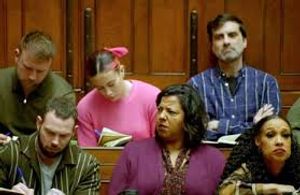
I've never been in a jury room but I've sat in enough courtrooms to know the programme did not recreate the solemn, serious atmosphere of a murder trial. The Scouse jurors were gassing on the backrow, harrumphing and tutting during witness testimony, and nodding or shaking their head during evidence.
There is not a judge in the land who would not put an immediate stop to any type of gesticulation or obvious giveaway of their thoughts.
I've seen sharp intakes of breath, and gradual looks of disgust or sympathy, especially when a rape victim is being cross-examined and having their character picked apart. But nothing like the C4's jurors antics.
You are more likely to see jurors fighting every single sinew in their body to stay awake than talking to one another.
However, last year I witnessed the family of man stabbed to death trading insults with the jury after a not guilty murder verdicts were delivered for his girlfriend and two youngsters who shot and stabbed their loved one to death.
There is nothing more dramatic in a courtroom than a not guilty murder verdict. The verdicts were delivered on a boiling hot Friday afternoon after the jury had deliberated since Monday and outraged heartbroken family members had to be escorted from the premises where an impromptu protest was held outside Wolverhampton Crown Court.
TV programmes need viewers, so a documentary investigating why our justice system is creaking needs the sexiness of human drama, which juries provide.
An hour of chronicling the backlog of cases would not be good TV. Anyone who pleads not guilty whilst on bail in Wolverhampton Crown Court today would not be tried until February 2028, elsewhere it could be 2030. So those accused of serious crimes like rape and wounding are on bail due to the lack of places in prison.
Forcing victims and witnesses to wait two and a half years is unfair, cruel and unprecedented. And innocent defendants are left in limbo, unable to get jobs, move away and get on with their lives. Memories fade, people retire or die and the likelihood of charges being dropped increase as ever month goes by;.
Another tepid but more honest documentary about how the entire judicial edifice runs on the good will of court staff, barristers, solicitors and judges often going against their own financial interests by ensuring cases go ahead.
And if it was a realistic recreation of the courts then there would be a lot of sitting around waiting for a hearing to get under way due barristers not turning up, defendants being late from prison, technical issues showing CCTV and countless other reasons.
But that would not make interesting television, with every episode ending with the same conclusion - You Cannot Get Justice On The Cheap - This is the Result of Austerity Cuts from Previous Governments!
Between 2008 and 2018 there was a 27 per cent cut in funding for The Ministry of Justice in the UK. Crown Prosecution Service (CPS) funding fell by 34 per cent and legal aid fell by 32 per cent. Every problem in our justice system is down to the lack of money. After Covid 23 per cent of barristers stopped working full time in the criminal justice system with many opting for the easier and more lucrative option of civil law.
But TV producers went for where the drama is - the jury system. The one part of the system which does work, morally, practically and ethically.
Any problems with the juries, usually like any group picked from the population, reflect the problems facing society.
The worrying calibre of jurors and their ability to problem solve, is down to the education and common sense of those picked. If you scrap free higher education then it stands to reason the general population will not be as clever as 30 years ago. Watch any quiz show from the 1980s, say Bullseye, the questions average dart players were expected to know were Mastermindesque compared to what prime time quiz contestants now have to answer, one Saturday night show they were actually asked questions which answer was either "red" or "black".
Children at school should be taught in detail about their rights and what to expect if they are called up for jury service.
In The Jury a real murder case was recreated in a Liverpool Crown Court. The names were changed but evidence and exchanges between barristers and witnesses were put to a jury of 12 normal people - you know the kind of normal people who put themselves forward to be on a television programme - and their discussions were filmed.
A disclaimer on screen explains evidence is real but has been abridged, for dramatic reasons. We got to know the jurors as the case went on including the "I knew she was guilty as soon as I saw her" juror and the "I've not listened any of the evidence but if she is a domestic violence victim then I'll acquit her" juror.
The programme hardly featured the judge. In reality, judges are the top dog in their domain, the legal apex predator of the legal ecosystem. Before any jury deliberates a verdict the judge will give directions. A juror might think the victim had it coming and the defendant was right to plunge a knife in their chest, but the judge will tell them a self defence acquittal can only be reached if the level of violence was proportionate to the threat.
Jurors are initially told they must have a unanimous verdict, meaning everyone votes the same way. And any decision needs to be made after jurors are certain "beyond reasonable doubt" meaning it is not good enough thinking someone committed the crime, they have to be certain before condemning a defendant to 30 years of porridge.
If they cannot manage a unanimous verdict after a day or so deliberating, the judge will permit them to return a majority 10-2 verdict. If they cannot do that then a mistrial is declared.
Throughout the TV trial jurors chatted about the case during lunch, which is the last thing the jurors would do.
The biggest decision jurors will make in their lunch hour (always between 1pm and 2pm) is what meal deal to have from Boots with their £5.41 food allowance. Most will be getting a breath of fresh air ahead of an afternoon sitting still, unable to talk and concentrating on evidence.
A Wolverhampton Crown Court judge told jurors before lunch a few weeks ago: "Do not discuss the case with anyone. If you see one of your fellow jurors out and about on lunch then by all means have a chat but not about the case. Talk about the weather or the latest Manchester United result but not the case. You must only discuss the case when all 12 of you are present."
So the deep and meaningful chats and plotting in small groups on the The Jury would not happen.
After the afternoon session finishes, like normal people in normal jobs they leave the building.
But what happens if Juror 2 has a fission of sexual tension when Juror 10 speaks, breathes or offers them a cup of tea?
Humans are humans, especially in new situations. It is well known speed awareness courses are a hotbed of hook ups. But two speedy lovers making the best of their punishment cannot collapse a multi-million pound public trial. Not long ago serious trial in the Black Country had to be halted because two jurors got too close for comfort.
A mistrial was declared. Which meant the entire case had to be tried again. And with a massive backlog of cases in system due to financial judiciary cuts by successive Conservative administrations this could mean a new trial date could be years away.
So jurors thinking about using the courthouse as a lonely hearts club need to remember they are undertaking one of the most important tasks of their lives by holding the destiny of defendants and victims in their hands.
Anyone called up for jury service is obliged to attend when asked, employers are compelled to let their workers attend jury service. They could be picked for a two day trial or two month trial, its the luck of the draw. Judges normally accommodate requests for doctors appointments and holidays. If a trial drags on longer than expected it can be halted until they get back, one trial had three jurors go away on holiday.
A lot can change in two and half years, witnesses memories wont be as sharp and police officers, lawyers and anyone else involved could have retired, died or moved continents. On several occasions after a gruelling trial lasting months, or even after a week long trial. I have seen jurors all head off to the pub together with a spring in their step.
Those 12 individuals have a unique shared experience only they, and they alone, can comprehend and compare about what happened. And you can bet the first thing many will do is search Google for more details about those involved in the case. Which are strictly forbidden to do during the case, and at the very least if they have done it alone, they can talk about the defendants Facebook profile or former crimes.
I was with the victims of one case who headed to the pub after a their tormentor was handed a long sentence.
On the way to the pub, a juror who had sat through weeks of harrowing evidence before voting guilty walked past the group. None of the young women and their families and the female juror knew exactly what the scenario of them speaking was.
They simply mouthed "thank you" to the juror who warmly smiled back looking like the weight of the world had been lifted from her weary shoulders.
It was a beautiful moment, one that only could have happened with our fit for purpose jury system.