The Flying Scotsman: All you need to know about the famous steam engine as it makes triumphant return to Severn Valley Railway
The Flying Scotsman is the most famous steam engine of all - and it is the star attraction as the Severn Valley Railway celebrates its full reopening.
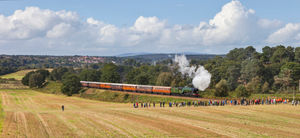
The engine was today (Friday) taking passengers along the heritage line, which is now operating properly again following repairs to a major landslip close to Bridgnorth.
But what is it that makes the Flying Scotsman so special? And why will it attract thousands of enthusiasts from today until Monday as it travels along the line between Kidderminster and Bridgnorth?
Here, courtesy of the National Rail Museum, is the potted history of this magnificent piece of engineering.
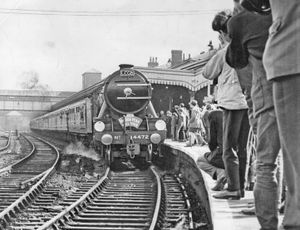
The Flying Scotsman started life as just another of Sir Nigel Gresley's A1 class of locomotives. It was build tin Doncaster in 1923, with a cost of just under £8,000.
It was the first locomotive of the newly formed London and North Eastern Railway (LNER) and went into service in February 1923 with number 1472.
KEY FLYING SCOTSMAN FACTS:
Built in 1923 at Doncaster Works, costing £7,944
Weight: 97 tonnes
Length: 70ft
Speed: Officially the first locomotive to reach 100mph, and the first to circumnavigate the globe
Endurance: Holds the world record for a non-stop run in a steam locomotive, set in 1989 with a 422-mile trip
By 1924, when it was selected to appear at the British Empire Exhibition in London, the loco had been renumbered 4472—and given the name 'Flying Scotsman' after the daily 10am London to Edinburgh rail service which started in 1862.
The British Empire Exhibition made Flying Scotsman famous, and it went on to feature in many more publicity events for the LNER.
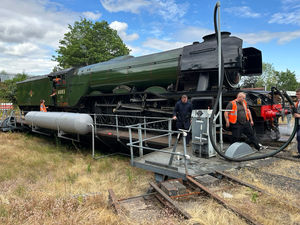
In 1928, it was given a new type of tender with a corridor, which meant that a new crew could take over without stopping the train. This allowed it to haul the first ever non-stop London to Edinburgh service on 1 May that year, reducing the journey time to eight hours.
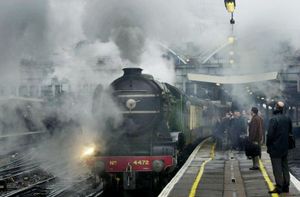
In 1934, Scotsman was clocked at 100mph on a special test run—officially the first locomotive in the UK to reach that speed. The test run proved to the LNER's directors that steam power could provide high speeds, negating a plan for the company to use diesel power on its high-speed services.
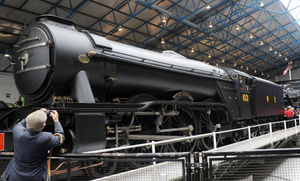
LNER passenger locomotives had always been painted Apple Green. But during the Second World War, Flying Scotsman was repainted in wartime black, in common with all railway stock. After the war, it became green again and was rebuilt as an A3 Pacific.
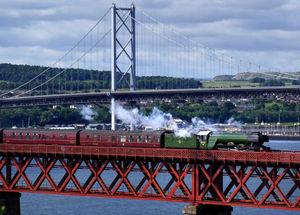
In 1948, British Railways was formed and rail travel in Britain was nationalised. Scotsman, now numbered 60103, was painted blue for a time, then BR Green.
It remained this colour until 1963, when it was retired by British Rail. By this time, it had undergone several alterations to improve its performance—but it had been pulling trains for 40 years, and steam engines were becoming old-fashioned.
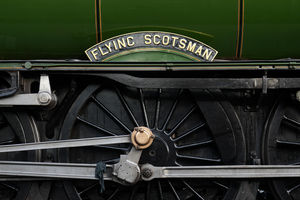
In January 1963, Alan Pegler bought Flying Scotsman. As part of the deal, Pegler negotiated a complete overhaul of the locomotive.
It was converted back to single-chimney condition and repainted in LNER livery. The tender was exchanged for a corridor type, and an agreement made that enabled it to run on the main line. In a blaze of publicity, Flying Scotsman ran its last train for British Railways on 14 January 1963.
In May 1968 on the 40th anniversary of the first non-stop run, Flying Scotsman travelled non-stop from London King's Cross to Edinburgh.
In 1969 Flying Scotsman headed to the United States on a tour intended to promote British exports. The tour broke even in its first year, but the second lost money.
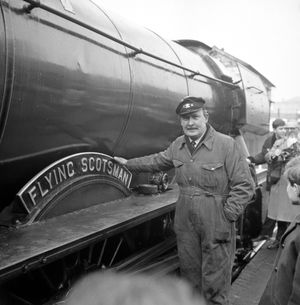
In a bid to balance the books, Pegler arranged for the train to travel to San Francisco. The trip worked well operationally but was a financial disaster. Alan Pegler was forced into bankruptcy and Scotsman was stranded in the USA.
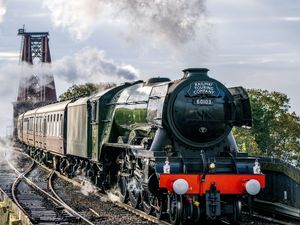
However, in 1973 Flying Scotsman was brought back to the UK after William McAlpine heard about the situation in the USA. He promptly put together a rescue plan, paying off the creditors and buying the locomotive.
McAlpine had the engine restored at Derby Works and kept it running for 23 years in his ownership, extensively overhauling it twice. He even took Flying Scotsman to Australia, making it the first steam locomotive to circumnavigate the globe on its voyage there and back. While in Australia in 1989 it also set a new record for the longest non-stop run by a steam locomotive at 422 miles.
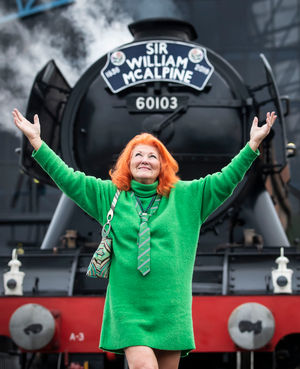
Following the successful tour of Australia, Flying Scotsman ran special trains around Britain, including regular runs over the famous Settle to Carlisle Railway and trips hauling the prestigious Orient Express Pullman train.
The locomotive was repaired again in the early 1990s, at which time pop impresario Pete Waterman formed a short-lived partnership with Sir William to run the locomotive. In February 1996 businessman Tony Marchington bought Scotsman outright for £1.25 million.
In 2004, Flying Scotsman hit the headlines again with yet another crisis over its ownership.
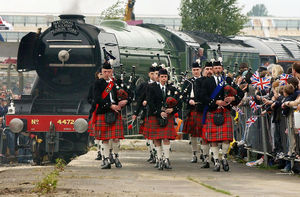
A campaign spearheaded by the National Railway Museum to save the locomotive for the nation amassed the support of thousands, confirming its status as a national treasure.
The appeal to keep the steam icon in Britain was supported by a £1.8 million grant from the National Heritage Memorial Fund and the generosity of the public. Its restoration was also completed with the help of a Heritage Lottery Fund grant of £275,000.
From 2006, Flying Scotsman underwent an extensive restoration in the workshop of Riley & Son (E) Ltd. In 2016 the painstaking £4.2m project to bring the legend back to life—resplendent in BR Green livery in its guise as 60103—was completed.
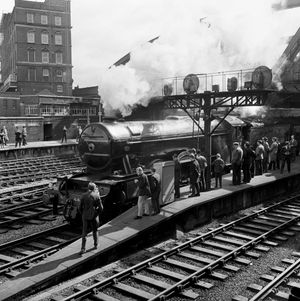
As the restoration process came to an end, all eyes were once again trained on the world’s most famous locomotive.
The next chapter in the Flying Scotsman story was its triumphant return as a working museum exhibit, conquering yet another record as the oldest mainline working locomotive on Britain’s tracks.
Undoubtedly one of the jewels in the crown of our world-class collection, it can now be experienced by a new generation of Scotsman fans and will captivate the public for generations to come.