Health warning issued as smog pollution hits record levels in West Midlands
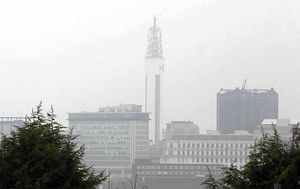
Record levels of air pollution continue to plague the nation - leaving the skyline of the West Midlands choked by a thick layer of smog.
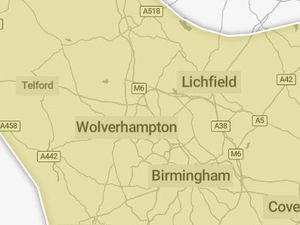
These images show the scene over Wolverhampton and Birmingham, with the West Midlands cited as one of the areas expected to be worst hit.
A perfect storm of dust from the Sahara, emissions from the continent, low south-easterly winds and domestic pollution has caused air quality to plummet and the smog-like conditions are not expected to clear until tomorrow. And the high levels of air pollution have sparked a health warning.
One university expert in the Black Country today said a good bout of April showers could be the key to dispelling the large plumes of dust.
University of Wolverhampton pollution science expert Dr Clive Roberts said strong wind would also help to clear the problem.
It comes after large parts of the country were warned to be aware of air pollution levels, which were reaching 10 out of 10 on the official scale in some places.
The Department for Environment, Food and Rural Affairs (Defra) ranks air pollution from one to 10, with one being the lowest and 10 the highest.
Those suffering from health problems such as asthma and heart conditions were warned to limit their time outdoors. But Dr Roberts says the problems could linger until rain comes to disperse it.
"Because some of the particles are so small, they don't settle back to earth and remain airborne causing the problems we are experiencing and the red dust that people are seeing on their cars," he said.
"Some rain will wash the particles and pollutants out of the atmosphere and get everything back to normal. Until then, it could linger."
Westerly winds from across the Atlantic could also help ease the problem, he added. Defra put out a warning across the country yesterday, as many woke to find a cloud of smog in the skies and a layer of red dust over cars and homes.
This was reported in some parts of Staffordshire, as well as in Bewdley.
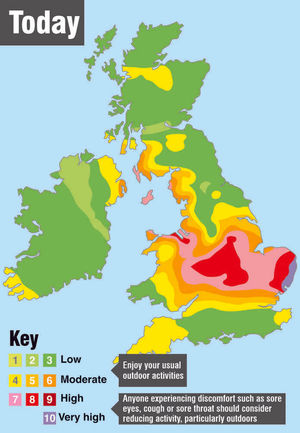
And this morning pollution levels have already reached level 9 (high) in the South East, Greater London and Eastern England, Defra reported on its website.
Very high levels of pollution are also forecast later today for the East Midlands.
Those with lung and heart conditions have been told to avoid strenuous activity outdoors while people suffering symptoms of pollution – including sore eyes, coughs and sore throats – should cut down the amount they do outside, health experts said.
Asthmatics have been warned of the need to use their blue reliever inhalers more often as they could be prone to attacks over the next few days.
Some schools in London have banned pupils from outdoor playgrounds to reduce their exposure to the fog. The decision was supported by Professor Frank Kelly, professor of environmental health at King's College London and a member of the Department of Health's Committee on the Medical Effects of Air Pollution, who said it would help reduce long-term harm to children.
"As a general response this is a good approach as children tend to run around outside and therefore breathe deeper," he said.
"Thus, on days like this they will be aspiring a lot more pollution if outdoors than when they are breathing normally (hopefully) inside."
Prof Kelly added: "Whether home-produced or arriving from the continent, the tiny particles we take into our bodies with each breath cause immediate problems for some individuals such as those with asthma and contribute to longer term problems for most of us in the form of heart disease and stroke.
"For those who are sensitive to air pollution, it's important they are provided with accurate forecasts of when air quality will deteriorate so they can plan their activities to reduce exposure, perhaps by taking different routes to work or school or avoiding strenuous exercise on those days.