Mala Tribich: How I survived hell of Holocaust camps
As Holocaust Memorial Day is marked today, survivor Mala Tribich tells her story.
I was nearly nine when war broke out in September 1939. On that day my world collapsed.
Poland was not at all prepared for the German invasion and ours was the first town that had a ghetto.
Within two months of the beginning of the war we were forced out of our homes.
We were herded into a very, very small area of the town where there was terrible overcrowding.
Our town had a population of around 150,000, of which about 15,000 were Jewish.
But because my town, Piotrkow Trybunalski, was quite near to the German border, we were immediately named what they called Judenfrei, which means Free of Jews.
A lot of Jewish people found their way into our ghetto and we ended up with a population of 28,000.
Conditions were very crowded and there could be as many as 10 people to a room.
Food was very scarce and people over the age of 12 were forced to wear a white armband with a blue Star of David.
We were not allowed out of the ghetto and only a very small part of the population had any chance of survival.
Those who were lucky enough managed to get a working permit and be employed by the Germans.
The rest were always very vulnerable.
We were there for around two years under very difficult conditions, but I cannot bare to go into details.
And then rumours started circulating that the ghetto was going to be liquidated and everybody was going to be deported to their deaths.
My parents, Sara and Moshe, made arrangements together with my aunt and uncle for me and their daughter Idiza to be smuggled out of the ghetto and sent to live with a Christian family in another town.
This was a business arrangement because it was not easy to get accommodation: my parents managed it but it was very difficult.
We felt very, very scared and very homesick. My cousin, who was an only child, was so terrified of being there that she asked to be taken back.
At first they said no because the persecution was still going on.
But when she told them she could stay with friends in her hometown they allowed her to come back.
I can remember thinking at the time how lucky I thought she was.
When I went back, I was met by my father at a flour mill which before the war he owned – but now he was lucky to still have a job there.
When he arrived, my uncle Joseph, Idiza's father was there too. He asked 'where's my daughter' and the man who bought me back said 'we have took her to your friends' but my uncle said 'she is not there, where is she?'
I can still remember vividly my uncle pacing up and down saying 'what have you done with my child?'
It transpired she had disappeared without a trace. No-one knows what happened to her.
That was the first tragedy that I lived through in a sense, because just living through that time was just one big trauma. We never felt safe at any moment.
Our family was still intact, which was very unusual as most families only had one or two members left and some had disappeared altogether.
Soon afterwards my mother and Lusia were taken away and murdered. After this, I was left in the ghetto with my father and my brother Ben.
My five-year-old cousin Anne, whose father was shot and mother was deported, stayed with us too.
The ghetto was liquidated at the end of 1942. Men went to a camp called Buchenwald while women were sent to Ravensbruck. They took everything away from us. We were stripped. They shaved our heads and we had to use communal showers. They gave us uniforms and when we emerged from the showers we could barely recognise each other.
It was as if they had taken our very soul. We were not human any more. We were just numbers.
It had a terrible effect on us as we started to lose hope and around us people were dying very quickly.
Conditions were terrible. Rations were half a slice of bread and some soup and coffee.
We were deported again to Bergen-Belsen. It was so overcrowded and what we saw on arrival defies description.
There was terrible smog engulfing everything and the smell of burning bodies.
Hundreds of people were packed into each barrack. In some cases it was a thousand.
Anne Frank was there at the same time. We arrived there in February. Anne Frank died in March. The camp was liberated in April 1945.
The British soldiers were absolutely wonderful when we were liberated. I found out that my brother Ben had survived and to be reunited was wonderful. But my father had died.
One would have thought the revelation of what took place in Nazi Germany and neighbouring countries during the Second World War – this hideous crime against humanity – would have delivered such a shock to mankind that any resurgence of self-destructive racial and religious hatred would be inconceivable.
Yet in spite of the Holocaust being the best-documented atrocity in the history of the world there are people who claim that this never happened.
So this is the value of Holocaust Memorial Day. To commemorate and to teach the generations that follow us to be on their guard against the denial or repetition of such evil.
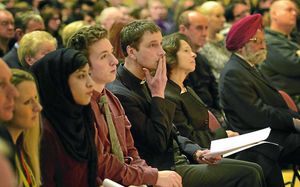
Mala Tribich told her story to students and dignitaries at a memorial event held at Dudley College.