Meet the Black Country adventurers who conquered Everest
From the seasoned mountaineer to the total novice, conquering Everest can become a driving obsession, although not all get to the summit.
Many experienced climbers content themselves with completing the still-arduous trek to the 17,000ft base camp which itself requires a high degree of fitness and many train for months before attempting the climb.
To put that into perspective, it is more than four times the height of Mount Snowdon.
Three adventurers from the Black Country have have all experienced the highs and lows of taking on the world's most challenging climb.
Raj Joshi, Walsall
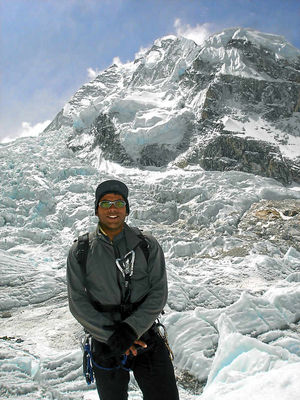
Experienced mountaineer Raj Joshi is among a small number of climbers to have scaled the highest mountains on all seven continents.
The 37-year-old doctor from Walsall, who scaled Everest in 2007 on an expedition, said the experience was 'amazing and magical'.
The founder of trekking and experience company 360 Expeditions ascended his first mountain at just 18 months when his parents took him to the top of Snowdon.
"I grew up learning about Edmund Hillary and Everest so I always had an interest in it," he said.
"There's a ridge on the way up where you see Tibet to one side and Nepal on the other and it's like you're standing on the edge of them both. You can even see the curvature of the Earth."
But reminders of the danger climbing Everest can bring are never far away, said Raj, who lives near The Broadway.
"When I was there, we did hear about deaths and people suffering from things like altitude and frostbite. We even helped in the rescue of a woman who had severe frostbite.
"But you just have to focus. You can't think about these things, you have to focus."
Mr Joshi's expedition took him around two and a half months in total.
"It is one of the most demanding expeditions I have done. It takes a lot of focus. You are on the mountain for long periods of time and climbing very high up so you have to stay focused for long periods of time – it's mentally demanding.
"There's also the fact there's an element of no matter how prepared you are you can be in the wrong place at the wrong time."
He said climbing Everest was a 'magical experience'.
"We reached the summit just as the sun was rising," he said.
"It was beautiful, one of those moments you never forget."
Darren Porter, Sedgley
Complete novice Darren Porter woke up one morning back in 2009 and 'for absolutely no reason whatsoever,' decided he wanted to climb Everest.
"I had never even been up a decent hill before, let alone a mountain," said the 48-year-old business development manager from Sedgley.
Nevertheless, that same morning he booked a flight to Kathmandu and reserved a place on a trekking trip to base camp.
He 'trained' by taking his mother's dog for walks while wearing a rucksack. By his own admission: "I was the worst-prepared trekker ever in the history of trekking. But what I did have was stubbornness and determination.
"There was no way I was not going to get there
When I did, it was tough. Every day up early in the freezing cold and walking mainly uphill until late afternoon, it was exhausting.
"About six days into the trek, the sherpas stopped and pointed to a black triangle above the other towering peaks. It was Mount Everest.
"I admit that I cried a little. It was magnificent, so majestic."
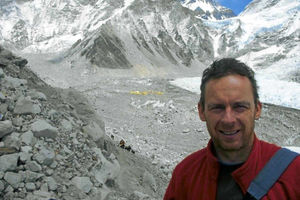
A few days later the group arrived back at Base Camp and Darren took the opportunity to explore the area a little.
The relief at getting back was immense, he said, and the views astonishing. He left a photograph of his late father at the camp. "I hoped he would appreciate the epic panorama."
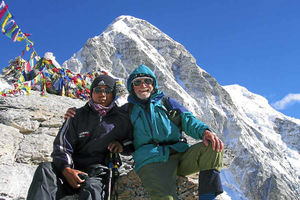
With a handful of other climbers, Darren scaled 20,000ft Kala Patthar, a mountain next to Everest, from where they watched the sun rise over the world's tallest peak.
He said: "It impressed on me was how tough it must be to get to the top. On Kala Patthar I couldn't even say my own name I was so befuddled by the lack of oxygen. The utmost respect goes out to the men and women who have conquered it."
Would he do it again? "To see those views of the Himalayas? Like a shot."
He made the trek with a couple of Swedes, four Australians and five Brits, all of whom had to bail him out when it came to kit-carrying. "I was desperately unprepared. I arrived in Kathmandu with a man bag, with my money, some suntan lotion and lipsalve. That was basically it.
"I didn't even have any money to pay the taxi driver when I arrived because the cash machines only work for an hour a day. We had to drive around until they came on.
"I'd brought a coat but, to be honest, I'd have been cold up Barr Beacon in that. I had to buy another and rent a sleeping bag. But I didn't have a rucksack so when it got hot during day, the others had to carry my coat, hat and gloves.
"The others were all experienced trekkers but, funnily enough, they all got altitude sickness and were on all kinds of medication. But I was fine."
The father-of-four had always wanted to climb a big mountain, he says. "But I thought if I started with a little mountain it would put me off and so I decided to start at the top."
The experience gave him a love of alpine scenery and he has since become an avid skier. He added: "Climbing Everest has become a bit of a business these days. People argue that if you've got the money, anyone can do it. But even with help from ropes and ladders. you've got to be fit. I remember looking up at it and thinking, I could never do that."
Pete Dutfield, Wolverhampton
Grandfather-of-four Pete Dutfield was one of four members of Wolverhampton Mountaineering Club who climbed to Everest's south base camp in Nepal in 2006. It took the group two weeks to complete the two-week trek, 17,598 ft high.
Now Mr Dutfield, who was aged 66 at the time, has written a book about his experiences. "The hardest thing was the conditions," said the 73-year-old, who had wanted to make the trip since a former colleague had put the idea in his head in the late 1960s.
"I found it particularly hard because of my age. The air is so thin. If a helicopter took you to that height and put you down you would collapse and die. It's difficult for ordinary people to imagine that. You have to go up slowly."
Mr Dutfield, a retired electrician, said the group would generally spend about half a day walking.
They would then climb down a short distance and set up camp to allow their bodies to acclimatise to the conditions. "You don't have to be that fit," he said.
"The fitter ones are those that tend to go ahead and get themselves in trouble. It's a classic mistake people make. At that height your body can't recover."
Mr Dutfield's group was accompanied by more than a dozen people from surrounding villages who carried the equipment, acted as guides and cooked the food. "Sleeping was very difficult," he said. "You can't breathe. You just lie there hoping to doze off."
After reaching base camp, Mr Dutfield, from Wollaston, Stourbridge, later climbed another two hours to reach the summit of Kala Patthar – one of the best places for viewing Everest.
"That was spectacular," he said. "I was close to tears. It was an old friend who originally put the idea in my head and he died of cancer. So it was very emotional." He added: "It was cold, peacefully quiet. The sky looked very dark blue."