Lights, cameras, no action - Region's speeding hot-spots revealed
The region 's speed cameras will be switched off at the end of March. Alex Ross reports on their effect and the future:
The locations of the most prolific speed cameras in the Black Country were today revealed for the first time – with some in the region shown to have caught more than 50 speeding motorists a day.
New figures obtained by the Express & Star show the area's 27 remaining active static cameras recorded 18,604 speeding drivers in 2012.
There are 305 camera housings across the West Midlands – including the Black Country, Birmingham, Coventry and Solihull – but many are now dummies and are never used, while others have the camera equipment moved between them.
It comes just over a week after funding for fixed Gatso cameras runs out and all the remaining active ones are due to be switched off due to police and council cost- cutting.
Instead, drivers will be targeted by mobile cameras in vans and will not know where they are going to be.
It is a move that police believe will curb the practice of motorists slowing down for a Gatso then speeding up again.
Almost half of the offences were snapped by just three cameras dotted along the A34 Birmingham Road through Sandwell.
In Sandwell, 12,492 speeding offences were caught on the borough's nine cameras while in Wolverhampton 4,038 offenders were caught by 10 cameras and in Dudley, 1,605 offenders were recorded on five cameras.
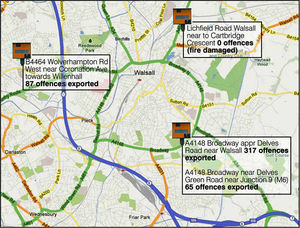
In Walsall, 469 tickets were issued after drivers were caught travelling above the speed limit by three cameras.
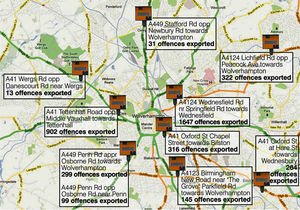
On average, each camera caught 689 offenders over the year and based on each speeding ticket costing £60, they raised just under £750,000.
The Express & Star is able to reveal today the details of the region's speed cameras following a Freedom of Information request to West Midlands Police.
Back in 2010 the force revealed the locations of the top three cameras for catching offenders across its district, but refused to give details of the camera locations in fear of vandalism.
But the force has now revealed the latest figures as it prepares to switch off the cameras.
The West Midlands Partnership Board, which is responsible for the 73 active cameras currently still in operation, is switching them off following the stop in funding by the Black Country's four councils.
Instead the number of mobile van cameras on the region's roads will double from two to four.
A proposal is on the table to keep the cameras on as part of an upgrade from wet film cameras to digital, a move that would make processing costs cheaper, but councillors will not make a final decision on it until May.
The figures show the four most prolific cameras were in Sandwell on the A34 and A41 Birmingham Roads. They accounted for 9,441 snapped motorists.
In total, the region's cameras caught 18,604 motorists over the year.
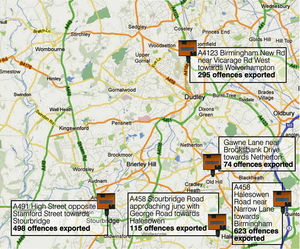
Figures show that in Dudley, the most prolific speed camera was situated on the A491 in Stourbridge. It caught 498 speeding motorists.
But Dudley Councillor Judy Foster, cabinet member for transport, backed her council's move on the cut in funding for static cameras, adding that mobile cameras provided a better road safety service.
She said: "I'm afraid there is always a risk on our roads, however what we are doing is making a great use of mobile cameras – listening to a community and putting the camera in place for a short-term measure.
"Combatting speed with a static camera is not as effective. Drivers learn to avoid the route or slow down when they see the camera before speeding up.
"The mobile cameras can be brought in quickly, before being moved on elsewhere in the district." In Wolverhampton, the speed camera on the A4124 towards Wednesfield clocked the most motorists, 1,647 in total.
Spokesman Gurdip Thandi said: "Mobile speed enforcement will continue and the vans may deploy to fixed camera sites as part of this approach.
"Other approaches such as road safety education programmes, campaigns and engineering measures will also continue to provide an integrated approach to managing road safety.
"As part of this work monitoring of the highway network will continue to assess any impacts created by the change of enforcement."
Councillor Roger Lawrence, leader of Wolverhampton City Council, said: "The figures for Wolverhampton show they're catching about 10 a day.
"I understand from the police that the mobile cameras are considered a better deterrent than fixed ones because people won't know where they're going to be.
"Drivers know where the fixed cameras are. They slow down for them and then they speed up again.
"Fixed cameras were very good for their time and they served their purpose but it's time to try something new."
In Sandwell, the most prolific camera was one on the A34 Birmingham Road opposite Pages Lane, toward Birmingham. It clocked 3,540 motorists.
Councillor Ian Jones, cabinet member for neighbourhood services, said: "Because of Government cuts to the Road Safety Partnership we are having to look at other ways to deal with road safety measures across Sandwell.
He added: "Other approaches such as road safety education programmes, campaigns and engineering measures will also continue to provide an integrated approach to managing road safety.
"As part of this work monitoring of the highway network will continue to assess any impacts created by the change of enforcement."
In Walsall, the camera on the A4148 Broadway snapped 317 motorists.
Councillor Tom Ansell, Walsall Council's portfolio holder for transport, said: "A review into the safety camera operation has been commissioned and the partnership is still awaiting the outcome.
"A decision is expected within the next few months as to the most appropriate way forward."
Maintaining the district's cameras cost £1million a year. Removal will cost £178,000 and work is taking place to disconnect them from the electricity supply.
In 2011 there were 19 deaths on the roads in the Black Country, according to the West Midland Casualty Reduction Scheme.
West Midlands Police assistant chief constable, Garry Forsyth, said work needed to be done on the machines.
He added: "The cameras that are currently in use require a major upgrade in order for them to remain effective and this would cost both police and local authorities a considerable amount of money at a time of a reduction across public sector budgets."
Mr Forsyth maintained the force was "committed" to road safety and said the number of mobile speed camera used in enforcement vans would increase from two to four in April.
He said: "They are more flexible than fixed cameras, allowing us to conduct speed enforcement on roads where a fixed housing could not be installed and can be deployed to roads where the collision history would not warrant a fixed camera, but where there is concern from the community, local authority or local police about speeding vehicles.
"We have always worked closely with our partners to regularly review the effectiveness of the enforcement methods we use and will continue to do so."
Several other areas across the country have already switched off their cameras including Wiltshire and Northamptonshire.
However there are no plans to turn off any more of the fixed cameras that are used in Staffordshire.
The county has 263 housings but 130 of these are not in use and only 29 are turned on at any one time.
Last year the number of motorists in Staffordshire caught by fixed cameras went up 20 per cent to 26,295.
The county also has six mobile camera vans.
Government figures show the number of fatal collisions in Staffordshire went up from 29 in 2010 to 37 in 2011.
There was also a rise in Sandwell over the same period from six to nine while Dudley went from three fatal accidents to four.
In Wolverhampton there was no change with three fatal accidents each year while Walsall saw a drop from five to two.
Figures on the number of fatal accidents for 2012 broken down by area are not yet available on the Department for Transport website. Franki Hackett, campaigns officer at Brake said:
"Getting rid of cameras is backward step, and will lead to greater speeds and more crashes and casualties.
"That's why we urge councils in the West Midlands to vote for digital cameras in May, as they will prevent the terrible suffering caused by crashes as well as the enormous financial costs.
In the meantime, it's vital that existing fixed cameras keep running, in order to continue keeping driver speed down which saves lives.
"Increasing the number of mobile cameras isn't an excuse to switch off many more fixed ones.
"It is also crucial drivers ensure they don't risk lives by breaking speed limits or driving too fast for conditions."