Experts steamed up on battle of theories
One thing is certain. In 1712 the great Thomas Newcomen built the world's first successful steam engine in the Black Country.
Most steam enthusiasts believe this revolutionary device was installed at the Coneygree coal works in Tipton, within sight of Dudley Castle.
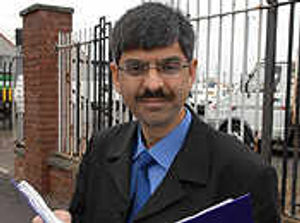
But Suhail Rana, a lecturer in computing at Dudley College and chairman of Wolverhampton History & Heritage Society, believes the engine was installed not at Coneygree but in Wolverhampton.
It is not a new theory. Wolverhampton's claim was first raised in 1948 but failed to convince the experts of the Newcomen Society in London.
Today, Mr Rana's case is rubbished as "pure fiction" by a veteran Black Country's engineer, John Allen of Stourton who produced a paper on the engine 15 years ago.
Pressure is rising. Tempers are fraying. To outsiders, it seems a bewildering bust-up.
The exact site of Thomas Newcomen's massive steam engine which changed the history of the world ought to be as certain as the pyramids or the Great Wall of China.
But even the Newcomen Society admits there is room for doubt. Roger Cline, editor of the society's journal says: "After 300 years it is very difficult to be certain where it was located."
Mr Allen, 83, a former president of the Newcomen Society, has an impressive engineering background. He worked in the drawing office at Carter Horseley (Engineers) of Tipton, which created the Dome of Discovery, the centrepiece of the 1951 Festival of Britain in London. It was the biggest metal dome ever constructed and at the age of 24, he was appointed site engineer for the project. He takes his engineering - and his history - very seriously.
Dismissing Mr Rana's theory he says: "It is very easy for a presenter to address and audience who largely have no knowledge of the subject and then impress them with their conclusions, particularly if they relate to Wolverhampton which would please a Wolverhampton audience."
* It was called "the steam engine near Dudley Castle" on a detailed print made in 1719. This print, by Thomas Barney, clearly shows the castle as it appears from Coneygree
* A map from the 1770s shows "old engine site" at Coneygree
* Martin Trieweld, a contemporary Swedish engineer, wrote: "Mr Newcomen erected the first fire machine in England in the year 1712 which erection took place at Dudley Castle in Staffordshire."
* A 1726 document by John Kelsall reports seeing the engine working from the Dudley - Birmingham road.
"There is no record of any so-called engine in Wolverhampton," says Mr Allen. "This argument seems to have been dragged down to the level of John Allen versus Mr Rana. It is no such thing. All I am saying is, just look at the evidence."
The Black Country Living Museum at Dudley shares his belief that the first Newcomen engine was built within a mile of the museum site.
But Mr Rana, 41, of Penn Fields, Wolverhampton, says: "When I began looking into this, something struck me about one of the names. After that, everything just fell into place. My belief is that it stood near to the end of Cross Street off the Willenhall Road just behind Moore Street.
He believes the engine was built for a Mr Bache, a Wolverhampton mine owner who was in financial trouble.
"In 1711 it looks like he was having one last attempt to make the mines successful. We know he borrowed £250. I believe he contacted Newcomen to build an engine."
Mr Rana says his new research uncovered an account book from 1717, a deed from 1332, a diary entry from 1736 and a map from 1770, all of which support the Wolverhampton case.
"I have great respect for John Allen and it has been an honour to meet him. But I believe my evidence shows the engine was built in Wolverhampton."
At the Newcomen Society headquarters in London's Science Museum, Roger Cline says he is dubious about Mr Rana's theory but admits there are grey areas:
"Thomas Newcomen and local mine owners did not keep written records of the erection of such engines which have survived to the present day. We do have a mine account book, but this only refers to an engine house at Wolverhampton without identifying the engine housed.
"The best records we have are from writers giving accounts several tens of years after the event. Their accounts are not exact and their memories may be at fault. Wolverhampton and Dudley are not more than six miles apart, so when a writer refers to a place near Dudley Castle, it could equally well cover Coneygree coal mine."
The society has received two new papers on the issue, from Mr Allen and Mr Rana. Both papers are due to be published in the July edition of the International Journal of the History of Engineering and Technology.
So will John Allen's long-established case for Dudley be rejected? Will Wolverhampton emerge as the site of the world's first successful steam engine?
Don't bank on it.
Roger Cline says: "The Wolverhampton case was first suggested to the Society in 1948, but the discussion following that paper indicated that the Society was not convinced."
If the Newcomen Society now accepts Mr Rana's findings, the 300th anniversary will be celebrated in Wolverhampton, not Dudley. It would be a blow to Dudley and a huge feather in Wolverhampton's cap.
It would also be a great coup for this Wolverhampton-born enthusiast who campaigned for city status, launched the LoveMyTown website and sings the praises of the city.
Is there not a danger that Suhail Rana's love for Wolverhampton may have clouded his judgment?
"It could be," he admits frankly. "But I have always been trained to be objective. I believe my research is as accurate and objective as possible."